
Pont du Gard: a three-tier Roman giant over the Gardon
Published on 08/19/2026 at 18:50 | Editorial responsibility: Rafael Müller, Editor-in-Chief AD HOC NEWS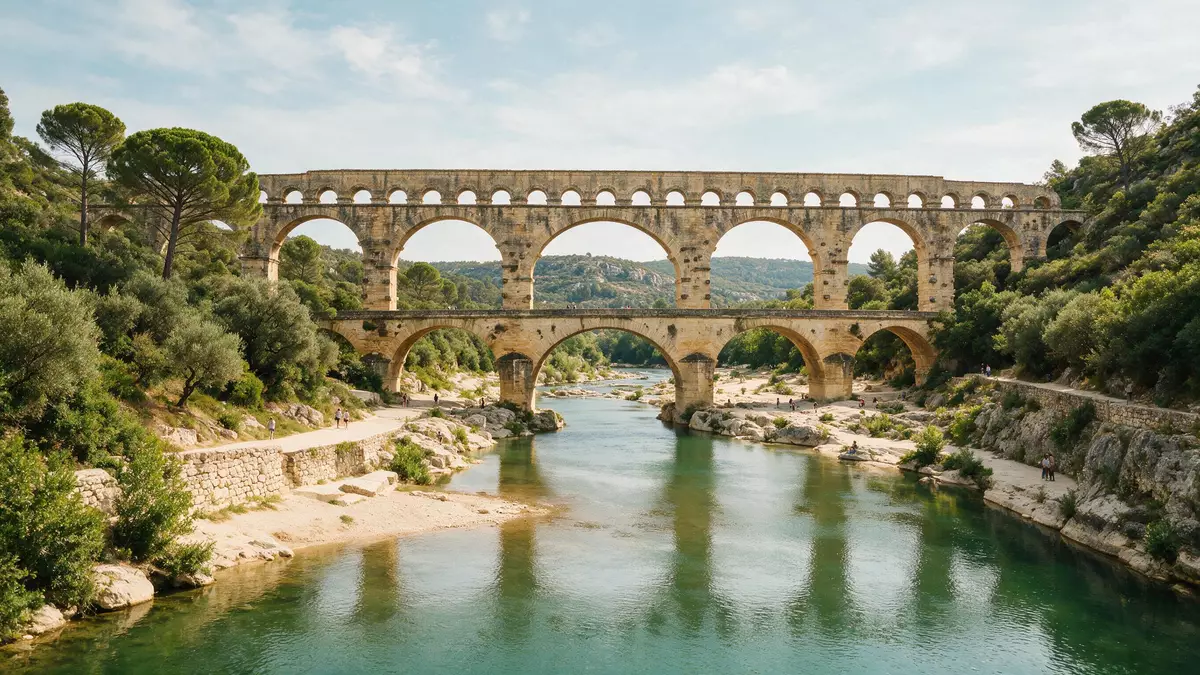
South of Uzès and north-west of Nîmes, the Pont du Gard strides across the Gardon valley as a vast stone aqueduct bridge from the Roman period. Built in the first century AD, it formed the most spectacular section of an approximately 50 km water conduit that supplied the colony of Nemausus, now Nîmes, with spring water from the area around Uzès.Roman aqueduct Its three superimposed tiers of arches and pale limestone masonry make it one of the clearest encounters in France with Roman engineering at monumental scale.
A Roman aqueduct frozen in mid-stride
The Pont du Gard is a fragment of a much longer aqueduct that once threaded through hills and plateaux between the Eure spring near Uzès and Nîmes. At this crossing the terrain drops into the Gardon gorge, and Roman engineers responded by extending the water channel across the river on a bridge whose stonework rises to about 49 m (161 ft) above the valley floor.dimensions The structure carries the narrow conduit on its upper level, supported by two lower storeys of larger arches that step over the banks and river bed.
The bridge-aqueduct belongs to the early imperial era and is associated with the reigns of emperors Claudius and Nero in the middle of the first century AD.first-century construction Its lower tier is built of substantial limestone blocks cut and fitted without mortar, a technique characteristic of major Roman works. Above that, smaller arches form the second level, and the uppermost tier once extended further along the valley with a long line of modest spans carrying the covered channel.
Stone, water and the Gardon valley
Seen from the riverbank, the Pont du Gard combines geology and engineering in a single view: pale, honey-coloured limestone rising from darker rock and water. The bridge spans the Gardon River near Vers-Pont-du-Gard in the Occitanie region, placing Roman masonry directly into a landscape of scrubland slopes and exposed stone ledges.location in Occitanie The arches frame slices of sky and river; from below, each tier appears offset, creating a stepped profile against the valley sides.
In antiquity the aqueduct carried tens of thousands of cubic metres of water per day from the springs around Uzès to Nîmes, relying on a very shallow gradient over its length.water supply to Nîmes At the Pont du Gard the channel continues this gentle fall across the river, its line barely perceptible from outside. The bridge’s mass and height dominate the valley, but the actual conduit is modest, tucked into the upper structure and shielded by stonework that has stood for around two millennia.
World Heritage and Roman craftsmanship
The Pont du Gard holds formal recognition as a UNESCO World Heritage Site, a status granted in 1985 for its exceptional preservation and testimony to Roman civilisation.World Heritage inscription As one of the highest surviving Roman aqueduct bridges, it demonstrates how hydraulic engineering, architecture and stonecutting combined to move water across varied terrain while embedding the infrastructure in a monumental form.
Accounts of its construction describe a workforce of around a thousand men labouring over several years, cutting and hoisting huge limestone blocks into place and supporting the central river span with timber centring during assembly.large workforce The result is a three-tiered ensemble whose arches vary in size from broad river crossings at the base to much smaller openings near the channel, all aligned to keep the water moving by gravity towards Nîmes.
Visiting Pont du Gard: what travellers from Western Europe should know
- Pont du Gard stands in the commune of Vers-Pont-du-Gard in southern France, between Uzès and Nîmes. It is reached by road from these towns and lies close to the Gardon River.
- The monument rises above a river valley with uneven ground, stone paths and stairways. Moving between viewpoints involves walking on inclines and negotiating flights of steps.
- The surrounding area includes riverbanks where people approach the water’s edge and open spaces where the entire length and height of the bridge can be seen.
- The official language is French and the currency is the euro.
Searching for Pont du Gard on social platforms
These links open searches for Pont du Gard on each platform.
Frequently asked questions about Pont du Gard
Where is Pont du Gard and what is it?
Pont du Gard is an ancient Roman aqueduct bridge over the Gardon River near Vers-Pont-du-Gard in southern France. It formed part of the aqueduct supplying Nîmes.
What can visitors expect on a visit to Pont du Gard?
Visitors encounter a three-tier limestone bridge high above a river valley, with paths and viewpoints that show the different levels, the arches and the surrounding landscape.
What makes Pont du Gard distinctive among Roman sites?
Pont du Gard stands out for its height, its three superimposed tiers of arches and its role as a preserved section of a long aqueduct that once carried water from Uzès to Nîmes.


