
Pont du Gard, a three-tier Roman aqueduct in limestone and light
Published on 09/15/2026 at 20:09 | Editorial responsibility: Rafael Müller, Editor-in-Chief AD HOC NEWS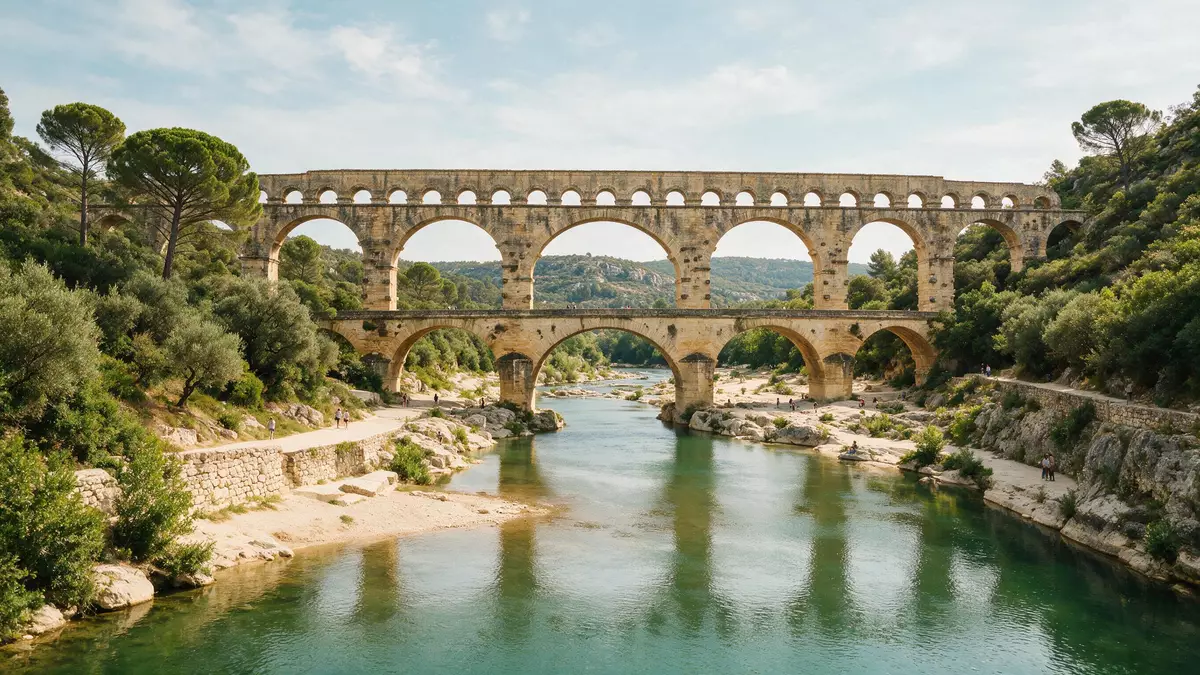
Pont du Gard near Vers-Pont-du-Gard in southern France is a monumental Roman aqueduct bridge whose three tiers of arches stride across the Gardon valley in pale limestone. Built in the first century AD as part of the aqueduct supplying Nemausus, the Roman city of Nîmes, it remains one of the most complete surviving pieces of Roman hydraulic engineering in France.Roman aqueduct bridge
A Roman bridge-aqueduct of three storeys
Pont du Gard is both a bridge and a segment of an aqueduct, combining a roadway at the lower level with the water conduit carried at the top.bridge-aqueduct The structure rises to about 49 m (161 ft) above the river, making it the highest known Roman aqueduct bridge.49 metres high It is organised into three superimposed levels of arches, a layout that is rare among ancient bridges and conspicuous even at a distance.three-tiered aqueduct
The lower tier carries a sequence of large arches spanning the river and its banks, supporting a platform that historically allowed passage along the valley.lower floor arches Above them, a second storey repeats the rhythm with smaller openings, while the uppermost level presents many narrower arches that enclose the water channel. Across all three levels the masonry is laid without mortar, relying on precise stone cutting and the weight of the blocks for stability.built without mortar
An aqueduct carrying water from Uzès to Nîmes
Pont du Gard forms the most dramatic section of a longer aqueduct, which ran for roughly 50 km (31 mi) between a spring near Uzès and the fountains of Nîmes.50.02 km aqueduct The whole system was laid out in the first century AD, under emperors such as Claudius or Nero, and operated for several centuries to deliver pressurised water to the Roman colony of Nemausus.built around 50 AD From the surrounding garrigue landscape, the aqueduct descended at a very gentle gradient, estimated at around 25 cm per kilometre, to maintain a steady flow by gravity alone.average gradient
The bridge allowed the conduit to cross the Gardon, a river that cuts a rocky corridor between Uzès and Nîmes.cross the Gardon River Roman engineers built the water channel as a covered masonry trench at the top level, preserving the cleanliness and pressure of the supply on its journey towards the baths, fountains and houses of the city. Over its working life the aqueduct delivered large volumes of water daily, and Pont du Gard’s role in that network gives the bridge both utilitarian and monumental character.
World Heritage and the limestone setting of Vers-Pont-du-Gard
Pont du Gard stands in the Occitanie region and has been listed as a UNESCO World Heritage Site since 1985, recognised as a masterpiece of Roman engineering and architecture.World Heritage Site since 1985 The bridge lies close to Vers-Pont-du-Gard, Remoulins and the wider Gard département, where scrubland, river terraces and limestone outcrops frame the structure.location in Gard From the banks, visitors see how the pale stone towers above the riverbed, with the arches forming a sequence of openings against the sky.
The limestone blocks used in the bridge were quarried nearby and fitted in horizontal courses that emphasise the length of the structure.limestone construction Light shifts across the tiers during the day, picking out the depth of the arches and the projecting stones at their edges. The site’s protected status has brought attention to both the monument and its river landscape, where paths, viewpoints and vegetation allow visitors to see the bridge from different angles while remaining within a clearly defined heritage area.heritage boundary
Visiting Pont du Gard: what travellers from Western Europe should know
- Pont du Gard stands near Vers-Pont-du-Gard in the Gard département of southern France, between Nîmes and Uzès, and is reached by regional roads across the river valley.
- The monument rises above a rocky riverbed where paths and viewpoints involve walking on uneven ground and using steps to move between terraces and banks.
- The official language is French and the currency is the euro.
Searching for Pont du Gard on social platforms
These links open searches for Pont du Gard on each platform.
Frequently asked questions about Pont du Gard
Where is Pont du Gard and what kind of place is it?
Pont du Gard is in the Gard département of southern France near Vers-Pont-du-Gard, and is an ancient Roman bridge-aqueduct crossing the Gardon river valley.
What should visitors expect when they arrive?
Visitors encounter a tall limestone structure of three tiers of arches above a rocky riverbed, with paths and viewpoints that involve walking on uneven terrain and using steps.
What makes Pont du Gard distinctive among Roman sites?
Its height, three-level arrangement of arches and role within a 50 km aqueduct from Uzès to Nîmes combine to make Pont du Gard an outstanding example of Roman hydraulic engineering.


