
Pont du Gard: a three-tier Roman aqueduct above the Gardon
Published on 09/14/2026 at 20:29 | Editorial responsibility: Rafael Müller, Editor-in-Chief AD HOC NEWS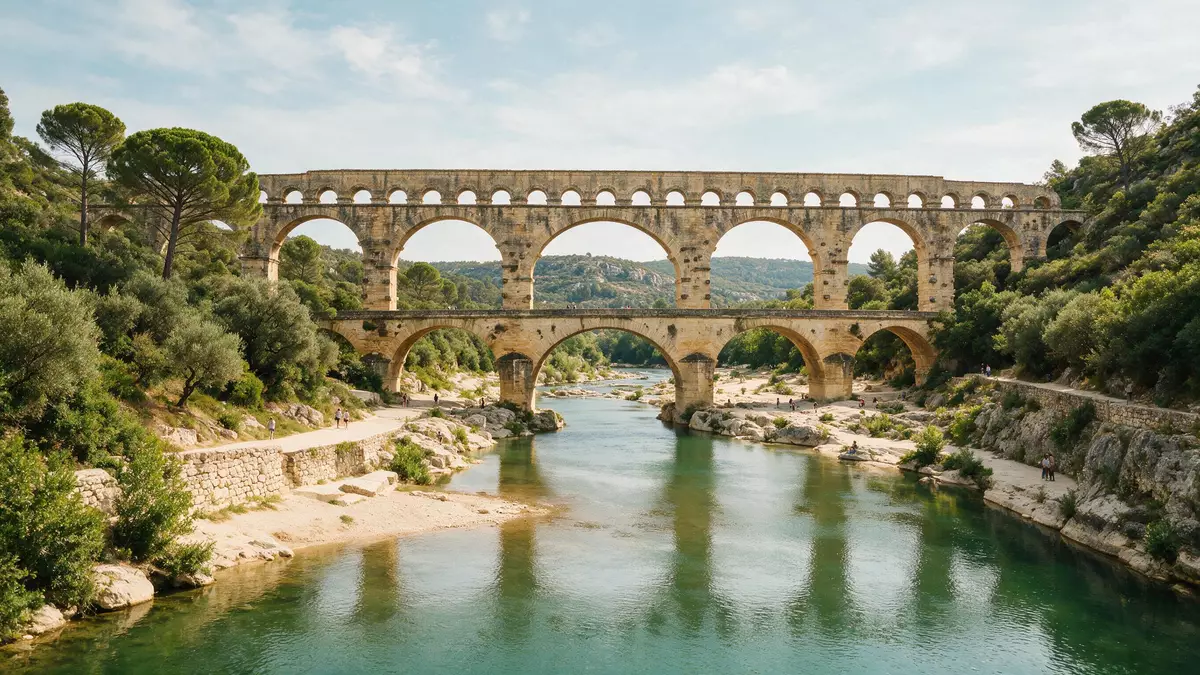
Pont du Gard near Vers-Pont-du-Gard in southern France is a monumental Roman aqueduct bridge whose three superimposed tiers of arches stride across the Gardon River in a single sweep. Built in the first century AD as part of the aqueduct supplying the colony of Nemausus, later Nîmes, it rises to around 49 m (161 ft) and has been recognised as a UNESCO World Heritage Site since 1985.
A Roman aqueduct frozen above the Gardon
The structure known as Pont du Gard forms the most spectacular segment of the aqueduct that once carried water from a spring near Uzès to Nîmes, over a course of about 50 km (31 mi). The bridge was constructed in the first century AD under the Roman Empire to allow the canal to cross the Gardon at a point where the valley narrows.major element of a 50 km aqueduct The water channel itself runs along the very top of the monument, enclosed within the masonry and following an exceptionally gentle gradient.
At Pont du Gard the aqueduct becomes an articulated bridge, built in three stacked levels of arches that together reach close to 49 m (161 ft) above the riverbed, making it the highest surviving Roman aqueduct bridge.highest Roman aqueduct bridge The lower storey carries broad arches spanning the river, the intermediate level supports a longer run of more slender openings, and the upper level once consisted of dozens of small arches aligning the concealed water conduit. Standing on the banks of the Gardon, the stone mass of the bridge fills the view from foreground to skyline, with its repetitive geometry framing slices of sky and rock.
Stone, arches and Roman engineering
Pont du Gard is built from local limestone quarried in the region, cut into large blocks and assembled without mortar in many parts, relying on the weight and precise fitting of the stones to hold the structure together. The bridge extends for about 275 m (902 ft) along its main visible span, a length that was originally even greater before some upper arches disappeared.49 metres high and 275 metres long Roman engineers designed the aqueduct with a fall of only around 25 cm per kilometre, an extraordinarily shallow slope that kept the water flowing by gravity without eroding the channel.
The three-level arrangement at Pont du Gard is rare among ancient aqueduct bridges and is the only example of a superimposed three-tier aqueduct still visible.only example of a three-tiered aqueduct still visible The central arch above the main river channel demanded an immense temporary wooden support structure during construction, demonstrating the ambition of the project. From ground level, the vertical rhythm of piers and arches draws the eye upward, revealing how the Roman builders translated hydraulic requirements into a vast piece of architecture. Even stripped of its functional role, the bridge reads as a lesson in proportion, mass and structural logic.
From aqueduct to heritage landscape
For several centuries after its completion, the Pont du Gard section of the aqueduct helped deliver large quantities of water to Nîmes, supporting baths, fountains and urban infrastructure.supplied Nîmes with water for five centuries The channel eventually fell out of use, but the bridge remained prominent in the landscape and took on other roles, including carrying traffic across the river. Its survival through periods when many aqueducts elsewhere were dismantled or reused gives Pont du Gard particular importance for the study of Roman engineering.
In 1985 the bridge and its surroundings were added to the UNESCO World Heritage List, recognised as a masterpiece of human creative genius and an outstanding example of Roman aqueduct construction.listed as a World Heritage Site since 1985 The designation acknowledges both the monument itself and the broader cultural landscape of the Gardon valley, where Mediterranean scrub, rock terraces and river pools form a setting that still complements the bridge’s pale stone. Viewed from different points on the banks, the arches appear against steep slopes, open water or stretches of woodland, each perspective emphasising another aspect of its scale.
Visiting Pont du Gard: what travellers from Western Europe should know
- Pont du Gard stands near Vers-Pont-du-Gard in the Gard département of southern France, between Nîmes and Uzès; road access leads from the D981 and other regional routes.
- The monument rises above a rocky river valley, with approaches that involve walking on uneven ground and stairways between different levels of the site.
- The official language is French and the currency is the euro.
- The Gardon River runs directly below the bridge, and riverside paths and open terraces provide views of the aqueduct from the banks and nearby slopes.
Searching for Pont du Gard on social platforms
These links open searches for Pont du Gard on each platform.
Frequently asked questions about Pont du Gard
Where is Pont du Gard located?
Pont du Gard stands near the town of Vers-Pont-du-Gard in the Gard département of southern France, in the Occitanie region, spanning the Gardon River.
What should visitors expect at Pont du Gard?
Visitors encounter a vast three-level Roman aqueduct bridge above a rocky river valley, with paths, terraces and viewpoints that reveal its arches from multiple angles.
What makes Pont du Gard distinctive among Roman sites?
Pont du Gard is distinctive as a three-storey Roman aqueduct bridge of about 49 m (161 ft) in height that still preserves its stacked tiers of arches above the Gardon.


