
Pont du Gard, a three-tier Roman aqueduct above the Gardon
Published on 09/05/2026 at 22:12 | Editorial responsibility: Rafael Müller, Editor-in-Chief AD HOC NEWS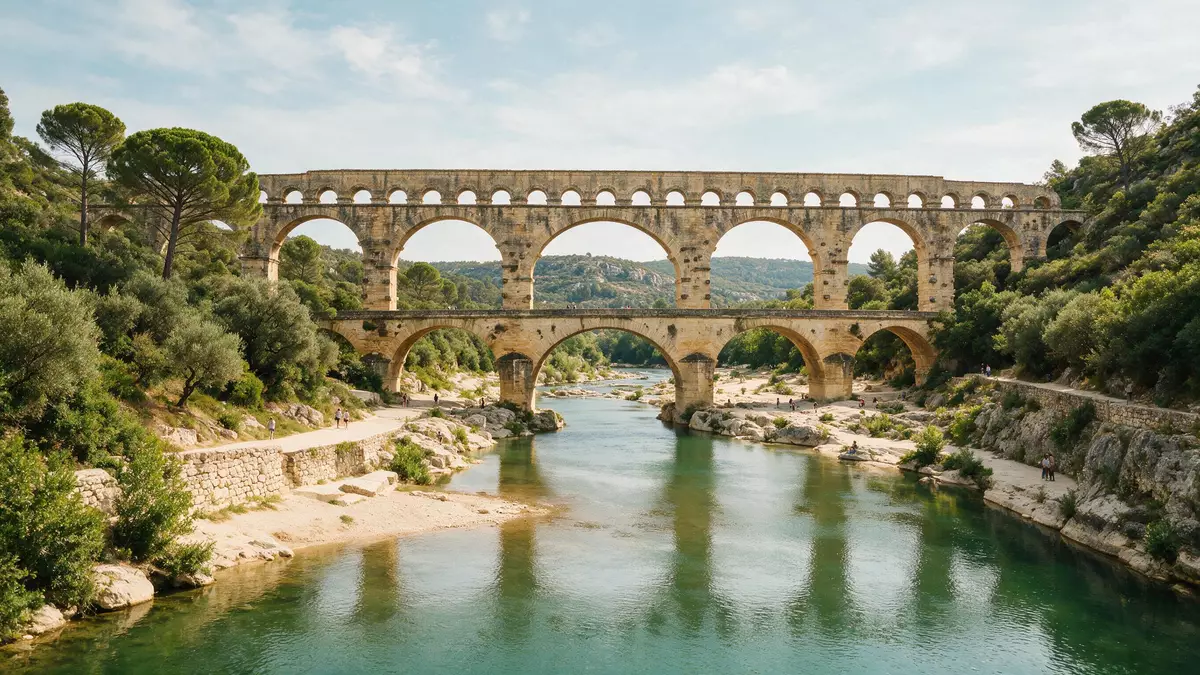
Pont du Gard in southern France is an ancient Roman aqueduct bridge that strides across the Gardon River near Vers-Pont-du-Gard, its three stacked tiers of arches dominating the valley landscape. Built in the first century AD as part of a long aqueduct carrying water to the Roman colony of Nemausus, now Nîmes, it combines monumental scale with precise engineering in a single stone structure that has survived for almost two millennia.
A three-tier stone bridge in the Gardon valley
Pont du Gard stands in the Gard department of France, spanning the Gardon River between Uzès and Nîmes in the limestone hills of Occitanie. The bridge forms the most spectacular visible section of an aqueduct of about 50 km (31 mi) that channelled spring water from the Fontaine d’Eure near Uzès to the city of Nîmes, a major Roman settlement in the region.aqueduct of 50 km The structure rises to just under 50 m (around 160 ft), carried by three levels of arches in cut stone that step across the river and its banks.
The bridge-aqueduct is laid out in three superimposed arcades: a lowest level with large arches that stride across the riverbed, an intermediate tier of smaller spans, and an upper row that once carried the water channel itself.three tiers of arches The masonry is laid without mortar, with precisely cut blocks locked together by their weight and fit, a characteristic of high Roman engineering. Seen from the riverbank, the regular rhythm of the arches frames strips of sky and rock, while the warm colour of the stone ties the structure visually to the surrounding cliffs.
Roman engineering for the aqueduct of Nîmes
The aqueduct that includes Pont du Gard was built under the Roman Empire in the first century AD to carry water from springs near Uzès to Nemausus, the Roman city that became modern Nîmes.first-century aqueduct to Nîmes Over its course the channel follows a very gentle gradient, descending only a small amount over each kilometre, so that water could flow steadily by gravity along the full length to the distribution basin in the city.gentle gradient for gravity flow
Within this system Pont du Gard solves the crossing of the Gardon River and its valley by lifting the channel high above the water on a bridge of three stacked levels. The engineering challenge produced one of the highest Roman bridges known, with a central span over the river and subsidiary arches over solid ground on either side.high Roman bridge-aqueduct For five centuries the aqueduct delivered large volumes of water daily to the fountains, baths and houses of Nîmes, tying this rural valley directly to urban life in the Roman city.
World Heritage landscape around a monumental crossing
Pont du Gard has been listed as a UNESCO World Heritage Site since 1985, recognised as an exceptional ancient monument and a masterpiece of Roman hydraulic engineering.World Heritage Site since 1985 The bridge stands within a protected landscape of garrigue vegetation, rock terraces and the meandering Gardon River, where the stone arches form a visual focus for the valley.
The site sits in the wider Occitanie region, with Nîmes and Avignon within reach and Uzès on the uplands to the north, so a visit to Pont du Gard can be combined with Roman remains and historic towns elsewhere in the area.Occitanie setting between Uzès and Nîmes From the river’s edge and nearby paths, different viewpoints reveal the bridge’s three-storey profile against the sky, its massive piers rooted in the riverbed and the fine line of the aqueduct channel along the top level.
Visiting Pont du Gard: what travellers from Western Europe should know
- Pont du Gard stands near Vers-Pont-du-Gard in the Gard department of southern France, between Uzès and Nîmes; it is reached by road from regional centres such as Nîmes and Avignon.
- The monument rises above the Gardon River with stone arches and rock terraces, and approaches from the car parks lead on foot across gently sloping paths and stairways down towards the riverbank.
- The surrounding terrain includes riverside gravel and uneven natural rock, so sturdy footwear is useful for exploring the viewpoints near the water and the paths that run close to the bridge.
- The official language is French and the currency is the euro.
Searching for Pont du Gard on social platforms
These links open searches for Pont du Gard on each platform.Frequently asked questions about Pont du Gard
Where is Pont du Gard located?
Pont du Gard spans the Gardon River near the town of Vers-Pont-du-Gard in the Gard department of southern France, between Uzès and Nîmes.
What should visitors expect at Pont du Gard?
Visitors encounter a three-tier Roman stone bridge above a river valley, with paths, terraces and riverside areas offering varied viewpoints of the arches and surrounding landscape.
What makes Pont du Gard distinctive among Roman remains?
Pont du Gard combines considerable height, three stacked levels of arches and a role within a long aqueduct, and has been recognised as a UNESCO World Heritage Site since 1985.


