
Pont Alexandre III and Paris’s most ornate bridge
Published on 08/26/2026 at 19:57 | Editorial responsibility: Rafael Müller, Editor-in-Chief AD HOC NEWS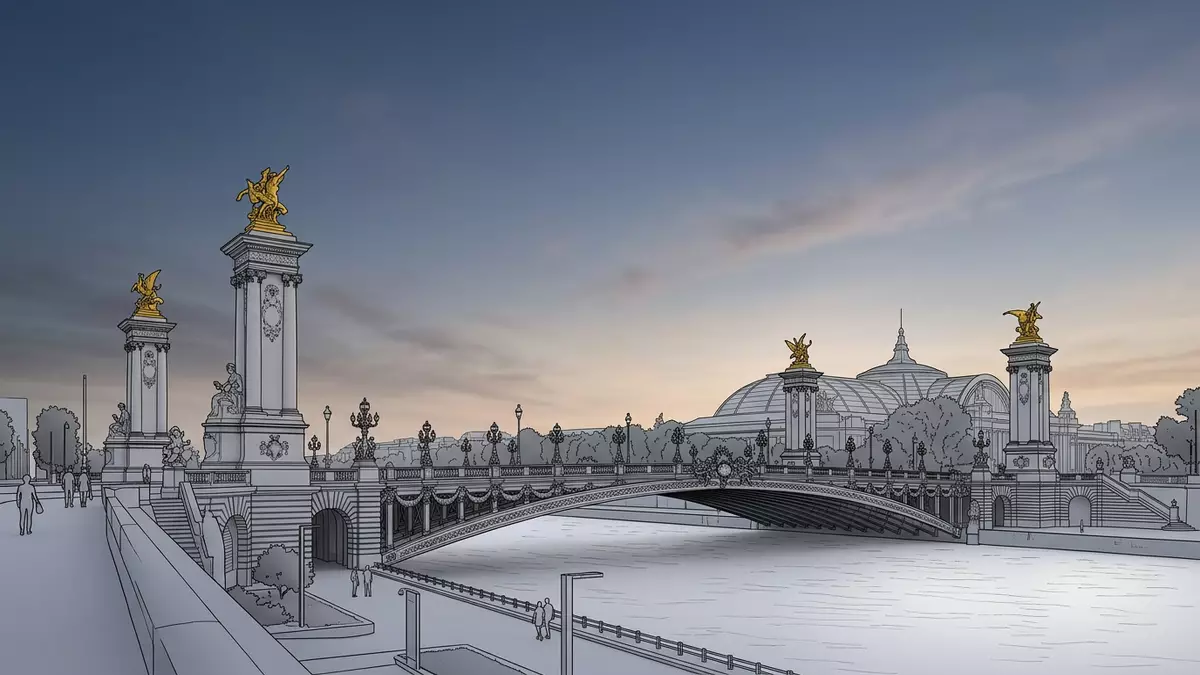
Pont Alexandre III crosses the Seine in Paris with a lavish decorative scheme over a steel arch. Opened in 1900, it links the Invalides side with the Champs-Élysées side and takes its name from Alexander III, the Russian emperor.
Beaux-Arts decoration over the Seine
The bridge belongs to the Belle Époque cityscape around the Seine, where stone quays, domed roofs and formal monuments frame the river. Its profile is low and broad, yet the ornament is emphatic: lamp standards, winged figures and sculpted groups line the span and its approaches.
The structure measures about 160 m (525 ft) in length and 40 m (131 ft) in width, with a single metal arch carrying the roadway above the river. Jean Résal and Amédée Alby are linked to the engineering of the bridge, while Joseph Cassien-Bernard and Gaston Cousin shaped its architectural treatment.
A bridge tied to the Exposition universelle
Pont Alexandre III was completed for the Exposition universelle of 1900, the great world fair that also brought the Grand Palais and Petit Palais into the same Parisian landscape. Its 1900 opening places it firmly within the late nineteenth-century culture of monumental public works and ceremonial river crossings.
The bridge is a French monument historique, a formal designation that recognises its place in the national built heritage. That status fits a crossing where engineering, sculpture and river frontage are all part of the same composition.
Imperial naming and Parisian setting
The name refers to Alexander III of Russia, whose reign belongs to the alliance between France and Russia in the 1890s. In the Paris setting, that name sits beside the Esplanade des Invalides, Avenue Winston Churchill and the museum quarter around the Grand Palais and Petit Palais.
The bridge reads as a formal link between two ceremonial banks rather than a purely functional crossing. Its ornaments, span and river position give it a strong identity in the city’s public realm, and the bridge remains closely associated with the atmosphere of the 1900 fair.
Visiting Pont Alexandre III: what travellers from Western Europe should know
- The bridge lies over the Seine in central Paris, between the Invalides side and the Champs-Élysées side. Metro and RER connections serve the surrounding district.
- The crossing is level and open to the river frontage. The approach on either bank is on paved urban ground rather than on steps.
- The bridge sits beside the Grand Palais, the Petit Palais and the Esplanade des Invalides. The river quays on both sides give clear views of the metal arch and sculpture.
- English is not an official language in France; the official language is French and the currency is the euro.
Searching for Pont Alexandre III on social platforms
These links open searches for Pont Alexandre III on each platform.
Frequently asked questions about Pont Alexandre III
Where is Pont Alexandre III?
It spans the Seine in central Paris, between the Invalides quarter and the area around the Champs-Élysées.
What does a visit involve?
The bridge can be crossed on foot as part of a walk along the riverbanks. The setting includes sculpture, lamps and open views towards nearby monuments.
What makes Pont Alexandre III distinctive?
Its combination of a metal arch and exuberant Beaux-Arts decoration sets it apart in Paris. The 1900 date and the imperial name connect it to a specific historical moment.


