
Pont Alexandre III, a low arch of gilded grandeur in Paris
Published on 09/14/2026 at 19:47 | Editorial responsibility: Rafael Müller, Editor-in-Chief AD HOC NEWS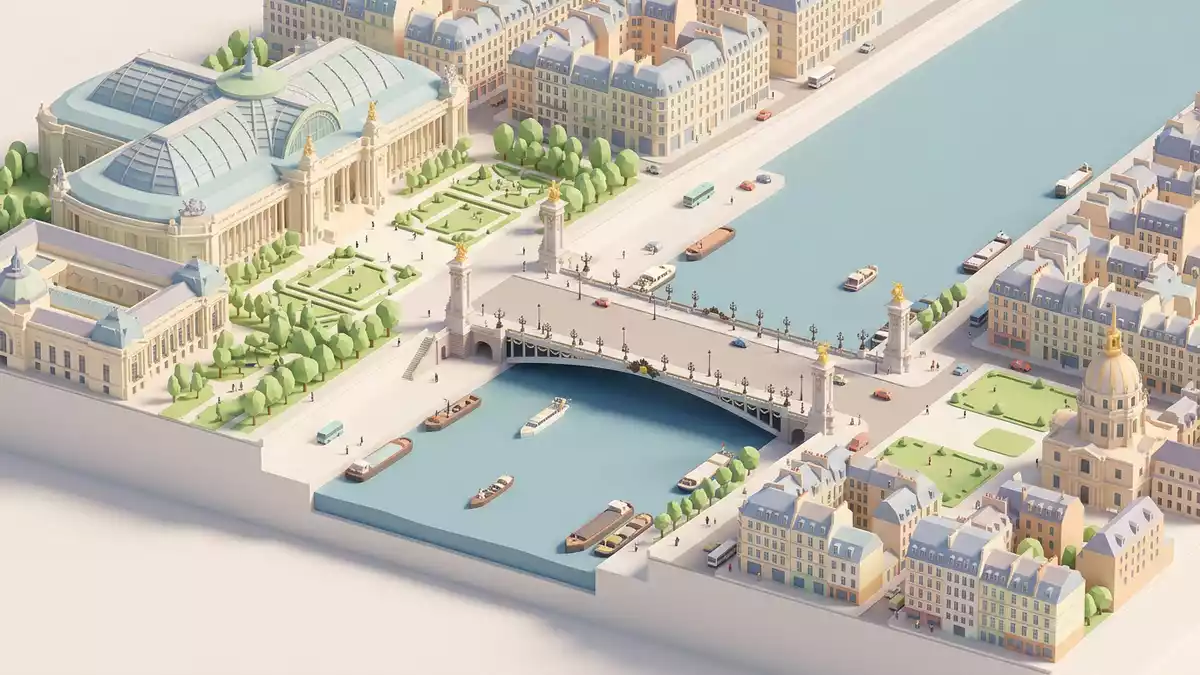
Pont Alexandre III is a low-slung steel arch bridge over the Seine in Paris, completed in 1900 for the Exposition Universelle and named after Tsar Alexander III of Russia. Crossing between the esplanade of Les Invalides and the avenue leading to the Grand Palais and Petit Palais, it combines Belle Époque engineering with an exuberant display of gilded sculpture and decorative detail.
A Belle Époque bridge between Invalides and the Grand Palais
The bridge occupies a central position in Paris, linking the open space of the Esplanade des Invalides on the Left Bank with Avenue Winston Churchill on the Right Bank, close to the Grand Palais and Petit Palais.linking the Esplanade des Invalides From the deck, the view reaches along the river to the Eiffel Tower and across to the façades of these exhibition halls, placing the bridge within a tight cluster of turn-of-the-century monuments.Eiffel Tower and over the Seine
Structurally, Pont Alexandre III carries a single steel span roughly 160 m (520 ft) long between its abutments, keeping the profile low above the water.Total length 160 metres The deck is about 40 m (130 ft) wide, accommodating road traffic as well as broad pavements on both sides.total length is 160 metres That combination of width and low height gives the bridge a horizontal emphasis, contrasting with the vertical thrust of the pylons and nearby landmarks.
Engineers, architects and the making of Pont Alexandre III
Pont Alexandre III was built in the late nineteenth century and inaugurated in 1900 in time for the Paris World Exhibition, part of a broader programme that also produced the Grand Palais and Petit Palais.Eröffnung 14. April 1900 The foundation stone was laid in 1896 in the presence of Tsar Nicholas II, underlining the bridge’s connection to the Franco-Russian alliance of that era.Grundsteinlegung fand am 7. Oktober 1896
The structure was a collaboration between engineers Jean Résal and Amédée Alby and architects Joseph Cassien-Bernard and Gaston Cousin, combining technical demands with a rich decorative programme.Jean Résal et Amédée Alby Built as a steel deck arch, the bridge keeps the main span low to preserve views across the river between the Champs-Élysées side and the silhouette of Les Invalides.single-span steel arch across the Seine Its Beaux-Arts character links it closely to the wider Belle Époque cityscape, where elaborate façades and new engineering technologies were combined.
Gilded pylons, sculptures and lamps
What most visitors notice first are the tall pylons at each corner of the bridge, rising high above the deck and topped with gilded winged horses that catch the light.pylons crowned with gilt bronze sculptures These columns anchor the bridge visually and carry allegorical figures representing areas such as Arts, Sciences, Commerce and Industry, tying the structure back to the themes of the 1900 exposition.
Along the balustrades and on the central sections of the bridge, sculpted nymphs, cherubs and other figures appear among ornate Art Nouveau lamps, turning the deck into a sequence of sculptural ensembles.Art Nouveau lamps, cherubs, nymphs The decoration follows a lavish neo-Baroque style, with gilded bronze details contrasting against the pale stone of the bases and the grey of the steel arch.im Stil des Neobarocks errichtete Brücke Classified as a historic monument since 1975, Pont Alexandre III stands as both a working river crossing and a carefully composed open-air gallery of turn-of-the-century sculpture.classed as a historic monument
Visiting Pont Alexandre III: what travellers from Western Europe should know
- Pont Alexandre III crosses the Seine between the Esplanade des Invalides in the 7th arrondissement and Avenue Winston Churchill in the 8th, close to the Grand Palais and Petit Palais.
- The bridge carries road traffic and pavements, with an approach on foot that runs along the river quays and up gentle ramps rather than steep staircases.
- The surrounding area includes the Champs-Élysées, the Eiffel Tower and Les Invalides within walking distance, making the bridge part of a compact circuit of Parisian landmarks.
- Paris is reached by rail and air from Western Europe, and local métro stations such as Invalides and Champs-Élysées – Clemenceau stand within a short walk of the bridge.
- France’s official language is French and its currency is the euro (EUR).
Searching for Pont Alexandre III on social platforms
These links open searches for Pont Alexandre III on each platform.
Frequently asked questions about Pont Alexandre III
Where is Pont Alexandre III in Paris?
Pont Alexandre III crosses the Seine between the Esplanade des Invalides and Avenue Winston Churchill, linking the 7th and 8th arrondissements in central Paris.
What can visitors expect when walking across the bridge?
Visitors encounter wide pavements beside a low, open steel arch, with close-up views of gilded sculptures on the pylons and long perspectives towards the Eiffel Tower and Les Invalides.
What makes Pont Alexandre III distinctive among Paris bridges?
Its combination of a single low steel span, Belle Époque engineering, lavish neo-Baroque sculpture and a setting among major exhibition buildings gives Pont Alexandre III a particularly ornate character.


