

Pompei’s buried Roman city beneath Vesuvius
Published on 08/12/2026 at 14:24 | Editorial responsibility: Rafael Müller, Editor-in-Chief AD HOC NEWS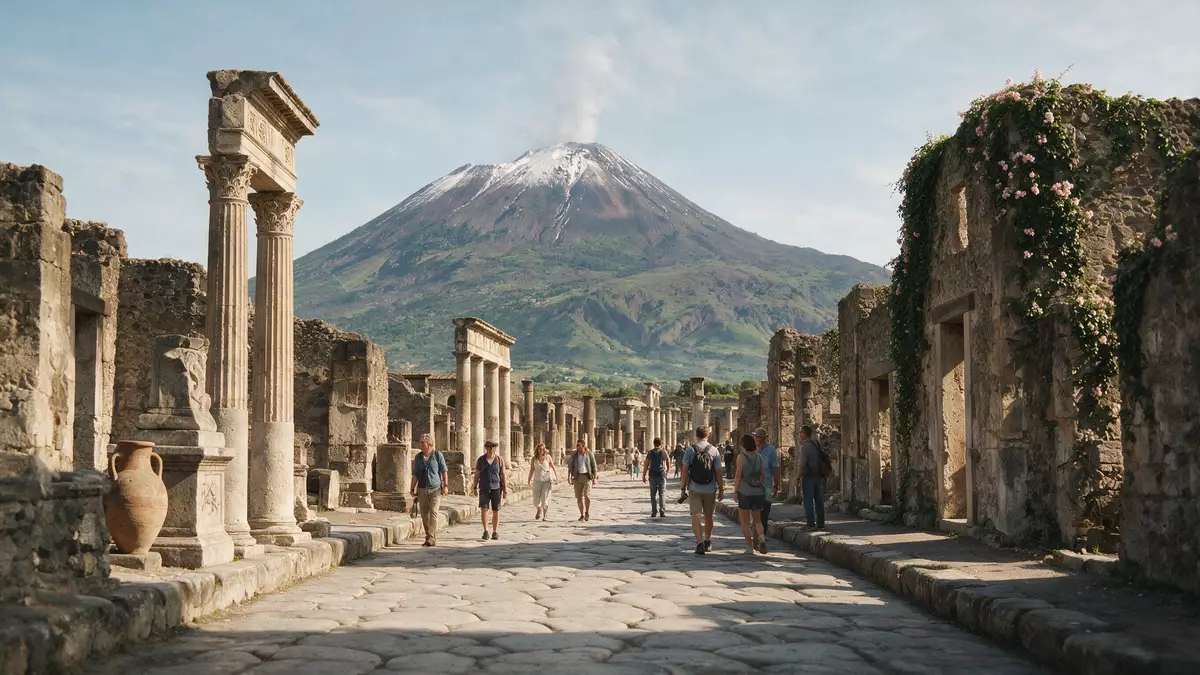
Pompei in southern Italy is inseparable from the ancient Roman city of Pompeii, buried by the eruption of Mount Vesuvius in 79 AD and uncovered as an extensive archaeological park. Set in Campania south-east of Naples, the site preserves streets, houses and public buildings on a scale rarely matched, offering a walkable snapshot of urban life in the early Roman Empire.
Streets, walls and the shadow of Vesuvius
The ancient city of Pompeii stood at the south-eastern base of Mount Vesuvius, close to the mouth of the Sarno River in what is now the Campania region of Italy.Campania region of Italy The ruins lie within the modern municipality of Pompei, in the Metropolitan City of Naples, and occupy a spur of land formed by earlier lava flows that once overlooked the Bay of Naples.spur formed by a prehistoric lava flow
Remains of the city walls enclose an area of about 66 hectares, with roughly two thirds of that area brought to light through excavation.area of about 66 hectares Within this circuit, long straight streets cross at right angles, lined with paving stones and edged by high kerbs that once separated carts from pedestrians.long straight streets cross at right angles In several places, raised stepping stones span the carriageways, arranged so that ancient wheels could pass between them while feet stayed clear of the surface water that collected in rain.
Houses, forums and everyday spaces
Pompeii developed from at least the ninth century BC and grew into a substantial Roman town long before its destruction in 79 AD.origins in the ninth century BC Excavation since 1748 has uncovered a dense fabric of houses, workshops and public buildings that together form an open-air museum of Roman construction.dense fabric of houses Domestic structures range from modest dwellings to expansive townhouses with internal courtyards, columns and wall paintings in vivid pigments that have survived beneath the volcanic deposits.
The civic heart of Pompeii centres on the Forum, a broad rectangular space flanked by colonnades and overlooked by temples and public buildings.Forum, located in the large level area To one side stands the so-called Triangular Forum, set on higher ground near the south wall and aligned towards the former shoreline, while further east the amphitheatre and Palaestra occupy a district devoted to spectacles and exercise.Triangular Forum, amphitheatre and Palaestra Across the excavated area, more than a thousand structures including houses and monuments have been identified, from bakeries with flour mills to baths fed by elaborate water systems.1500 buildings have been brought to light
From burial in 79 AD to UNESCO World Heritage
On a day in 79 AD, a major eruption of Mount Vesuvius buried Pompeii and nearby settlements such as Herculaneum and Stabiae under several metres of ash and pumice.eruption of Mount Vesuvius in 79 CE Buildings collapsed under the weight of the fall, roofs gave way and streets filled, yet the rapid covering preserved walls, floors, everyday objects and even negative forms of bodies in their final positions.buried in volcanic ash
The ruins were rediscovered in the sixteenth century and systematic excavations began in the eighteenth century, attracting attention from scholars and travellers and contributing to the rise of archaeology as a discipline.excavations in the mid-18th century In 1997 the Archaeological Areas of Pompeii, Herculaneum and Torre Annunziata were added to the UNESCO World Heritage List, recognising the extent and preservation of an entire Roman urban landscape.Archaeological Areas of Pompei, Herculaneum and Torre Annunziata The World Heritage property covers not only the excavated streets and buildings but also associated villas, including the Villa of the Mysteries near Pompeii and villas in Torre Annunziata overlooking the bay.
Visiting Pompei: what travellers from Western Europe should know
- Pompei lies south-east of Naples in the Campania region of Italy, close to the south-eastern slopes of Mount Vesuvius and served by regional rail links.
- The archaeological park covers a large area with long streets in stone paving, and a visit involves extended walking on uneven surfaces and negotiating steps between levels.
- The ruins stand near the course of the Sarno River and views from parts of the site take in Vesuvius and the broader landscape of the Bay of Naples.
- Italian is the official language and the currency is the euro.
- Entry requirements depend on your nationality; UK travellers can check the FCDO travel advice at gov.uk/foreign-travel-advice, Irish travellers the Department of Foreign Affairs at ireland.ie.
Searching for Pompei on social platforms
These links open searches for Pompei on each platform.
Frequently asked questions about Pompei
Where is Pompei and the archaeological site of Pompeii?
Pompei is a town in Campania in southern Italy, south-east of Naples, at the south-eastern base of Mount Vesuvius near the course of the Sarno River.
What can visitors expect to see at Pompei?
Visitors encounter an extensive archaeological park with paved streets, houses, temples, baths and an amphitheatre, preserved under volcanic deposits since the eruption of Vesuvius in 79 AD.
What makes Pompei distinctive among archaeological sites?
The scale and preservation of Pompeii’s urban fabric, from its 66-hectare walled area to its painted interiors and public spaces, give an unusually complete view of a Roman city.


