
Plitvicka jezera: water, limestone and forest at Croatia’s lake terrace
Published on 09/18/2026 at 15:09 | Editorial responsibility: Rafael Müller, Editor-in-Chief AD HOC NEWS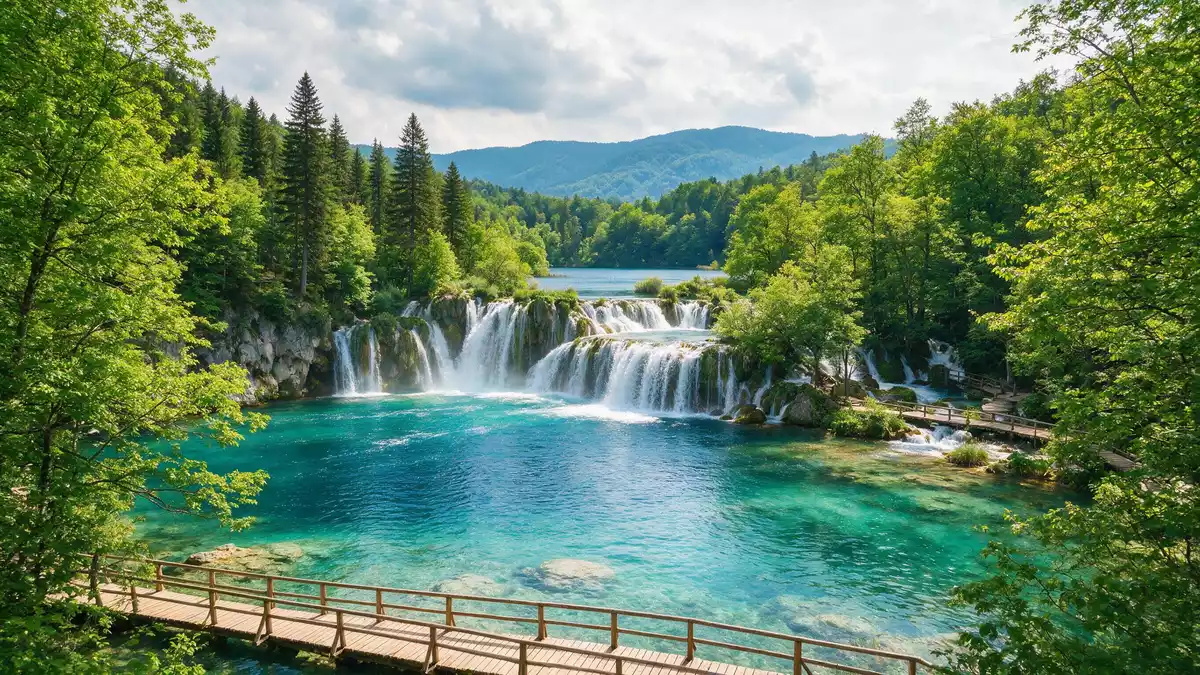
Plitvicka jezera, known in English as Plitvice Lakes, is a national park in central Croatia where water, limestone and forest combine into a terraced landscape of lakes and waterfalls. Established as a protected area in 1949, the park later gained recognition as a UNESCO World Heritage Site for its karst geology and constantly forming tufa barriers, making it a classic example of a Dinaric mountain lake system in the twentieth century.
Water cascading through a karst landscape
The defining feature of Plitvicka jezera is a series of interconnected lakes that step down through a karst valley, each feeding the next through cascades and waterfalls. The official park description notes that the lake system consists of 16 named lakes, with smaller pools between them, arranged in a sequence where one overflows into another over travertine formations.The lake system changes in detail over time as calcium-rich water deposits new tufa and builds natural dams.
These lakes lie between the Mala Kapela and Li?ka Plješivica mountain ranges, in the lower elevations of the Dinarides, and are set within a wider protected area of almost 30,000 ha that also includes substantial forest.Plitvice Lakes National Park is described as Croatia’s largest national park, with lakes, rivers and waterfalls occupying only a fraction of its total area compared with woodland and grassland.
A twentieth-century national park with global recognition
Plitvicka jezera was formally declared a national park on 8 April 1949, making it the oldest national park in Croatia and one of the earliest large-scale protected areas in south-eastern Europe.The national park designation established legal protection for the lake system and its surrounding karst terrain, which lies close to an important north–south road linking the country’s interior with the Adriatic coast.
In 1979 Plitvice Lakes National Park was inscribed on the UNESCO World Heritage List as a natural site, recognised for a combination of outstanding scenery and ongoing geological and biological processes that create travertine barriers and complex hydrology.The UNESCO inscription emphasises the way the lakes, caves and waterfalls form a coherent system rather than isolated features. The protected area extends across Lika-Senj and Karlovac counties, reflecting the way the karst basin cuts across administrative boundaries.
Forest, trails and viewpoints around the lakes
Although the lakes and waterfalls draw most attention, a large proportion of Plitvicka jezera consists of forest on limestone slopes and plateaus. The official park information points out that the protected area covers just under 30,000 ha, of which a significant share is forest, with lake surfaces accounting for only a few hundred hectares.General information about the park highlights mixed woodland surrounding the water, providing a setting of trees, clearings and rock.
Visitors move through this landscape on marked walking routes and boardwalks that hug the lake margins and cross streams, with several official programmes for exploring the lake system and a set of mountain paths leading into higher ground.Descriptions of Plitvice Lakes National Park refer to terraced lakes backed by cliffs and dense forest, with viewpoints that look down onto long chains of water and cascading falls.
Visiting Plitvicka jezera: what travellers from Western Europe should know
- Plitvicka jezera lies in central Croatia’s mountainous region, between the Mala Kapela and Li?ka Plješivica ranges, with the main Zagreb–Split road passing through the wider municipality of Plitvicka Jezera.
- Trails around the lakes include sections of boardwalk close to the water and paths on slopes, so visitors spend extended periods on foot, sometimes on uneven karst terrain and stairways.
- The protected area includes forested hills as well as lakes, meaning that parts of the park involve walking under tree cover and along inclines rather than only beside level shorelines.
- The official language in the region is Croatian and the currency is the Croatian kuna.
Searching for Plitvicka jezera on social platforms
These links open searches for Plitvicka jezera on each platform.
Frequently asked questions about Plitvicka jezera
Where is Plitvicka jezera?
Plitvicka jezera is in central Croatia, in the mountainous Plitvice region between the Mala Kapela and Li?ka Plješivica ranges, within Lika-Senj and Karlovac counties.
What can visitors expect during a visit?
Visitors encounter a terraced chain of clear lakes, numerous waterfalls, forested slopes and marked paths and boardwalks that lead close to the water and up onto viewpoints.
What makes Plitvicka jezera distinctive among European landscapes?
The park combines an extensive karst lake system with actively forming travertine barriers and dense forest, recognised since 1979 as a UNESCO World Heritage natural site.


