
Plitvicka jezera and the living architecture of water
Published on 09/23/2026 at 11:47 | Editorial responsibility: Rafael Müller, Editor-in-Chief AD HOC NEWS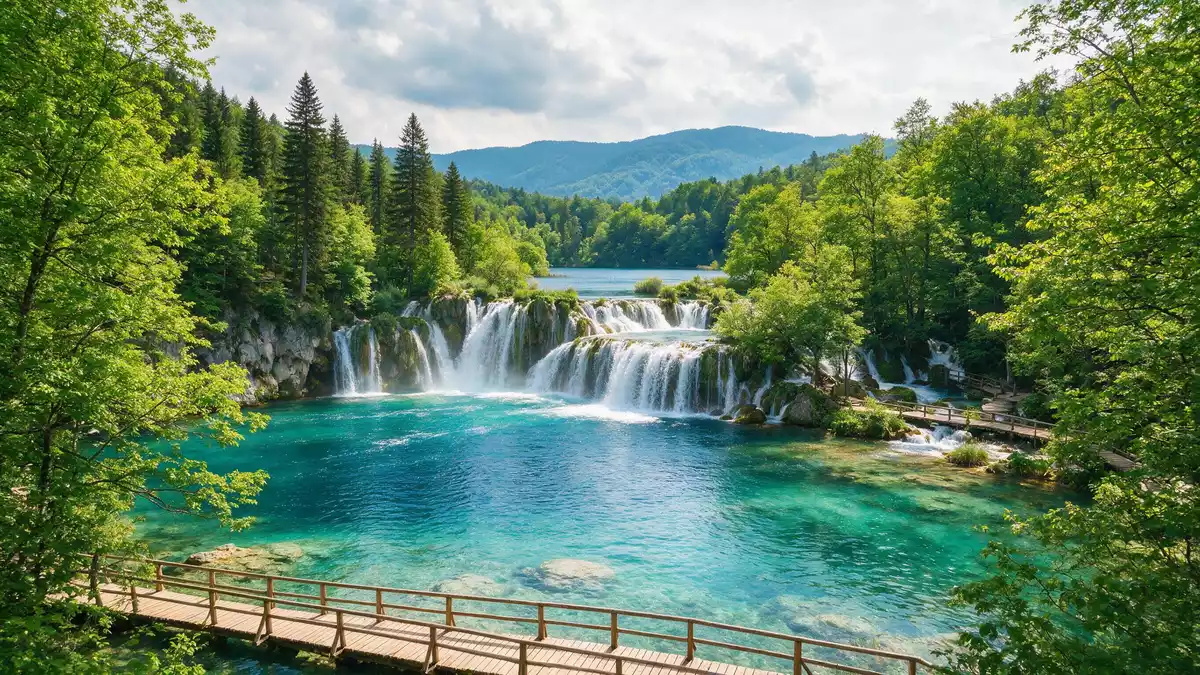
Plitvicka jezera is a chain of turquoise lakes, waterfalls and tufa barriers in Croatia’s central Plitvice region. Water is the visible architecture, crossing porous limestone and moss before gathering in pools below. The landscape became Croatia’s first national park on 8 April 1949 and entered the UNESCO World Heritage List on 26 October 1979.
Plitvicka jezera: a landscape assembled by water
The lakes lie within the Dinaric Karst, a region of limestone, dolomite, underground channels and sinking rivers. Their surfaces appear in linked levels, with streams passing through woodland and over pale mineral barriers. The barriers are made of tufa, also called travertine, a porous rock associated with calcium carbonate deposited on mosses, algae and aquatic organisms.
This process gives Plitvicka jezera its distinctive visual grammar. Water does not simply occupy a pre-existing basin. It crosses ledges, gathers behind mineral rims, falls into lower pools and reappears among trees. The result is a connected landscape of lakes, cascades, caves and forest rather than a single isolated sheet of water. The park’s World Heritage status recognises this relationship between geology, water and living organisms.
From national park to World Heritage landscape
Protection of the Plitvice lakes has a recorded history reaching back to the nineteenth century. The Association for the Conservation and Enhancement of the Plitvice Lakes was created in 1893, providing an early organised expression of concern for the area’s natural features. National park status followed on 8 April 1949.
The designation made Plitvicka jezera Croatia’s first national park. The protected area was enlarged in 1997 to include the wider catchment and much of the groundwater system connected with the lakes. On 26 October 1979, the park was inscribed on the UNESCO World Heritage List for the natural value of its tufa formation and lake system. The park’s tufa formation process remains central to its identity.
The upper and lower lakes of Plitvice
Plitvicka jezera is commonly understood through its upper and lower lake areas. The upper lakes occupy a wooded, more open landscape, while the lower lakes lie within narrower limestone scenery. Wooden walkways and footpaths pass beside the water, across streams and above sections of the tufa barriers.
Veliki Slap is the park’s best-known waterfall, dropping beside the lower lakes. Lake Kozjak is the largest lake in the system and forms a clear geographical link between different sections of the park. Small caves, wooded slopes and mineral terraces appear between the water surfaces. The karst lake basin combines limestone, dolomite and barriers formed through biological and chemical processes.
Visiting Plitvicka jezera: what travellers from Western Europe should know
- Plitvicka jezera lies in central Croatia, between Zagreb and Zadar. Buses serve the park from Zagreb, Karlovac, Zadar and Split, while the D1 state road passes the entrances.
- The railway network does not pass through the Plitvice municipality. Rail travellers can reach Zagreb, Karlovac or Split before continuing by bus, rented car or taxi.
- The park contains steep wooded sections, steps, bridges and uneven paths. The route passes beside lakes, over streams and across tufa terraces.
- Electric boats operate on Lake Kozjak, and park transport connects sections of the lake system. The official language is Croatian and the currency is the euro.
Searching for Plitvicka jezera on social platforms
These links open searches for Plitvicka jezera on each platform.Frequently asked questions about Plitvicka jezera
Where is Plitvicka jezera?
Plitvicka jezera is in central Croatia, in the mountainous karst landscape around Plitvice. The park lies between major routes linking Zagreb, the Adriatic coast and Dalmatia.
What can travellers expect at the lakes?
Travellers encounter linked lakes, waterfalls, forest paths, wooden walkways, bridges, caves and tufa barriers. Electric boats and park transport connect parts of the lake system.
What makes Plitvicka jezera distinctive?
Its lakes are connected by tufa barriers formed through calcium carbonate deposition on mosses and other aquatic organisms. The continuing relationship between water, rock and vegetation defines the landscape.


