
Plaza Mayor in Salamanca and the theatre of Spanish Baroque
Published on 08/30/2026 at 15:12 | Editorial responsibility: Rafael Müller, Editor-in-Chief AD HOC NEWS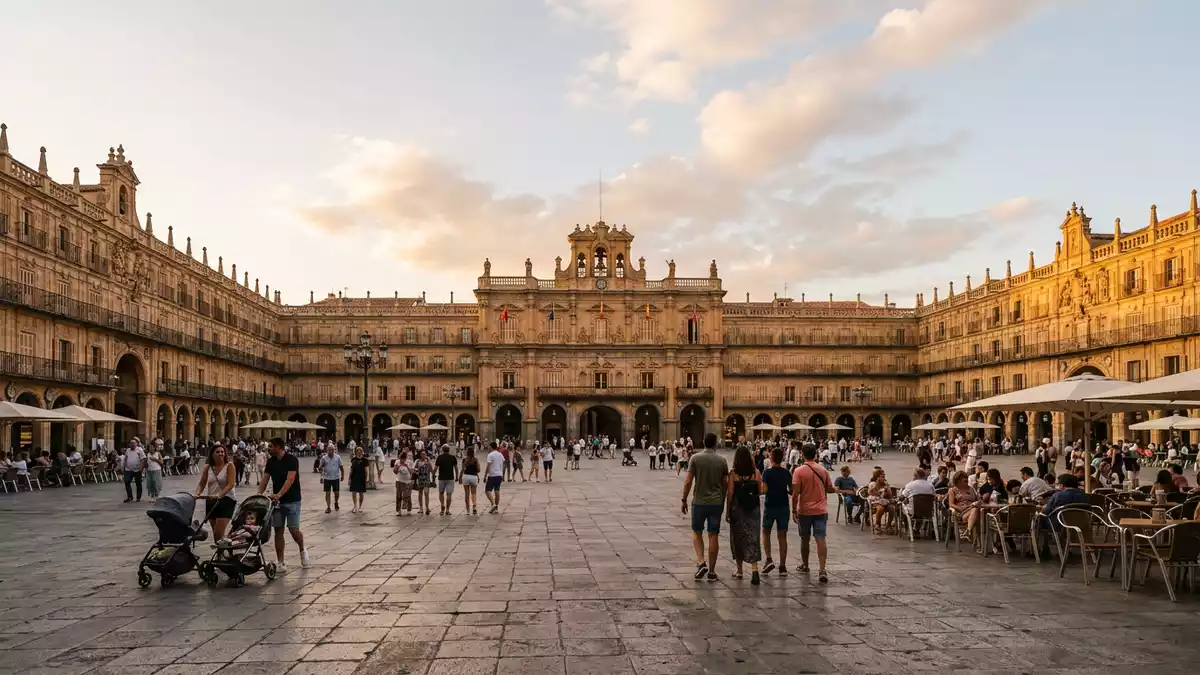
Plaza Mayor in Salamanca is a grand Baroque square of golden sandstone, enclosed by arcaded facades that turn an urban space into a single architectural room. Built in the eighteenth century under King Philip V, it gathers market life, civic ceremony and quiet pauses beneath a continuous ring of arches and balconies.
A Baroque square shaped as an urban room
Plaza Mayor is defined by four uniform facades of three storeys, each carried on arcades whose arches rest on stone columns and form a covered walkway around the entire perimeter.Four three-storey pavilions frame the square and create a coherent envelope of carved stone, punctuated by balconies and balustrades.
The material is the warm sandstone associated with Salamanca, whose colour shifts gently with the light and binds the square to the wider historic centre.Golden sandstone façades carry ornamental shields and medallions, while the arcades shelter cafés and meeting points. Standing near the centre, the square reads less as a void between buildings and more as a singular hall open to the sky.
Eighteenth-century construction under Alberto de Churriguera
The present Plaza Mayor was laid out in the early eighteenth century, during the reign of the Bourbon monarch Philip V, when Salamanca reshaped its medieval market space into a more regular civic square.Work began in 1729 and extended over several decades. The initial design is credited to the architect Alberto de Churriguera, whose name links the project to the Churrigueresque current of Spanish Baroque.
Construction proceeded in phases from the late 1720s through the mid-1750s, with Alberto de Churriguera overseeing the early pavilions and other architects continuing the scheme with limited changes.The square was completed around 1755, and the City Hall pavilion on the north side is associated with Andrés García de Quiñones, whose later work sealed the composition. As a product of the eighteenth century, the square belongs firmly to the Baroque period, yet its measured proportions give it a calm clarity alongside more exuberant churches and colleges in the city.
From medieval market field to civic stage
Long before the eighteenth-century works, the area now occupied by Plaza Mayor formed part of a larger open space used for trade and festivities in front of the church of San Martín.This earlier square was known as Plaza de San Martín and extended across several adjoining spaces that together hosted markets and celebrations.
In the eighteenth century that dispersed field was regularised and reduced to the proportions of the present Plaza Mayor, concentrating civic life within a clearly bounded rectangle of arcades and upper-storey rooms.The resulting square became a principal gathering place for proclamations, ceremonial acts and public spectacles, including bullfights held on sand spread across the paving until the nineteenth century. Today its open floor remains a stage for everyday routines and organised events, framed by a continuous backdrop of Baroque architecture.
Visiting Plaza Mayor: what travellers from Western Europe should know
- Plaza Mayor sits within Salamanca’s historic centre in western Spain, surrounded by narrow streets that radiate towards the cathedral quarter and the university buildings.
- The square is level and paved with stone, with arcades that provide covered walkways; reaching the central space from surrounding streets involves short approaches on foot across urban paving.
- The arcades house cafés and shops in ground-floor premises, with entrances stepping directly off the paved walkway and tables arranged under the arches.
- Spanish is the official language and the currency is the euro.
Searching for Plaza Mayor on social platforms
These links open searches for Plaza Mayor on each platform.Frequently asked questions about Plaza Mayor
Where is Plaza Mayor in Salamanca located?
Plaza Mayor is located in the historic centre of Salamanca, in western Spain, surrounded by traditional streets and close to major civic and religious buildings.
What should visitors expect when entering the square?
Visitors step from surrounding streets into a broad stone-paved space enclosed by arcaded sandstone facades, with covered walkways, cafés and a clear view of the City Hall pavilion.
What makes Plaza Mayor distinctive among Spanish squares?
Its eighteenth-century Baroque design by Alberto de Churriguera, completed under King Philip V, creates a unified architectural envelope of arcades and sandstone that has long served as Salamanca’s civic stage.


