
Plaza Mayor in Salamanca and the rise of Baroque urban form
Published on 08/28/2026 at 11:59 | Editorial responsibility: Rafael Müller, Editor-in-Chief AD HOC NEWS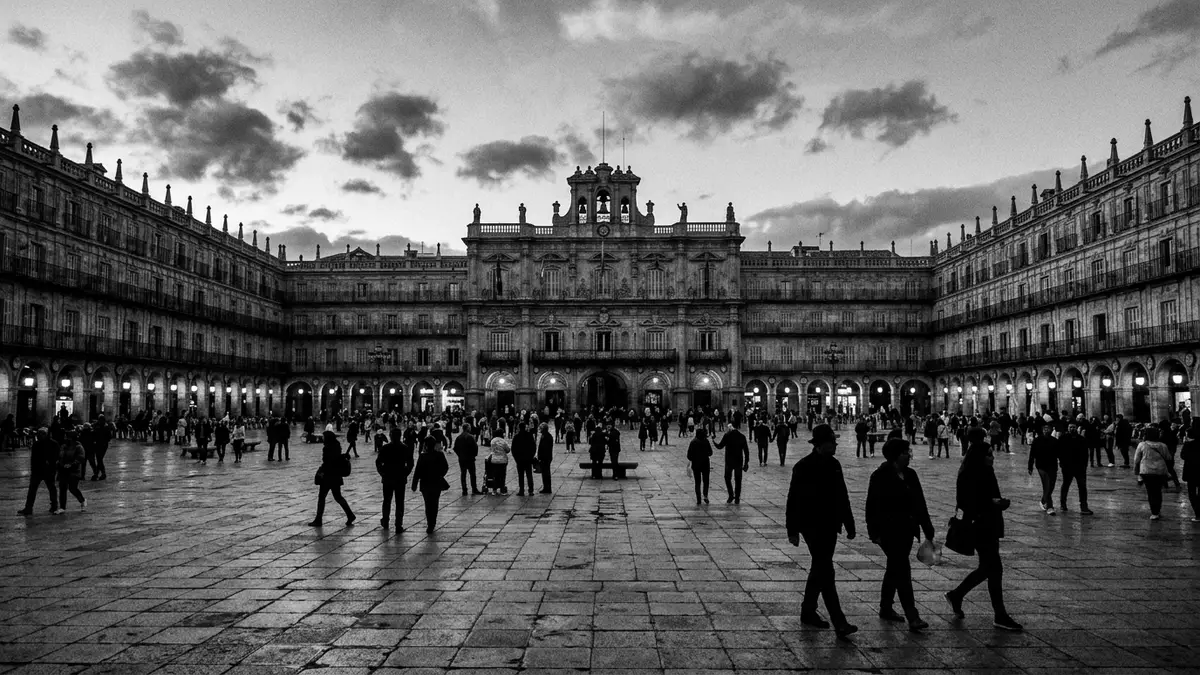
Plaza Mayor in Salamanca is a Baroque square of sandstone arcades, long associated with Alberto de Churriguera and the reign of Philip V. Its measured facades make the square read as a single architectural envelope rather than a loose collection of buildings.
Plaza Mayor’s Baroque frame in Salamanca
The square belongs to Salamanca’s Old City, a World Heritage area, and its fabric sits within a wider historic centre shaped by stone, arcades and civic buildings. The result is a public space defined by repeated arches, uniform height and a disciplined frontage that faces inward.
Construction began in 1729 and was finished in 1755, with later work carried forward by Andrés García de Quiñones. The name most closely tied to the project is Alberto de Churriguera, whose work links the square to the wider Churrigueresque current in Spanish Baroque.
How the square reads at street level
Plaza Mayor is enclosed by arcaded facades in warm sandstone, and the town hall occupies one side of the composition. The square’s repeated bays, balconies and medallions give it a formal rhythm that is easy to read from any entrance.
The space is open and level, with the arcades forming a continuous edge around the paving. That makes the square feel like an urban room rather than a traffic space, even when seen only in passing.
A civic space shaped by ceremony
The square’s history includes markets, proclamations and bullfights, and it has long acted as a civic stage for Salamanca. The same architectural order that gives it unity also makes it a natural setting for gatherings under the arcades.
The UNESCO listing for Salamanca’s historic centre places Plaza Mayor within a cityscape recognised for its Baroque quality and historic coherence. In that setting, the square stands out through proportion, stonework and the strict repetition of its facades.
Visiting Plaza Mayor: what travellers from Western Europe should know
- Plaza Mayor sits in the centre of Salamanca’s historic area, within walking reach of the surrounding old streets and civic buildings.
- The square is level and fully paved, with arcades on all sides and a continuous perimeter of facades.
- Plaza Mayor forms part of the UNESCO-listed Old City of Salamanca, which also includes the city’s wider historic fabric.
- The official language is Spanish and the currency is the euro.
Searching for Plaza Mayor on social platforms
These links open searches for Plaza Mayor on each platform.
Frequently asked questions about Plaza Mayor
Where is Plaza Mayor?
It is in Salamanca, in western Spain, within the city’s historic centre. The square sits among the streets and civic buildings of the old town.
What does a visit involve?
The place is an open square with arcades, facades and a paved interior. Visitors usually encounter it as an urban space to walk through and look across.
What makes Plaza Mayor distinctive?
Its Baroque unity is the main feature: one coherent square, repeated arches and a sandstone finish. The result is a strong civic composition rather than a single monument.


