
Plaza Mayor in Salamanca and its golden Baroque square
Published on 08/29/2026 at 20:50 | Editorial responsibility: Rafael Müller, Editor-in-Chief AD HOC NEWS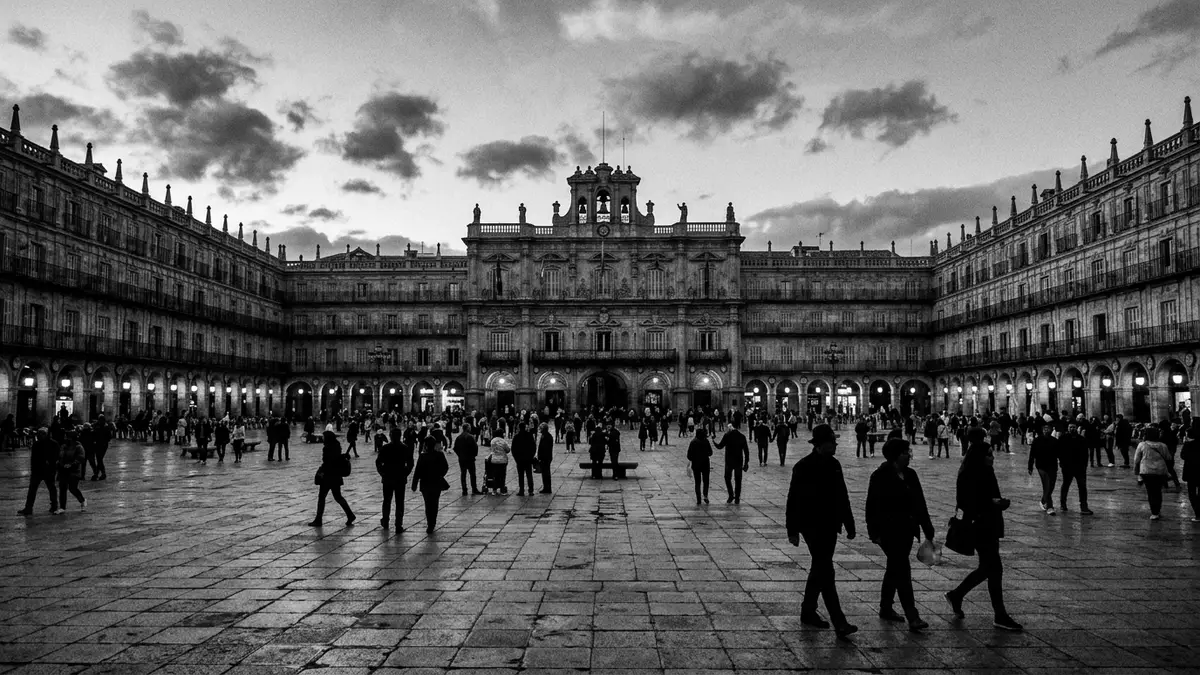
Plaza Mayor in Salamanca is a grand Baroque square in western Spain, enclosed by sandstone facades and arcades that gather the city into a single monumental space. Its present form dates from the eighteenth century, when construction began in 1729 under architect Alberto de Churriguera and was completed in the mid?1750s, giving Salamanca a new civic centre in golden stone.
Golden sandstone and a complete urban room
Seen from ground level, Plaza Mayor reads as a single urban “room”, defined by continuous three?storey facades in warm sandstone and arcaded walkways that run around all four sides of the square. The architecture belongs to the Spanish Baroque tradition and has been linked to the Churrigueresque current, visible in the rich sculptural ornament on balconies, pilasters and cornices that animate the long elevations.Spanish Baroque style The stone used for the square gives Salamanca its “golden” tone, especially evident when the light catches the carvings and mouldings of the arcades.
The space itself is broadly rectangular, with its perimeter lined by arcades carried on columns and piers, sheltering cafés, shops and entrances into interior staircases and courtyards behind the facades.arcaded square Above the arches, continuous balconies run along the upper floors, punctuated by slightly projecting pavilions that provide rhythm to the long sides. Visitors standing in the centre of the square are enclosed by this ring of architecture, with arcades framing every outward view.
Eighteenth?century construction and royal initiative
The present Plaza Mayor was created in the eighteenth century as part of a wider reorganisation of Salamanca’s main market space. Building work began in 1729 and continued for more than two decades, with different architects overseeing phases of the project while keeping close to the initial design. The first phase of construction, including key pavilions, was led by Alberto de Churriguera, a member of the Churriguera family associated with Spanish Baroque architecture, and later stages towards completion involved Andrés García de Quiñones, who is linked with the northern side and the town hall building.construction began in 1729 and finished in 1755 Absolute dates vary slightly between sources, but the core consensus places the works between 1729 and the mid?1750s.
The initiative for the square reached beyond municipal ambitions. King Philip V authorised the project in the early eighteenth century, giving formal backing from the Bourbon monarchy for a new plaza modelled on contemporary Castilian examples.authorised by King Philip V The primitive market area at this site had been known as Plaza de San Martín and was much larger than the square that exists today; the eighteenth?century works carved out a more regular Baroque space from that medieval field, bringing order and architectural coherence to what had previously been a sprawling commercial ground.
City hall, arcades and everyday life
One side of Plaza Mayor is dominated by the city hall, which rises above the arcades with a more elaborate composition of openings and sculptural details, signalling its civic importance within the ensemble.northern facade with the City Hall The building forms part of the continuous facade line yet stands out through its central position and decorative emphasis. Around the rest of the perimeter, the arcaded walks provide protected circulation and a frame for terraces, where tables and chairs occupy the shade beneath the arches.
Historically, the square has accommodated a wide range of uses, from markets and civic ceremonies to bullfights during the eighteenth and nineteenth centuries.bullfighting until the mid?19th century Over later centuries, interior elements such as gardens and a central bandstand were removed to leave the open space largely unobstructed, emphasising the clarity of the paved surface and its surrounding architecture.removal of gardens and bandstand Today, Plaza Mayor continues to function as a central meeting ground for Salamanca, with people crossing the open square, pausing under the arcades and using the space as a passage between nearby streets and districts of the historic centre.
Visiting Plaza Mayor: what travellers from Western Europe should know
- Plaza Mayor sits within the historic core of Salamanca in western Spain, a short walk south?west from the cathedral complex and near the junction of several pedestrian streets.
- The square is paved throughout, with broad level surfaces; access from surrounding streets involves passing under arcades, and the city hall side includes staircases leading up into the building.
- Salamanca is in Spain, where the official language is Spanish and the currency is the euro.
- Travellers arriving by rail will find that Salamanca railway station stands to the north?east of the old town, with streets and local transport connecting the station area to Plaza Mayor.
- Entry requirements depend on your nationality; UK travellers can check the FCDO travel advice at gov.uk/foreign-travel-advice, Irish travellers the Department of Foreign Affairs at ireland.ie.
Searching for Plaza Mayor on social platforms
These links open searches for Plaza Mayor on each platform.
Frequently asked questions about Plaza Mayor
Where is Plaza Mayor in Salamanca located?
Plaza Mayor lies in the historic centre of Salamanca in western Spain, surrounded by streets of the old city and relatively close to the cathedral complex.
What can visitors expect when they arrive at Plaza Mayor?
Visitors encounter a large paved square enclosed by Baroque sandstone facades and arcades, with terraces under the arches and the city hall occupying a prominent side.
What makes Plaza Mayor distinctive among Spanish squares?
Its eighteenth?century Baroque design, continuous arcades and golden sandstone give Plaza Mayor a coherent architectural character recognised within the World Heritage old city of Salamanca.


