
Plaza de Espana in Sevilla and its sweeping brick embrace
Published on 09/19/2026 at 07:18 | Editorial responsibility: Rafael Müller, Editor-in-Chief AD HOC NEWS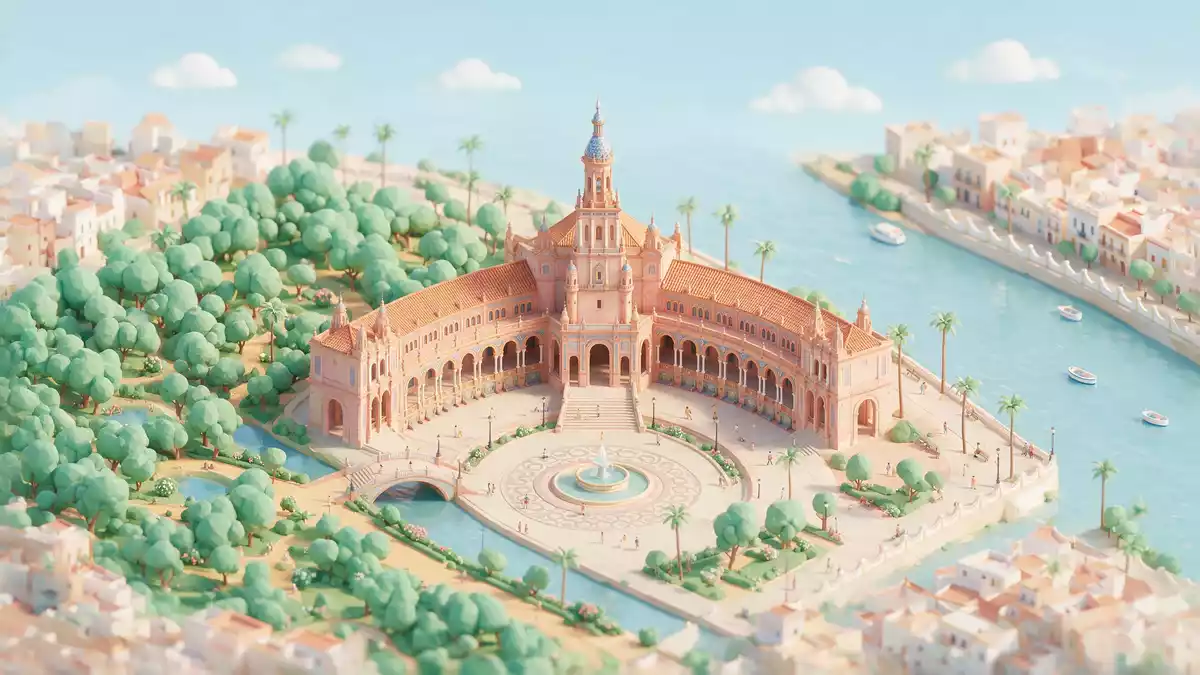
Plaza de Espana in Sevilla is a sweeping semicircular ensemble of brick, stone and ceramic that curves around a canal inside Maria Luisa Park, created in the early twentieth century for a major exposition. Its arc of buildings by architect Aníbal González turns a city park into a grand architectural set piece rooted in Spanish traditions of craftsmanship.
A vast semicircle built for the 1929 exposition
Plaza de Espana stands within Maria Luisa Park, south of Sevilla’s historic centre, on ground adapted as a principal site for the Ibero-American Exposition of 1929. The complex was designed by Seville-born architect Aníbal González, who worked on it over the 1910s and 1920s, giving the city an architectural statement that extends in a broad curve around a central space.Aníbal González combined exposed brickwork with stone and glazed ceramic, creating a palace-like front that follows the plaza’s semicircular plan and faces inwards towards a fountain and a canal.semi-circular brick building
The plaza was completed as part of the preparations for the exposition that opened in 1929, and its style is often described as a blend of Neo-Renaissance, Neo-Mudejar and Neo-Baroque, reflecting different periods of Spanish architecture within one composition.blend of styles The long façade is punctuated by towers at each end, rising above the park as vertical markers connected by galleries, arches and staircases. Within the curved space below, a paved area, a central fountain and the water of the canal form a layered foreground to the building’s brick and ceramic surfaces.
Tiled alcoves and bridges as a map of Spain
One of Plaza de Espana’s most distinctive features is the sequence of tiled alcoves along the inner side of the curve, each dedicated to a province of Spain. These alcoves are lined with azulejos, the painted ceramic tiles characteristic of Andalusia, forming benches and panels that depict maps, coats of arms or scenes associated with each province.tiled alcoves The tiled work extends to medallions and decorative bands on balustrades and staircases, bringing colour into the otherwise earthy tones of brick and stone.polychrome tile medallions
In front of the building runs a canal that traces the inner edge of the semicircle, crossed by several bridges with railings and balustrades also clad in ceramic. The water, the bridges and the arc of the façade together create a layered composition that visitors can view from different levels, including balconies and stair landings within the building. The brick palace, with its towers and colonnades, is reflected in the canal, turning the plaza into a setting where architecture, ornament and water are closely interwoven.plaza in Maria Luisa Park
Materials, styles and later uses
The buildings framing Plaza de Espana make extensive use of exposed brick, local stone and ceramic tiles, underlining the regionalist approach that became prominent in early twentieth-century Seville. The façades combine arches, columns and balustrades with coffered ceilings over galleries and staircases, while the towers at each end rise in stages with cornices and ornamental details that recall Baroque church towers in Andalusia.high towers The mixture of Neo-Renaissance forms and Neo-Mudejar references, including horseshoe arches and brick patterns, gives the complex a character that links it to both European and Moorish traditions in Spanish architecture.Regionalism architecture
After the exposition period, parts of the building were assigned to institutional uses, including offices of Spanish government bodies and a military presence, while the open plaza and park remained accessible as public space.organismos estatales The complex has also served as a filming location for international productions, including scenes in “Star Wars: Episode II – Attack of the Clones”, where its arcades and terraces appear as a backdrop.setting for films This combination of everyday public use and cinematic representation adds to the way the plaza is recognised as a symbol of Sevilla.
Visiting Plaza de Espana: what travellers from Western Europe should know
- Plaza de Espana lies inside Maria Luisa Park, south of Sevilla’s historic centre, close to Avenida de Isabel la Católica and within walking distance of the Alcázar and the Guadalquivir riverfront.
- The plaza’s central area is paved and largely level, but the surrounding building includes broad staircases, raised galleries and tower interiors reached by narrow stairways, so visiting upper levels involves climbing steps.
- The park setting means that planted areas, tree-lined paths and other landscaped spaces surround the plaza, and views of the brick towers are framed by foliage from many approaches.
- The official language is Spanish and the currency is the euro.
Searching for Plaza de Espana on social platforms
These links open searches for Plaza de Espana on each platform.Frequently asked questions about Plaza de Espana
Where is Plaza de Espana in Sevilla?
Plaza de Espana is located inside Maria Luisa Park in the southern part of Sevilla, close to Avenida de Isabel la Católica and within reach of the historic centre.
What can visitors expect when they arrive at Plaza de Espana?
Visitors encounter a large semicircular plaza framed by brick and ceramic buildings, a canal crossed by tiled bridges, a central fountain and a long row of azulejo-lined alcoves.
What makes Plaza de Espana distinctive among Sevilla’s public spaces?
Its combination of early twentieth-century regionalist architecture, province-themed tiled benches, canal and towers forms a single composition that serves as both park landmark and ceremonial square.


