
Plaza de Espana in Sevilla and its semicircular arcades
Published on 08/28/2026 at 19:23 | Editorial responsibility: Rafael Müller, Editor-in-Chief AD HOC NEWS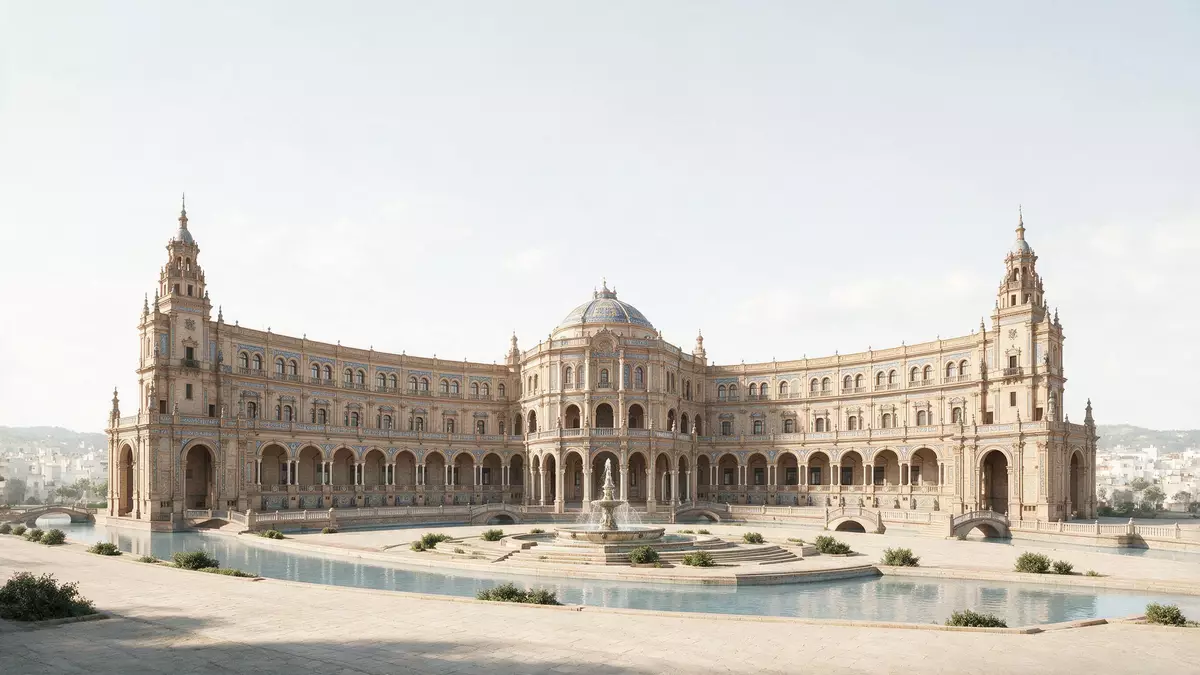
Plaza de Espana in Sevilla is a broad architectural ensemble in Maria Luisa Park, shaped by Aníbal González between 1914 and 1929 for the Ibero-American Exhibition of 1929. Its semi-elliptical plan, brickwork and ceramic detailing make the square itself the main attraction.
Aníbal González and the exhibition setting
The square belongs to the regionalist tradition in Seville, with Renaissance Revival and Neo-Mudéjar references visible in the brick, tile and wrought-iron surfaces. It stands among the signature public works associated with Aníbal González, whose name is central to the city’s early twentieth-century architecture.
The ensemble was completed in 1928 and later became one of the clearest surviving reminders of the 1929 exhibition landscape. The architectural language is deliberate and theatrical, with two flanking towers, long curved wings and a central building that gives the composition its formal balance.1929 exhibition
Ceramic benches, towers and the curve of the square
Along the outer sweep of the plaza run ceramic benches for Spain’s provinces, each with painted tile scenes and matching heraldic details. The arrangement gives the place a strong visual rhythm, with repetitive forms broken by portraits and panels.
The curved frontage faces the waterway edge of the park, and the whole composition reads as a monumental façade rather than a single enclosed court. The square’s scale is substantial, with an area of about 50,000 square metres, and the length of the wings reinforces that breadth.50,000 square metres
A place for walking the outer edge
Visitors encounter a sequence of open spaces, arcades and bridges rather than a single central hall. The semi-elliptical form creates a continuous perimeter, while the towers and galleries divide the façade into distinct sections.
The square also carries a civic memory beyond architecture, because the benches and busts turn the perimeter into a gallery of provincial and historical references. That combination of formal planning, decorative tilework and public iconography gives Plaza de Espana its enduring character.decorative tilework
Visiting Plaza de Espana: what travellers from Western Europe should know
- The plaza lies at the north-east end of Maria Luisa Park in Sevilla. Urban buses, taxis and walking routes from the park reach the ensemble without difficulty.
- The building traces a broad curve, with arcades, towers and a perimeter that invites a circuit on foot. The scale is large enough that the façade and the ceramic benches deserve time from several angles.
- The official language is Spanish and the currency is the euro.
- The open edges of the square, the tiled seating and the central water feature form the main elements visible on site. The nearby park adds trees and long promenades around the monument.
Searching for Plaza de Espana on social platforms
These links open searches for Plaza de Espana on each platform.
Frequently asked questions about Plaza de Espana
Where is Plaza de Espana?
Plaza de Espana is in Sevilla, at the north-east edge of Maria Luisa Park. It forms part of the city’s large exhibition landscape.
What does a visit involve?
The visit centres on the curved frontage, the towers, the arcades and the tiled benches around the perimeter. It is a place for walking, viewing and reading the ceramic details.
What makes Plaza de Espana distinctive?
Its semi-elliptical plan, regionalist style and extensive tile decoration give it a strong identity. The association with Aníbal González and the 1929 exhibition ties the architecture to a clear historical setting.


