
Plain of Jars: stone vessels on the Xiangkhoang Plateau
Published on 09/16/2026 at 22:05 | Editorial responsibility: Rafael Müller, Editor-in-Chief AD HOC NEWS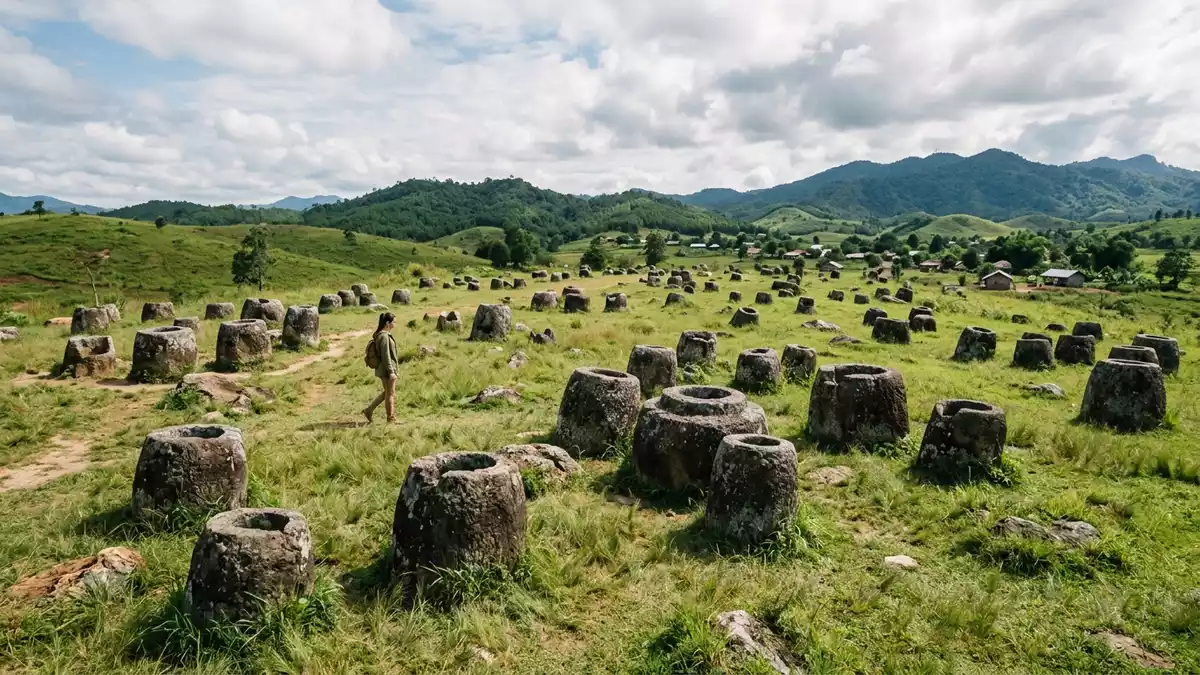
The Plain of Jars near Phonsavan in Laos is a highland landscape where clusters of massive stone vessels stand across the Xiangkhoang Plateau, forming one of Southeast Asia’s most enigmatic archaeological sites from the Iron Age.Megalithic Jar Sites in Xiengkhuang – Plain of Jars
Stone jars scattered across a Laotian plateau
The Plain of Jars lies on the Xiangkhoang Plateau in central Laos, with key jar sites reached from the town of Phonsavan in Xieng Khouang Province.Xiangkhoang Plateau, Laos The setting is open upland country, where low hills rise from grassland and fields, and jar clusters occupy slopes and gentle ridges.
The stone jars are megalithic containers cut from sandstone and other rock, with heights reaching around 3 m (10 ft) and weights that can reach many tonnes.large stone jars Across the wider landscape more than 2,100 jars and associated archaeological features have been recorded, though only selected sites near Phonsavan are prepared for visits.over 2,100 megalithic stone jars
An Iron Age funerary landscape
The jars belong to a megalithic complex linked to Iron Age mortuary practices, forming one of the clearest material traces of an otherwise little-known civilisation on the Xiangkhoang Plateau.testimony to Iron Age funerary practices Archaeological work dates the jar sites broadly between about 500 BCE and 500 CE, giving them a long chronological span that bridges prehistory and early historic periods in mainland Southeast Asia.dated from between 500 BCE and 500 CE
Many jars sit alongside stone discs, burial pits and other features that indicate a complex funerary landscape extending over the hills around Phonsavan.associated archaeological features French archaeologist Madeleine Colani carried out extensive research in the 1930s, documenting jar groups and suggesting a role in treatment of the dead, though the exact sequence of use remains a matter of study.Madeleine Colani did an extensive study
UNESCO recognition and visiting the main sites
In 2019 eleven jar sites in Xieng Khouang Province were inscribed together on the World Heritage List as the “Megalithic Jar Sites in Xiengkhuang – Plain of Jars”, recognising their outstanding universal value.2019 World Heritage inscription The inscription highlights both the density of jars and the continuity of funerary use across several centuries, as well as the need for careful management in a landscape affected by twentieth-century conflict.
For visitors based in Phonsavan, the most accessible jar groups are known simply as Site 1, Site 2 and Site 3, each occupying hills at varying distances from the town and offering distinct arrangements of jars and views over the plateau.Site 1, 2 and 3 near Phonsavan Pathways lead through jar clusters and around bomb craters, and marked routes keep visitors within cleared zones where exploration focuses on the relationship between the vessels, the ground and the surrounding landforms.cleared jar sites open to visitors
Visiting Plain of Jars: what travellers from Western Europe should know
- Plain of Jars is reached from Phonsavan, the main town of Xieng Khouang Province in north-central Laos, with access to jar sites along roads leading into the surrounding hills.
- Walking at the jar sites involves uneven ground, short climbs on earthen paths and steps on slopes, and routes pass near bomb craters in an upland environment.
- The wider landscape around Phonsavan lies at plateau altitude, so weather on site can shift quickly, and footwear suited to dirt paths and grassy slopes is useful.
- The official language is Lao and the currency is the Lao kip.
- Entry requirements depend on your nationality; UK travellers can check the FCDO travel advice at gov.uk/foreign-travel-advice, Irish travellers the Department of Foreign Affairs at ireland.ie.
Searching for Plain of Jars on social platforms
These links open searches for Plain of Jars on each platform.Frequently asked questions about Plain of Jars
Where is Plain of Jars located?
Plain of Jars is on the Xiangkhoang Plateau in Xieng Khouang Province in central Laos, with major jar sites accessible from the town of Phonsavan.
What should visitors expect at the site?
Visitors encounter groups of large carved stone jars on hills and plains, linked by marked paths through an upland landscape shaped both by archaeology and bomb craters.
What makes Plain of Jars distinctive among archaeological sites?
Its dense concentration of massive stone vessels, Iron Age funerary associations and inscription in 2019 as a World Heritage property give Plain of Jars a rare character in mainland Southeast Asia.


