
Plain of Jars, Laos’ megalithic stone landscape near Phonsavan
Published on 09/14/2026 at 09:03 | Editorial responsibility: Rafael Müller, Editor-in-Chief AD HOC NEWS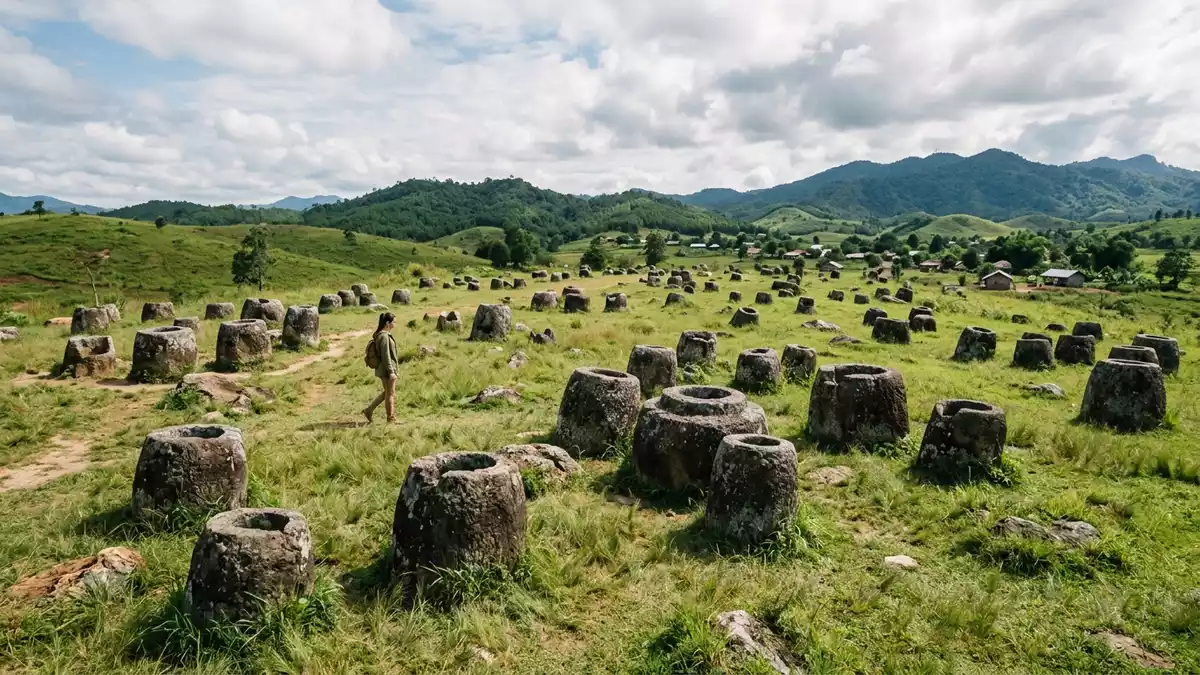
On the high plateau around Phonsavan in northern Laos, the Plain of Jars spreads large megalithic stone vessels across grassy fields and low hills, forming an open-air archaeological landscape shaped by Iron Age mortuary practices. The jars belong to a complex dated between the Iron Age centuries around 500 BCE and 500 CE, and parts of this landscape are inscribed on the UNESCO World Heritage List as the “Megalithic Jar Sites in Xiengkhuang – Plain of Jars”.
Stone jars scattered across the Xiengkhouang plateau
The Plain of Jars lies on the Xiangkhouang plateau in central-northern Laos, with the most visited jar fields in the countryside around Phonsavan.Xiangkhouang plateau location The landscape takes its name from more than 2,100 megalithic stone jars distributed across upland valleys and lower foothills, many grouped into distinct sites and others standing alone.over 2,100 stone jars
These jars are carved largely from sandstone and granite and reach heights of several metres, creating clusters that stand out against rice paddies and pasture on the surrounding plateau.sandstone and granite jars Archaeological research links them to funerary practices in the Iron Age, with associated stone discs, burial deposits and grave markers found among the jars, quarries and manufacturing sites in the wider area.Iron Age funerary complex
From Site 1 to the wider jar fields around Phonsavan
Although jar sites occur across Xiangkhouang Province, several fields close to Phonsavan are the most accessible for visitors, commonly referred to as Site 1, Site 2 and Site 3.three main visitor sites Site 1 lies to the south-west of Phonsavan and is known for its dense concentration of jars on open ground, with views across the surrounding plateau and nearby hills.Site 1 near Phonsavan
Site 2 and Site 3 sit further out among farmland and low hills, where jars are arranged on ridges and gentle slopes, sometimes edging patches of forest or small villages.sites near Phonsavan Together these jar fields display different densities and settings, from crowded assemblages to groups spread more loosely across the terrain, reflecting the scale of the mortuary landscape on the Xiengkhouang plateau.
World Heritage recognition and archaeological significance
The international significance of the Plain of Jars was recognised in 2019, when the “Megalithic Jar Sites in Xiengkhuang – Plain of Jars” were inscribed on the UNESCO World Heritage List under cultural criterion (iii).2019 UNESCO inscription The serial property encompasses 15 components, including jar fields, quarries, manufacturing areas and associated burials, which together document mortuary practices spanning a long Iron Age period on this part of the Lao highlands.15-component World Heritage property
Archaeological investigations on the Xiengkhouang plateau have found human remains, grave goods and stone discs in and around the jars, supporting interpretations of the landscape as a major funerary zone with regional importance.burials associated with jars Research has also identified numerous jar sites across the province, with more than 1,300 jars documented within the core World Heritage components and further sites likely concealed by forest and agricultural land.documented jar sites
Visiting Plain of Jars: what travellers from Western Europe should know
- The Plain of Jars lies on the Xiengkhouang plateau in north-central Laos, with main jar fields reached via the town of Phonsavan by road and domestic flights from other Lao cities.
- Paths through the jar sites cross uneven ground and low slopes, with stretches over grass and earth; visitors move between jars on foot along marked routes.
- The official language is Lao and the currency is the Lao kip.
- Entry requirements depend on your nationality; UK travellers can check the FCDO travel advice at gov.uk/foreign-travel-advice, Irish travellers the Department of Foreign Affairs at ireland.ie.
Searching for Plain of Jars on social platforms
These links open searches for Plain of Jars on each platform.Frequently asked questions about Plain of Jars
Where is the Plain of Jars located?
The Plain of Jars is on the Xiengkhouang plateau in north-central Laos, with key jar fields in the rural area around the town of Phonsavan.
What can visitors expect on a visit to the Plain of Jars?
Visitors walk among large carved stone jars set on grass and low hills, following paths across an archaeological landscape with views over the surrounding plateau.
What makes the Plain of Jars distinctive compared with other archaeological sites?
The site is distinctive for its concentration of megalithic stone jars linked to Iron Age funerary practices and for its recognition as a UNESCO World Heritage property.


