
Plage de Legzira’s red sandstone arch and Atlantic surf
Published on 09/18/2026 at 22:31 | Editorial responsibility: Rafael Müller, Editor-in-Chief AD HOC NEWS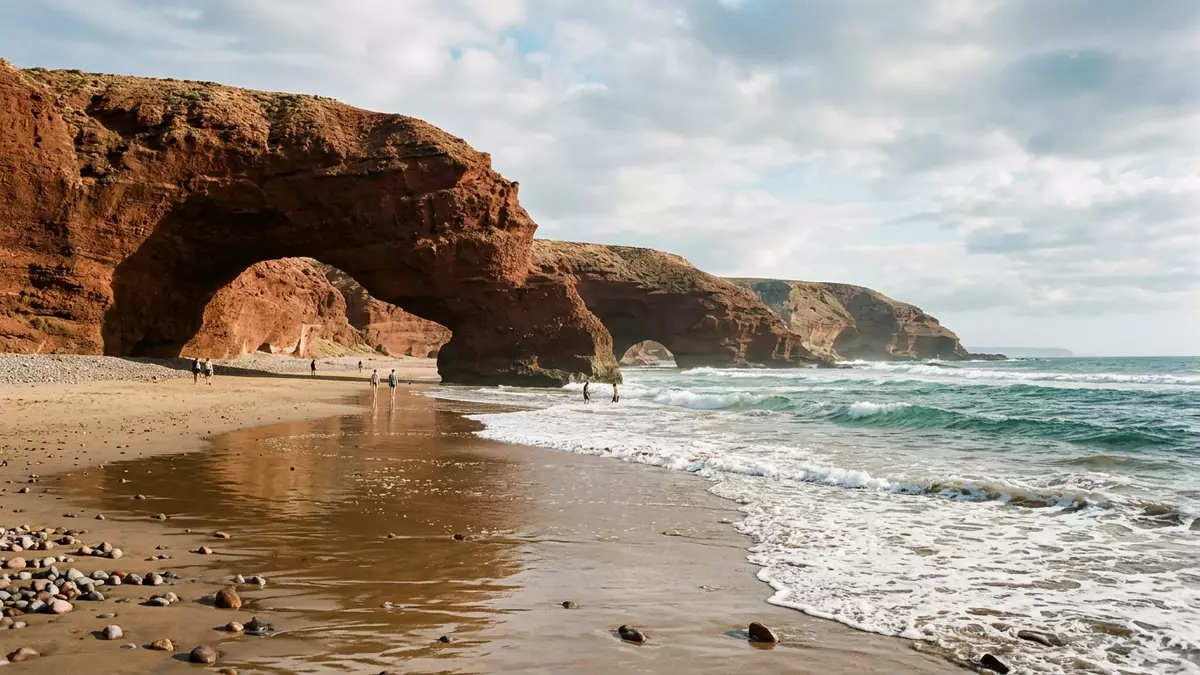
On Morocco’s south-west Atlantic coast near Sidi Ifni, Plage de Legzira is a long sweep of sand backed by red sandstone cliffs, marked by a remaining natural arch that has become the defining feature of this stretch of shoreline. Set in the Guelmim-Oued Noun region on the Souss-Anti-Atlas coast between Sidi Ifni and Mirleft, the beach occupies a section of Atlantic frontage where the ocean has carved the red rock into arches, buttresses and ledges over centuries of erosion.Plage de Legzira
Red sandstone cliffs and the remaining arch
Plage de Legzira is framed on its landward side by cliffs of deep red sandstone, a sedimentary rock that weathers into rounded forms and vertical faces as the Atlantic surf works against it.red sandstone cliffs At the boundary between sand and cliff, the sea has cut arches straight through the rock, leaving openings that align with the beach and the wave line. Until the mid-2010s Legzira was known for a pair of connected arches, but a natural collapse of one structure left a single main arch standing as the most recognisable element of the bay.pair of connected arches
The surviving arch rises from the sand like a massive bridge of rock, with its base sculpted into smooth curves by repeated tides and swells.remaining arch at Legzira At low tide, firm sand stretches out around the foot of the arch, exposing the underside of the rock and the water-cut ledges that run along its inner face.broad flat sand High on the cliff line, further buttresses and projections mark where the sea continues to eat into the sandstone, reminding visitors that this is a dynamic coastline shaped by erosion rather than a static monument.
A long ribbon of Atlantic beach
Beyond the arch itself, Plage de Legzira forms a ribbon of sand that runs beneath the cliffs, meeting the Atlantic in a line of surf that advances and retreats with the tide.broad sandy beach Travel guides describe the beach as extending for several kilometres along the base of the cliffs, giving it enough length for stretches of sand that feel distinct in character even within one bay.extends 3 km Closer to the landward edge, the sand meets the cliff foot in narrow margins dotted with boulders and smaller rock formations.
The wider landscape around Legzira follows the same Atlantic pattern: a plateau on the inland side drops towards the ocean, where bands of red and ochre sandstone meet the water in a sequence of cliffs, small coves and occasional sandy inlets.wild section of Atlantic shoreline This coast lies roughly south of Agadir and belongs to a belt of fishing towns and resort villages that includes Mirleft and Sidi Ifni, with Legzira’s beach sitting a short distance north of Sidi Ifni along the road that threads between cliffs and sea.between Mirleft and Sidi Ifni
South-west Morocco and the Guelmim-Oued Noun coast
Administratively, Plage de Legzira falls within the rural commune of Tioughza and the Guelmim-Oued Noun region, part of Morocco’s south-west Atlantic corridor where long beaches alternate with rocky headlands and small ports.commune of Tioughza The wider area is sometimes described under the Souss-Anti-Atlas coastal label, reflecting its position between the Anti-Atlas ranges inland and the Atlantic sea margin.Souss-Anti-Atlas coast Sidi Ifni, once a Spanish enclave and now a Moroccan coastal town, anchors the southern end of this stretch, while Mirleft and Tiznit lie further north along the same route.
Legzira’s arches and cliffs have drawn attention as one of the more visually distinctive coastal formations in Morocco, with the red rock contrasting against the Atlantic and the long beach offering a foreground of sand to frame the geological forms.natural red sandstone arch Travel and nature features have highlighted the way the arches demonstrate erosion at work on sandstone over long periods, with the collapse of one arch in September 2016 underscoring the ongoing changes in the shape of the cliffs.collapsed in September 2016
Visiting Plage de Legzira: what travellers from Western Europe should know
- Plage de Legzira lies a short distance north of Sidi Ifni on Morocco’s south-west Atlantic coast, reached from the town by the coastal road that runs towards Mirleft and Tiznit.road between Sidi Ifni and Mirleft
- The beach sits beneath cliffs of red sandstone, and access from the parking areas involves descending on foot to the sand and walking along the shoreline where the arch stands.leave the car at the parking
- Plage de Legzira lies in Morocco, where the official language is Arabic and the currency is the Moroccan dirham.
- Entry requirements depend on your nationality; UK travellers can check the FCDO travel advice at gov.uk/foreign-travel-advice, Irish travellers the Department of Foreign Affairs at ireland.ie.
Searching for Plage de Legzira on social platforms
These links open searches for Plage de Legzira on each platform.
Frequently asked questions about Plage de Legzira
Where is Plage de Legzira?
Plage de Legzira lies on Morocco’s Atlantic coast in the Guelmim-Oued Noun region, a short distance north of Sidi Ifni between that town and Mirleft.north of Sidi Ifni
What should visitors expect on a visit?
Visitors find a long sandy beach beneath red sandstone cliffs, with Atlantic surf breaking along the shore and a remaining natural arch formed in the cliff line.long sandy beach and arch
What makes Plage de Legzira distinctive?
The beach is distinctive for its deep red sandstone cliffs and the single surviving sea arch, a large opening cut through the rock by erosion that frames the Atlantic horizon.natural monument in deep red sandstone


