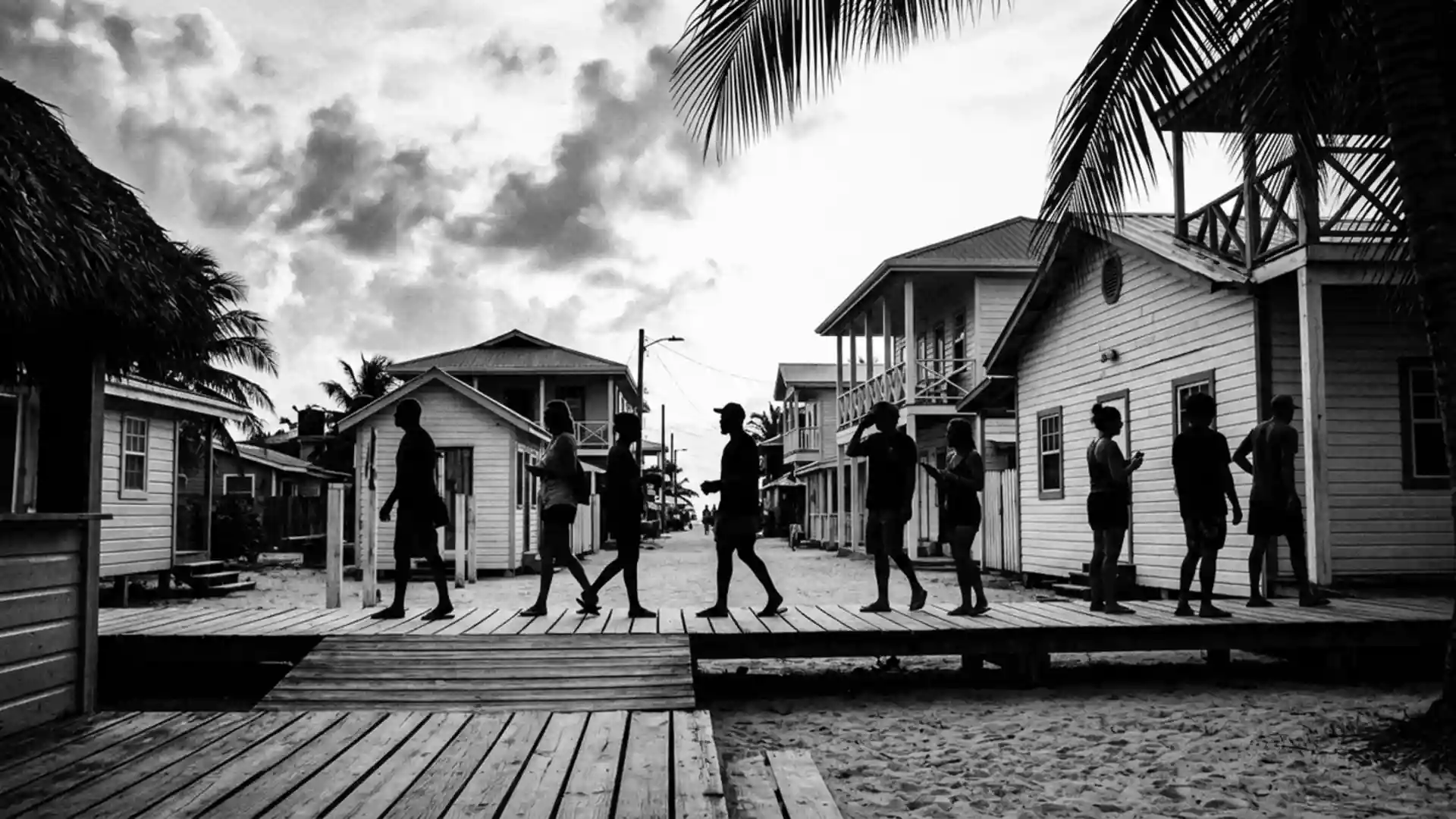
Placencia’s sand peninsula between lagoon and Caribbean
Published on 09/09/2026 at 18:51 | Editorial responsibility: Rafael Müller, Editor-in-Chief AD HOC NEWS
Placencia in southern Belize is a small coastal village at the southern tip of a long sand peninsula, facing the Caribbean Sea on one side and a sheltered lagoon on the other. Set in the Stann Creek District, it has grown from a fishing settlement into a recognised beach destination while keeping the scale and rhythm of a village community.
A village at the end of a long peninsula
Placencia Village lies at the southern end of the Placencia Peninsula, a narrow strip of sand and littoral forest that runs for around 16 miles (about 26 km) between open sea and mangrove lagoon.Placencia Peninsula The peninsula begins near Riversdale in the north and continues past small communities such as Maya Beach and Seine Bight before tapering to the point where the village sits. On one side of the peninsula the Caribbean Sea forms a long line of beach; on the other lies the Placencia Lagoon, backed by low-lying mainland and the distant Maya Mountains.
The village itself occupies the extremity of this landform, which gives Placencia a distinct feeling of being at the end of a route rather than on the way to somewhere else.seaside village on the tip Houses, guesthouses and small businesses line sandy streets near the waterfront, with jetties and piers extending into the water. The setting highlights the contrast between the calm inner lagoon and the more open Caribbean shore, both accessible within a short walk.
From Maya salt production to Creole fishing village
Long before Placencia was a named village, the surrounding lagoon and coast formed part of the wider Maya world. Archaeological studies in southern Belize indicate that coastal lagoon environments near Placencia were used for salt production, a valued commodity traded across the region.Maya salt production Later, in the colonial period from the sixteenth to the nineteenth centuries, the southern Belize coast remained relatively isolated, with sparse settlements along the shoreline.
The name “Placencia” derives from the earlier Spanish “Punta Placentia”, meaning Pleasant Point, given by Spaniards travelling the coast.Punta Placentia More permanent village life took shape in the late nineteenth and early twentieth centuries, when fishing families settled at the southern end of the peninsula and developed a Creole fishing community that relied on the sea for livelihood.Creole fishing community Over the twentieth century, as road and air links improved, Placencia began to connect more closely with the rest of Belize, bringing visitors to its beaches and reef access while fishing remained central to local identity.
Sand, sea and lagoon: the landscape of Placencia
The peninsula on which Placencia stands is one of Belize’s longer sand formations, bordered by the Caribbean Sea to the east and a mangrove-backed lagoon to the west.long sand peninsula Along the seaward side run wide beaches of pale sand, forming a waterfront that extends far beyond the village itself. On the lagoon side, the water is generally quieter, providing sheltered anchorages and views towards the low hills and Maya Mountains on the mainland.
Placencia’s coastal setting places it within reach of the Belize Barrier Reef, which lies offshore along much of the country’s Caribbean margin and is recognised as one of the larger barrier reef systems worldwide.barrière de corail du Belize From the peninsula, boats head out towards cayes, reef walls and patch reefs, while closer to shore the waters along the beach and lagoon support small-scale fishing and local transport. Within the village, sandy paths, wooden structures and the proximity of water on both sides give Placencia a clear sense of being defined by its coastal geography.
Visiting Placencia: what travellers from Western Europe should know
- Placencia is located in southern Belize on the Stann Creek District’s peninsula, reached overland along the peninsula road or by domestic flights to Placencia Airport (PLJ) from Belize City.
From the village, boats operate on both the Caribbean Sea side and the Placencia Lagoon. - The terrain consists largely of level sand and low-lying ground, with beach areas and simple streets; walking involves firm sandy paths rather than steep climbs, though sections of the beach can be soft underfoot.
- Placencia lies in Belize, where the official language is English and the currency is the Belizean dollar.
- Entry requirements depend on your nationality; UK travellers can check the FCDO travel advice at gov.uk/foreign-travel-advice, Irish travellers the Department of Foreign Affairs at ireland.ie.
Searching for Placencia on social platforms
These links open searches for Placencia on each platform.
Frequently asked questions about Placencia
Where is Placencia and what kind of place is it?
Placencia is a small coastal village in the Stann Creek District of southern Belize, set at the southern tip of the Placencia Peninsula between the Caribbean Sea and the Placencia Lagoon.
What should visitors expect when they arrive in Placencia?
Visitors encounter a low-lying sand peninsula with long beaches, a village of modest scale, and easy access to both lagoon and open sea, with local services closely tied to the waterfront.
What makes Placencia distinctive among Belize’s coastal settlements?
Placencia’s position at the end of a narrow peninsula, its combination of village streets and extensive beach, and its historical roots in fishing and coastal trade give it a character strongly shaped by sand, sea and lagoon.