
Piopiotahi: a fiord of cliffs, forest and deep water
Published on 09/23/2026 at 23:24 | Editorial responsibility: Rafael Müller, Editor-in-Chief AD HOC NEWS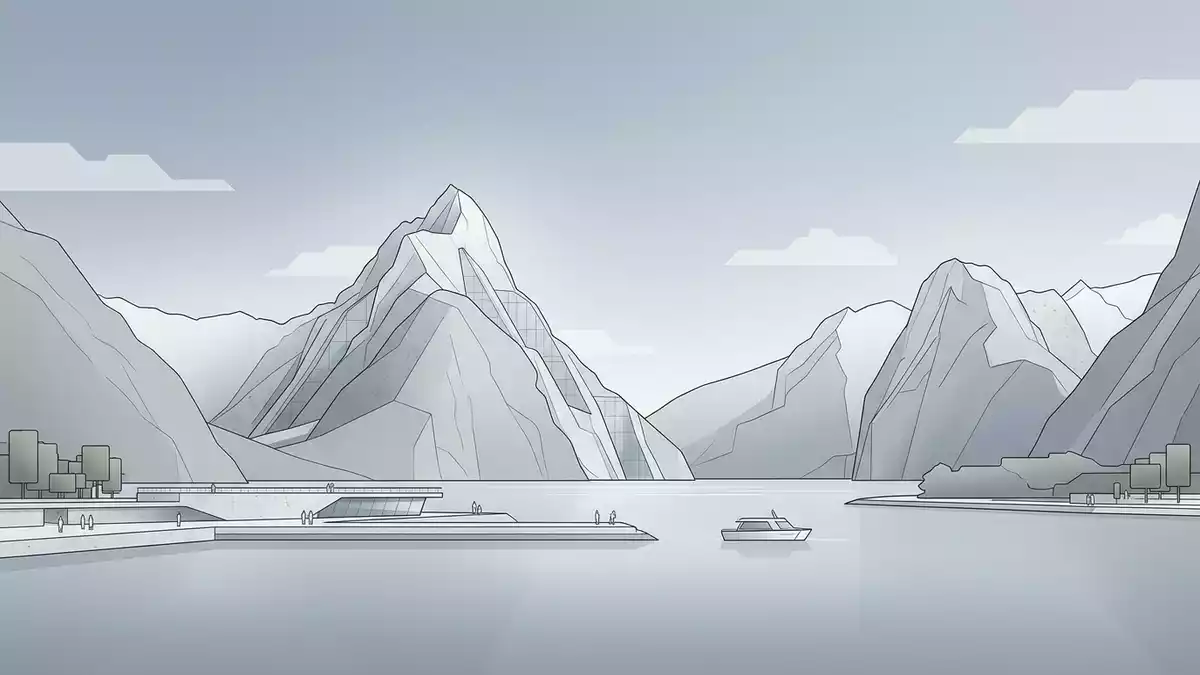
Piopiotahi is a glacier-carved fiord in Fiordland on New Zealand’s South Island. Sheer rock walls rise from dark water, while rainforest covers ledges and valleys above the shore. The name connects the landscape with the piopio, a native thrush now thought to be extinct.
Piopiotahi and the shape of a glacial fiord
Piopiotahi lies in the north-west of Fiordland National Park, where valleys cut by glacial ice meet the Tasman Sea. The waterway extends for 16 km, from its inland head towards the open coast, and the surrounding mountains continue below the surface.
Mitre Peak is the dominant named summit beside the fiord. Its rock walls rise 1,692 m directly from the water, creating a close relationship between alpine height and sea-level landscape. The mountain belongs to the Darran range, whose peaks form part of Fiordland’s rugged relief. The Fiordland National Park landscape includes valleys, peaks, rainforest and deeply cut coastal inlets.
Piopiotahi above and below the water
Piopiotahi is also a marine landscape. The Piopiotahi Marine Reserve occupies 690 hectares along the northern side of the fiord, stretching from the settlement at its head towards Dale Point and the Tasman Sea. It was established in 1993.
Below the surface, deep muddy basin, reef and rock-wall habitats support sponges, soft corals, anemones, sea pens and black coral. Stingrays, crayfish, octopus, seals and reef fish occur in the reserve. The Piopiotahi Marine Reserve gives the place a second scale, extending the landscape from forested summits into underwater habitats.
Piopiotahi in M?ori and European history
Piopiotahi means “one native thrush”, referring to the piopio. The name preserves a M?ori connection with the fiord and its surrounding country. M?ori routes linked the Fiordland coast with the interior, and greenstone travelled along coastal and inland pathways.
The English name Milford Sound came from John Grono, a Welsh sealing captain, who named the inlet after Milford Haven. Donald Sutherland became the first European resident and lived beside the fiord from 1878. The Milford Track created a land route between Te Anau and Piopiotahi, while the Homer Tunnel eventually connected the area with the road network. The fiord lies within Te Waipounamu World Heritage Area, a protected landscape encompassing major mountains, forests, glaciers and fiords.
Visiting Piopiotahi: what travellers from Western Europe should know
- Piopiotahi is in north-west Fiordland National Park. Milford Road, also called State Highway 94, runs from Te Anau to the settlement at the head of the fiord.
- The route crosses the Homer Tunnel and reaches steep mountain country. Rock walls, deep water and alpine terrain define the approach and the shoreline.
- Mitre Peak can be viewed from the Milford Sound foreshore. The Milford Track and nearby walking routes connect the fiord with Fiordland’s interior.
- The official language is English and M?ori, and the currency is the New Zealand dollar.
- Entry requirements depend on your nationality; UK travellers can check the FCDO travel advice at gov.uk/foreign-travel-advice, Irish travellers the Department of Foreign Affairs at ireland.ie.
Searching for Piopiotahi on social platforms
These links open searches for Piopiotahi on each platform.
Frequently asked questions about Piopiotahi
Where is Piopiotahi?
Piopiotahi is in Fiordland National Park on New Zealand’s South Island. The fiord lies at the north-western edge of the park and opens towards the Tasman Sea.
What can travellers expect to see?
Visitors encounter steep rock walls, forested valleys, alpine peaks and dark marine water. The foreshore, road approaches, walking routes and boat excursions present different views of the same glacial landscape.
What makes Piopiotahi distinctive?
Its visible landscape continues below the water, where a marine reserve protects deep basin, reef and rock-wall habitats. The M?ori name also links the fiord with the piopio, a native thrush.


