
Pingyao Gucheng and the Ming-era walls of Pingyao
Published on 08/27/2026 at 09:58 | Editorial responsibility: Rafael Müller, Editor-in-Chief AD HOC NEWS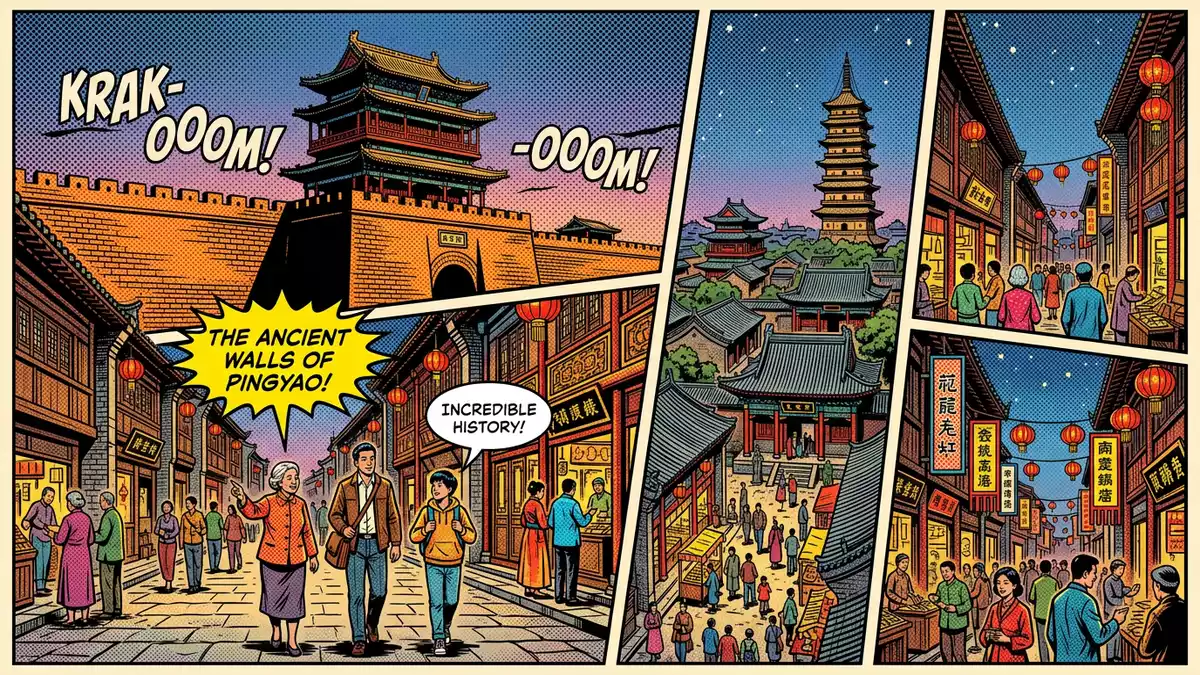
Pingyao Gucheng is the historic walled core of Pingyao in Shanxi Province, a compact town where Ming- and Qing-era streets still run inside a continuous ring of city walls from the fourteenth century.
The ancient city within its walls
Pingyao Gucheng refers to the old urban area enclosed by the defensive walls of Pingyao, a county-level city in central Shanxi in northern China. The historic core preserves the street grid, courtyard houses, temples and official buildings of a traditional Han Chinese town whose urban form dates back to the Ming and Qing periods.Ancient City of Ping Yao The enclosed settlement covers a modest area that can be crossed on foot, but within that compact rectangle the texture of an older China remains visible in brick facades, timber shopfronts and tiled roofs.
The Ancient City of Ping Yao was inscribed as a cultural World Heritage Site by UNESCO in 1997, recognised for its well-preserved Ming dynasty urban layout and its role in Chinese economic history.UNESCO World Heritage Site designation in 1997 The protected property includes not only the streets within the walls but also Zhenguo Temple to the northeast and Shuanglin Temple to the southwest, extending the heritage landscape beyond the old town itself.Zhenguo Temple and Shuanglin Temple
Ming dynasty walls: scale, form and fabric
The walls of Pingyao Gucheng form a near-rectangular circuit around the old town, a fortification first constructed in 1370 during the reign of the Hongwu Emperor at the start of the Ming dynasty.construction in 1370 They rise to around 10–12 m (33–39 ft) and run for more than 6 km (about 3.7 mi), enclosing an area of over 2 km² (around 0.8 sq mi).rectangular city wall stretching 6.4 km The structure combines a core of rammed earth with an outer facing of brick and stone, a technique visible where the masonry has weathered enough to reveal the compacted soil within.rammed earth faced with brick
Along the wall, a series of watchtowers and crenellations mark former defensive positions. The circuit incorporates six city gates: one facing north, one south, and pairs to east and west, each with its own tower and courtyard space inside the line of defence.six city gates and watchtowers From the wall-walk, the view takes in the dense grid of lanes, the tiled roofs of courtyard compounds and the outline of temple halls, while beyond the fortifications the more recent parts of Pingyao spread into the surrounding plain.
Courtyard houses, temples and historic banks
Inside Pingyao Gucheng, the main streets run roughly north–south and east–west, lined with traditional courtyard houses that open from the lane into inner yards hidden behind gatehouses. Many of these dwellings retain timber lintels, carved stone thresholds and grey-brick walls, reflecting the building traditions of Shanxi during the Ming and Qing dynasties.Ming-dynasty street grid and courtyard houses Between the residential compounds stand temples and former government offices, their courtyards and halls occupying larger plots along the principal axes of the town.
Pingyao’s role in financial history is visible in buildings such as the Rishengchang Draft Bank, often described as the first modern bank in China, whose compound lies within the walled town.Rishengchang Draft Bank compound The mix of domestic courtyards, religious complexes and commercial houses gives Pingyao Gucheng the character of a lived-in urban museum, where heritage sites and everyday life share the same lanes and doorways.
Visiting Pingyao Gucheng: what travellers from Western Europe should know
- Pingyao Gucheng lies within Pingyao County in Shanxi Province in northern China, roughly south of Taiyuan; mainline and high-speed rail routes serve stations close to the old town.
- Within the walls, the ground is largely flat but paved with stone slabs, and many viewpoints on the city wall are reached via staircases with a significant number of steps.
- The surrounding region of Shanxi has a continental climate, and in the cold season conditions within the exposed wall-walks and streets can be harsh for extended periods outdoors.
- The official language is Chinese and the currency is the renminbi (yuan).
- Entry requirements depend on your nationality; UK travellers can check the FCDO travel advice at gov.uk/foreign-travel-advice, Irish travellers the Department of Foreign Affairs at ireland.ie.
Searching for Pingyao Gucheng on social platforms
These links open searches for Pingyao Gucheng on each platform.
Frequently asked questions about Pingyao Gucheng
Where is Pingyao Gucheng located?
Pingyao Gucheng is the historic walled town within Pingyao County in Shanxi Province in northern China, enclosed by Ming dynasty walls.
What should visitors expect inside the old town?
Visitors encounter stone-paved lanes, traditional courtyard houses, temples, former government buildings and historic bank compounds set within a compact Ming- and Qing-era street grid.
What makes Pingyao Gucheng distinctive among historic towns?
Pingyao Gucheng combines a complete fourteenth-century city wall circuit, an intact traditional street layout and living residential quarters, all recognised together as a UNESCO World Heritage Site.


