
Pingyao Gucheng and the intact Ming–Qing city wall
Published on 09/14/2026 at 10:35 | Editorial responsibility: Rafael Müller, Editor-in-Chief AD HOC NEWS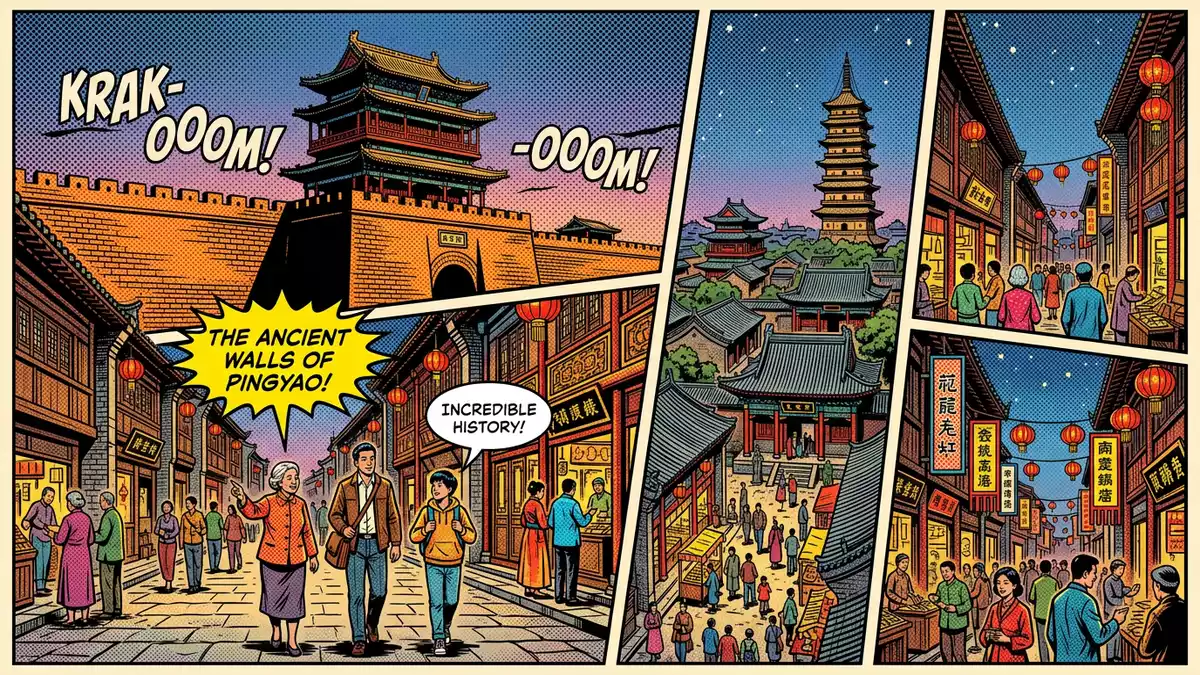
Pingyao Gucheng is the walled old city of Pingyao in Shanxi Province, and its most striking feature is the complete city wall that still encloses the historic core. The place was inscribed on the UNESCO World Heritage List in 1997, and its streets preserve a Ming and Qing urban pattern.
Pingyao Gucheng and its complete fortifications
The city wall dates from 1370, in the early Ming dynasty, and it gives the old town a sharply defined edge. Inside that edge, the grid of streets, lanes and compounds remains legible as a traditional Han Chinese county city.UNESCO listing
The wall is a major part of the place’s identity because it still reads as a full circuit rather than a fragment. Its ramparts, towers and gates frame the roofs and courtyards below, keeping the town’s historic outline easy to trace from within and above.city wall
Streets, courtyards and the banking town
Pingyao Gucheng is not only a defensive shell. Within the walls are courtyard houses, temples, shops and former banking premises, many of them linked to the town’s role in finance during the nineteenth century and the early twentieth century.traditional Han Chinese city
The built fabric is varied but coherent, with timber fronts, brick walls and tiled roofs repeating through the old town. That mixture gives Pingyao Gucheng its particular texture: a living county town whose historic streets remain readable as a single urban whole.historic walled core
Pingyao Gucheng as a World Heritage town
The UNESCO inscription highlights the town as an exceptionally well-preserved example of a Han Chinese city founded in the 14th century. That date matters because it places the surviving fabric within a long imperial urban tradition rather than a later reconstruction.well-preserved example
Pingyao Gucheng also stands out for the way its built environment spans several centuries without losing its overall form. The wall, street grid and domestic compounds work together as a single historic landscape, and the continuity is visible in the masonry, timber and rooflines.single continuous urban ensemble
Visiting Pingyao Gucheng: what travellers from Western Europe should know
- Pingyao Gucheng lies in Pingyao County in Shanxi Province, north of the city of Taiyuan. Rail and road links connect the modern town to the ancient core.
- The old city is enclosed by a high wall, and parts of the fortifications require climbing staircases and walking on elevated ramparts.
- Within the walls, the streets are narrow and the surface is often stone-paved.
- Shuanglin Temple lies to the south-west of Pingyao Gucheng, and Zhenguo Temple lies to the north-east.
- The official language is Chinese and the currency is the renminbi (yuan).
Searching for Pingyao Gucheng on social platforms
These links open searches for Pingyao Gucheng on each platform.
Frequently asked questions about Pingyao Gucheng
Where is Pingyao Gucheng?
Pingyao Gucheng is the historic walled core of Pingyao in Shanxi Province, northern China. It sits inside a complete fortification line that defines the old town’s shape.
What does a visit involve?
It means moving through narrow streets, courtyard compounds and temple precincts, then climbing onto the ramparts for views over the roofscape. The old city reads as a compact historic town rather than a single monument.
What makes Pingyao Gucheng distinctive?
Its distinction lies in the combination of an intact Ming dynasty wall, a recognisable street grid and a dense stock of preserved domestic and commercial buildings. The result is a coherent historic townscape rather than a set of isolated sights.


