
Pingyao Gucheng and its Ming–Qing walled cityscape
Published on 09/16/2026 at 19:06 | Editorial responsibility: Rafael Müller, Editor-in-Chief AD HOC NEWS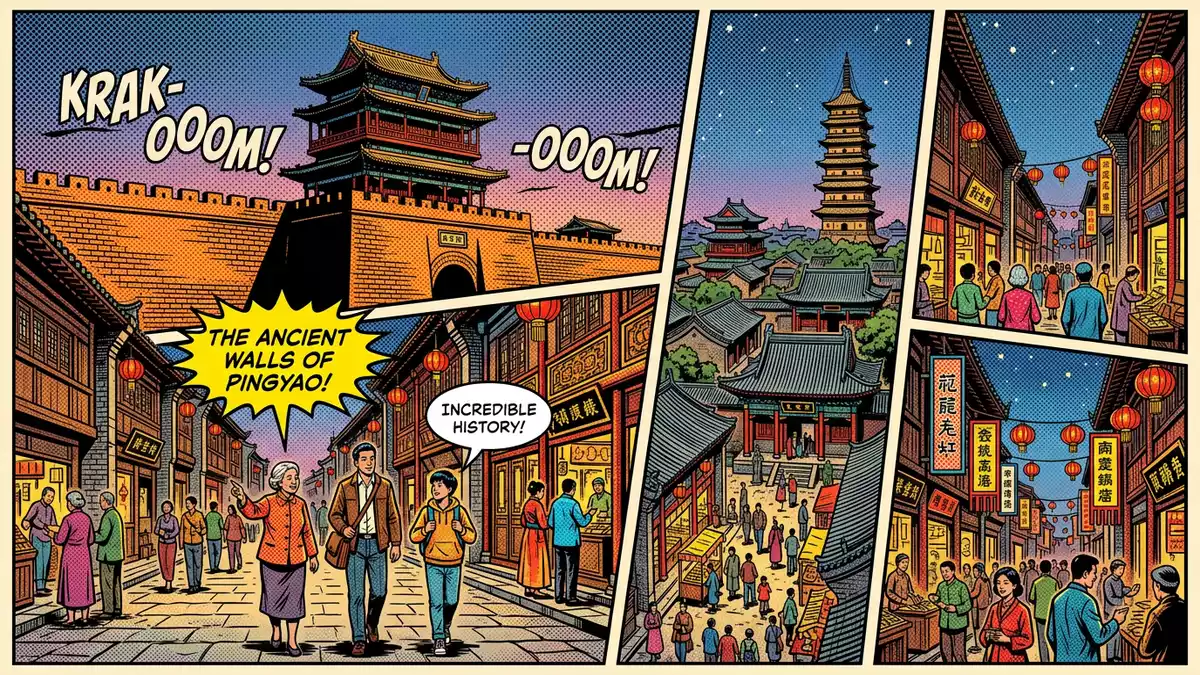
Pingyao Gucheng is the ancient walled core of Pingyao in Shanxi Province, a Han Chinese county town whose urban fabric still reflects the Ming and Qing dynasties in its streets, courtyards and fortifications.Ancient City of Ping Yao The old city was inscribed on the UNESCO World Heritage List in 1997 as an exceptionally well-preserved example of a traditional Han Chinese urban settlement framed by complete defensive walls.inscribed on the World Heritage List in 1997
A rectangular wall enclosing a living county town
Pingyao Gucheng is enclosed by a rectilinear city wall whose line still encircles the settlement as a complete rectangle of fortifications, a defining feature of the place.ancient brick city wall The wall in its present form was rebuilt with brick over a rammed-earth core in 1370 during the early Ming dynasty, creating a continuous defensive ring around the county town.well-preserved ancient county-level city
Running for more than 6 km (about 3.7 mi) in circumference, the wall rises to around 12 m (39 ft) in height and carries a broad walkway above the town, punctuated by watchtowers and battlements.fortifications run for more than 6 km Gates aligned broadly to the cardinal directions lead through to the interior streets, and from the ramparts the outline of the town can be read in the pattern of tiled roofs, courtyard trees and straight lanes stretching away from each gate.urban plan and city walls
Ming and Qing streets, courtyards and trading houses
Within the walls of Pingyao Gucheng lies an urban grid whose lanes and plots largely follow a plan established under the Ming (1368–1644) and Qing (1644–1911) dynasties, preserving the layout of a traditional Han Chinese county town.well-preserved Ming and Qing urban planning Courtyard houses, official residences and temples constructed in timber and brick stand close together along the streets, forming continuous frontages broken only by gateways leading back to inner yards.more than 300 cultural relics and nearly 4,000 traditional buildings
Pingyao Gucheng developed as a market town and administrative centre and became an important focus of Chinese banking during the nineteenth century, a role reflected in the imposing former finance houses that still stand along its commercial streets.buildings associated with banking The historic premises of the Rishengchang Exchange Shop and other draft banks occupy multi-storey compounds whose halls and courtyards form sequences running back from the street, with meeting rooms, strongrooms and domestic quarters retaining period fittings and signs.Rishengchang Exchange Shop
Pingyao Gucheng as a World Heritage ensemble
The Ancient City of Ping Yao inscription on the UNESCO World Heritage List covers the entire area within Pingyao Gucheng’s walls as well as Shuanglin Temple and Zhenguo Temple in the surrounding county, recognising a coherent ensemble of fortifications, streets and buildings.property includes three parts The city is described as a medium-sized settlement founded in the fourteenth century, whose fabric shows the evolution of architectural styles and town planning in imperial China over several centuries.exceptionally well-preserved example
Within Pingyao Gucheng, religious sites such as the Temple of the City God, the Temple of Literature and various ancestral halls sit alongside the yamun, or county government office, and dense rows of courtyard dwellings, giving the townscape a mixture of civic, mercantile and domestic architecture.yamun, downtown streets, dwellings and temples The orthogonal grid of lanes, the continuous roofscape and the complete circuit of fortifications together form a rare surviving picture of a traditional county-level town in northern China.ancient walls guard China's Ming city
Visiting Pingyao Gucheng: what travellers from Western Europe should know
- Pingyao Gucheng lies in Pingyao County in central Shanxi Province in northern China, reached by rail services to Pingyao and by road connections from Taiyuan and other regional centres.
- Within the enclosure, streets are laid out in a grid and many routes involve walking on stone paving, with stairways leading up to the city wall and down again at each gate tower.
- The ancient city stands on a plain at an elevation typical of the Shanxi plateau, with the wall adding an additional climb for viewpoints over the tiled roofs and courtyards.
- The official language is Chinese and the currency is the renminbi.
- Entry requirements depend on your nationality; UK travellers can check the FCDO travel advice at gov.uk/foreign-travel-advice, Irish travellers the Department of Foreign Affairs at ireland.ie.
Searching for Pingyao Gucheng on social platforms
These links open searches for Pingyao Gucheng on each platform.
Frequently asked questions about Pingyao Gucheng
Where is Pingyao Gucheng located?
Pingyao Gucheng forms the ancient walled city of Pingyao in central Shanxi Province in northern China, enclosed by Ming dynasty fortifications that define the historic core.
What can visitors expect on a visit to Pingyao Gucheng?
Visitors encounter a dense grid of stone-paved streets lined with courtyard houses, temples, former banking halls and an intact city wall whose walkway gives broad views over the tiled roofs.
What makes Pingyao Gucheng distinctive among historic towns?
Pingyao Gucheng is distinctive for the way a complete rectilinear wall, a largely unchanged Ming–Qing street plan and thousands of traditional buildings together survive as a single continuous urban ensemble.


