
Pike Place Market, Seattle’s layered waterfront marketplace
Published on 09/17/2026 at 20:41 | Editorial responsibility: Rafael Müller, Editor-in-Chief AD HOC NEWS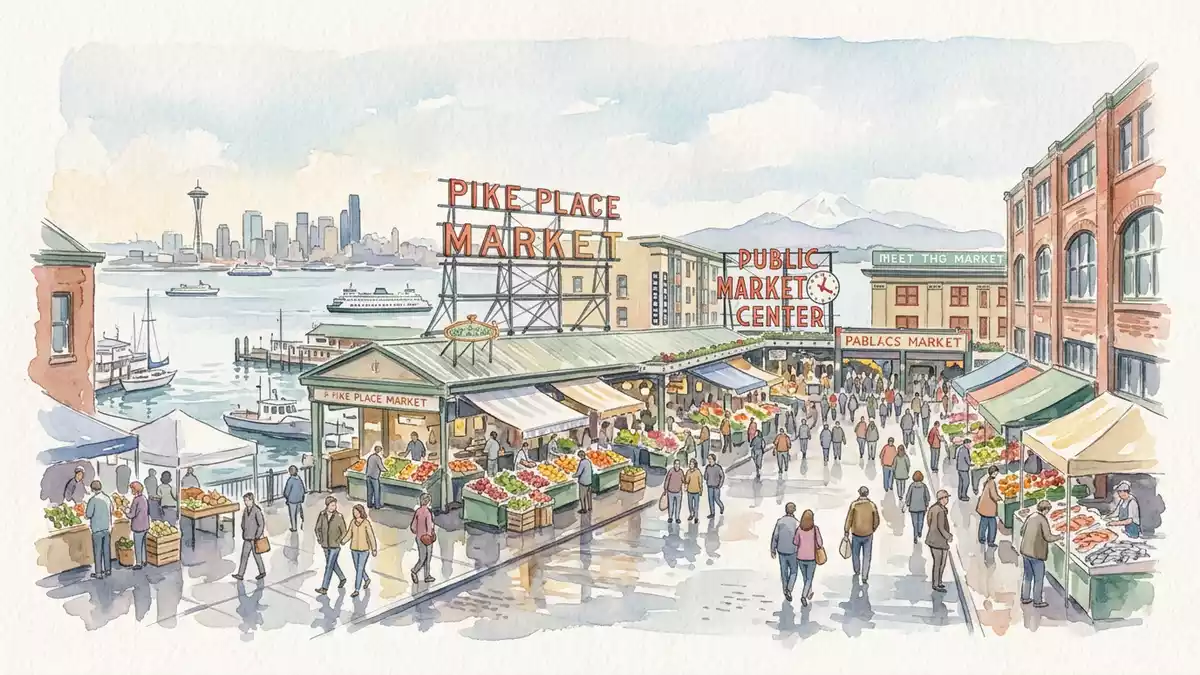
Pike Place Market rises above the Seattle waterfront as a multi-level public marketplace where steep streets, arcades and laneways stack food, crafts and daily life into a compact urban hillside. Established in 1907 as a farmers’ market backed by the Seattle City Council, it has grown into a historic district that still feels like a small city woven into the slope between downtown and Elliott Bay.
From farmers’ experiment to historic district on the bay
The story of Pike Place Market begins in the early twentieth century, when local farmers and city residents complained about high food prices and the role of commission houses along Western Avenue. In response, Council member Thomas P. Revelle led an ordinance in August 1907 designating part of Pike Place as a public market so growers could sell produce directly to shoppers, cutting out the middlemen.establish a farmers market at Pike Place On the first official Market Day on 17 August 1907, a handful of farmers arrived with wagons and carts and sold out rapidly to crowds on the newly planked street.the market officially opened on August 17, 1907
Construction quickly followed. Later in 1907, the first permanent building, known as the Main Arcade, was completed along the edge of the street, giving farmers covered stalls and marking the shift from an open row of wagons to a built marketplace.the Main Arcade opened November 30, 1907 Through the 1910s and 1920s, additional buildings such as the Economy Market and Corner Market filled the blocks, creating the network of levels, ramps and internal corridors that visitors walk through now.by 1917 much of the Market we know today was constructed
Architecture on a slope: arcades, ramps and the Public Market sign
Pike Place Market is built into the hillside above Elliott Bay, and its architecture follows the terrain. The main street level runs along Pike Place itself, with a long arcade lined by produce and flower stalls on one side and brick and concrete buildings on the other. Below and above this line, floors step down towards the water and up towards First Avenue, linked by ramps, staircases and internal corridors that turn a simple shopping trip into a vertical walk.
The buildings date largely from the early decades of the twentieth century and carry the robust forms of that era: brick façades, steel-framed windows and simple concrete interiors adapted to stalls, shops and workshops. In 1927 a large neon sign reading “Public Market” and a clock were installed above the main arcade, giving the market one of its most recognisable features and marking its presence along the western edge of downtown.the neon “Public Market” sign and clock are installed The combination of stepped levels, narrow interior alleys and the street-facing arcade means that Pike Place Market feels both open to the city and enclosed in its own world.
Layers of community: food, crafts and preservation
From its beginnings, Pike Place Market has been a working place for farmers selling directly to residents. Over the decades it expanded beyond fresh produce to include fishmongers, bakeries, speciality food shops, cafés, craft stalls and small studios, all fitted into the matrix of arcades and lower levels. Permanent shops occupy the brick buildings, while temporary and semi-permanent stalls line corridors and open areas, creating a layered mix of long-established businesses and market tables.
The market’s social history is closely tied to Seattle’s immigrant communities and wartime upheavals. Before 1942, farmers of Japanese descent held a large share of the produce stalls, until Executive Order 9066 led to their forced removal and incarceration during the Second World War, leaving a visible gap in the market’s farming community.Japanese American farmers filled a majority of the stalls Later, in the 1960s, large-scale redevelopment plans threatened to replace the ageing buildings with offices and parking structures, but activists including architect Victor Steinbrueck and the group Friends of the Market campaigned for preservation. In 1971 voters approved the creation of the Pike Place Market Historical District, a protected area of several acres that safeguards both the built fabric and the market’s role as a public place.Seattle voted in 1971 to establish a seven-acre Pike Place Market Historical District
Visiting Pike Place Market: what travellers from Western Europe should know
- Pike Place Market stands between First Avenue and the Elliott Bay waterfront in central Seattle, on the western side of downtown, within walking distance of major city hotels.
- The site occupies a steep slope, with multiple levels connected by ramps and staircases; exploring the market involves frequent changes of level and some narrow internal passages.
- Seattle’s official language is English and the currency is the US dollar.
- Entry requirements depend on your nationality; UK travellers can check the FCDO travel advice at gov.uk/foreign-travel-advice, Irish travellers the Department of Foreign Affairs at ireland.ie.
Searching for Pike Place Market on social platforms
These links open searches for Pike Place Market on each platform.
Frequently asked questions about Pike Place Market
Where is Pike Place Market located in Seattle?
Pike Place Market occupies a set of streets and buildings above the Elliott Bay waterfront, between First Avenue and the water on the western side of downtown Seattle.
What can visitors expect on a visit to Pike Place Market?
Visitors encounter produce stalls, fishmongers, speciality food shops, craft tables and small studios spread across arcades, lower levels and lanes that follow the hillside.
What makes Pike Place Market distinctive among city markets?
Its combination of early twentieth-century brick and concrete buildings, neon “Public Market” sign, multi-level layout and protected historic district status give it a layered character tied closely to Seattle’s waterfront slope.


