
Pike Place Market’s layered terraces above Elliott Bay
Published on 08/31/2026 at 14:02 | Editorial responsibility: Rafael Müller, Editor-in-Chief AD HOC NEWS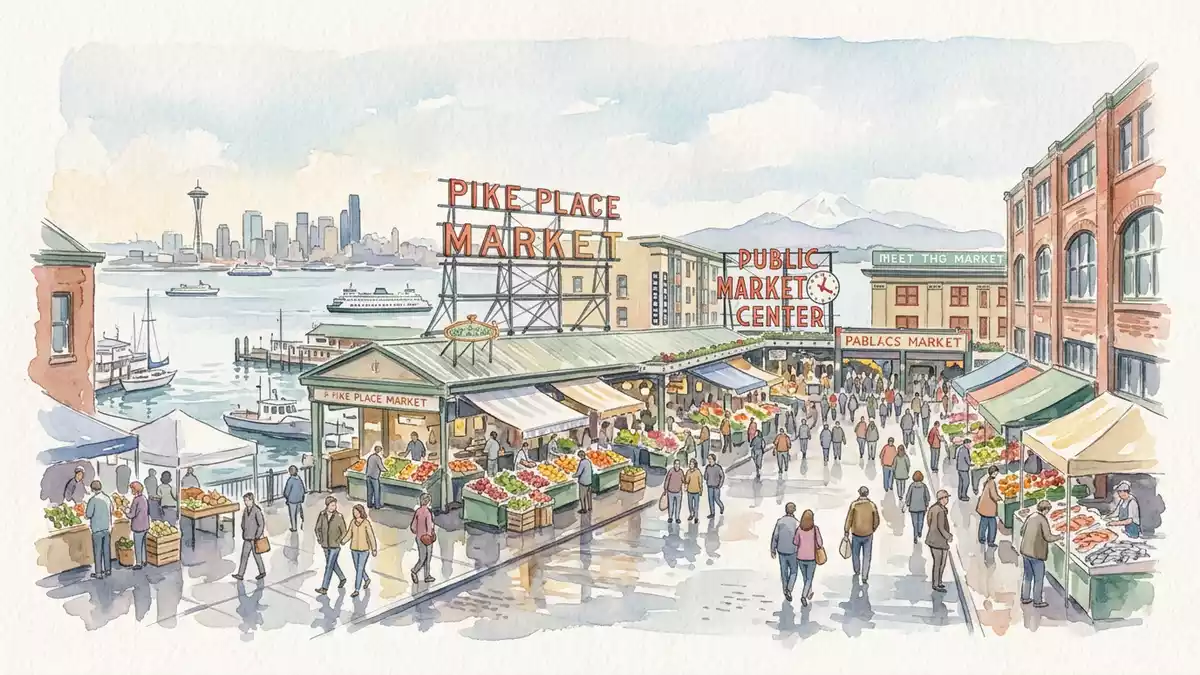
Between First Avenue and the edge of Elliott Bay, Pike Place Market stacks terraces, ramps and arcades into a compact neighbourhood of stalls and small shops overlooking the water. Established as a public market in 1907, it has grown from a handful of farm wagons into a dense urban fabric of produce vendors, specialty food counters, craftspeople and residents arranged on several levels along the bluff above the bay.created in 1907
From farm wagons to a public market district
Pike Place Market began in August 1907 as an open stretch of planked street set aside by the Seattle City Council so farmers could sell produce directly from wagons and carts.farmers market on the west side of Pike Place Council member Thomas P. Revelle sponsored the ordinance, and the first “Market Day” on 17 August 1907 drew crowds large enough that the initial group of farmers sold out their produce early.Market Day on 17 August 1907
Within the same year, real-estate developer Frank Goodwin added the Main Arcade, taking part of the market indoors and giving the farmers a continuous line of covered stalls along Pike Place.Main Arcade opened in November 1907 Through the 1910s and early 1920s, further structures such as the Economy Market, Corner Market and Sanitary Market filled in the blocks facing the waterfront, and by 1922 the core group of buildings that define the present-day market had taken shape as a low-rise district of concrete and brick fronting the bay.much of the Market was constructed by 1917
Terraces, arcades and the descent towards Elliott Bay
One of the striking features of Pike Place Market is how its buildings step down the slope towards Elliott Bay, creating a sequence of levels linked by stairways, ramps and interior corridors. At street level along Pike Place, the arcades form long, narrow halls where produce vendors line up behind counters, backed by pillars and low ceilings that frame views out to the street.
Below the main arcade level, further floors run towards Western Avenue and the waterfront, with small shops, cafés and crafts stalls occupying spaces that open onto narrow passageways and occasional glimpses of the bay between buildings. The overall effect is a vertical layering of market life, with stalls, restaurants and housing stacked along the bluff so that different floors face either the city streets or the water.
Preservation, neon signs and an historic district
By the mid-twentieth century, Pike Place Market had weathered economic shifts, wartime disruption and debates over urban renewal, and large-scale redevelopment proposals raised the possibility of demolition. In 1971 voters in Seattle approved a measure establishing a historic preservation zone around the market, creating a seven-acre district and a commission to safeguard its physical and social character.seven-acre Pike Place Market Historical District The area was listed on the National Register of Historic Places the following year, formalising its status as a protected ensemble of early twentieth-century market buildings.placed on the National Register of Historic Places
Across the façades along Pike Place, one visual marker binds the district together: the large electric “Public Market Center” sign and clock, installed in the late 1920s above the intersection with First Avenue.neon sign and clock installed in 1927 Its bold lettering, suspended over the street, signals the entrance to the market’s terraces and arcades, and has become a fixed point in the skyline between downtown streets and the water.
Visiting Pike Place Market: what travellers from Western Europe should know
- Pike Place Market occupies a block between First Avenue and Western Avenue above Elliott Bay in central Seattle, on the western side of downtown.
- The market’s various levels are linked by stairways and ramps, and moving between the upper arcade and the lower floors involves climbing or descending multiple flights of steps.
- Seattle is in the United States of America, the official language is English and the currency is the US dollar.
- Entry requirements depend on your nationality; UK travellers can check the FCDO travel advice at gov.uk/foreign-travel-advice, Irish travellers the Department of Foreign Affairs at ireland.ie.
Searching for Pike Place Market on social platforms
These links open searches for Pike Place Market on each platform.
Frequently asked questions about Pike Place Market
Where is Pike Place Market in Seattle?
Pike Place Market stands in central Seattle on the bluff above Elliott Bay, between First Avenue and Western Avenue near the intersection with Pike Street.
What can visitors expect during a visit?
Visitors encounter a maze of indoor and outdoor stalls spread across several levels, with produce vendors, food counters, craftspeople and small shops lining arcades and terraces.
What makes Pike Place Market distinctive among urban markets?
Its combination of early twentieth-century arcades, multi-level layout descending towards the bay and legally protected historic district give it the character of a lived-in market neighbourhood rather than a single hall.


