
Picos de Europa: limestone peaks above Cangas de Onis
Published on 09/18/2026 at 06:29 | Editorial responsibility: Rafael Müller, Editor-in-Chief AD HOC NEWS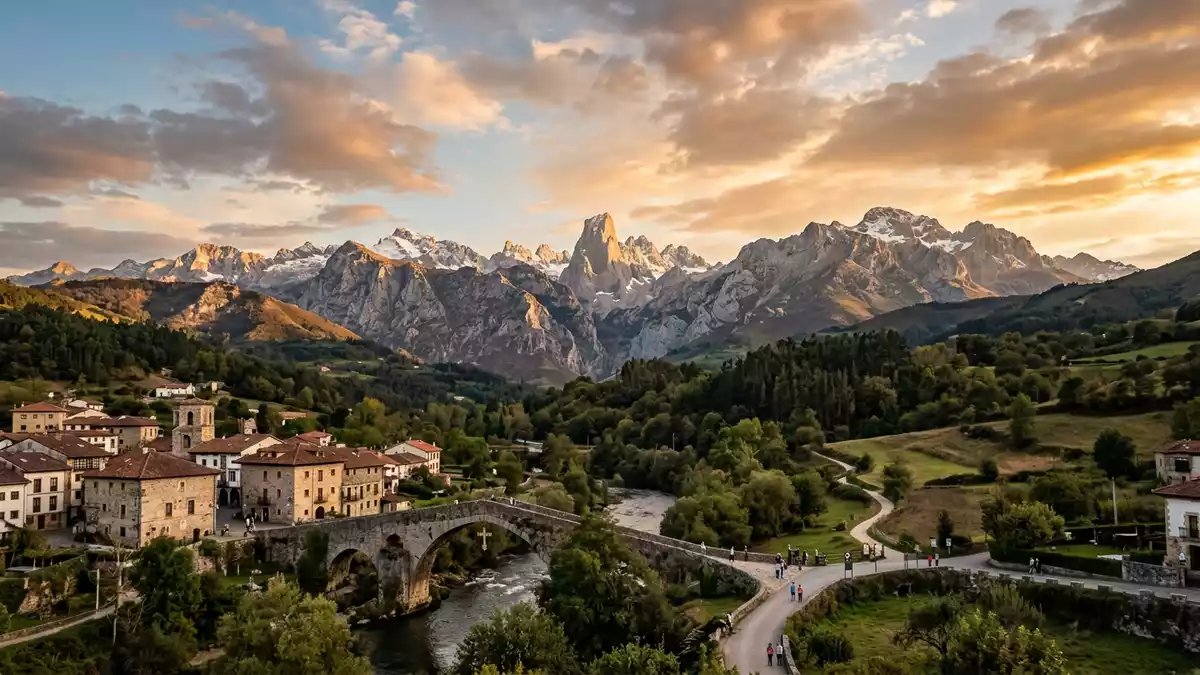
Picos de Europa is a compact limestone mountain range in northern Spain, rising inland from the Cantabrian coast and forming a rugged backdrop to Cangas de Onis in Asturias. The massif is part of the broader Cantabrian Mountains and much of it is protected as Picos de Europa National Park, a designation that originated in 1918 around the Montaña de Covadonga area.
Limestone massifs and deep gorges
The core of Picos de Europa consists of pale Carboniferous limestone laid down in a warm shallow sea more than 300 million years ago, then lifted and folded during major mountain-building episodes such as the Alpine orogeny.Carboniferous limestone The range is divided into three main massifs — Western (Cornión), Central (Urrieles) and Eastern (Ándara) — cut apart by deep river valleys and narrow gorges that give each sector its own character.Western, Central and Eastern massifs
Glacial erosion during the last two million years carved cirques, hanging valleys and basins where lakes such as Enol and Ercina lie in hollows surrounded by steep walls.glacial basins with lakes Enol and Ercina The park’s valleys and the famous Cares gorge cut sharply through the limestone, creating abrupt height differences between valley floors and the high pastures and ridges above. In places, the cliffs rise almost directly above riverbeds, giving the range its compact, dramatic profile compared with more sprawling mountain systems.
Spain’s first national park and a biosphere reserve
Protection of this landscape began in the early twentieth century when the Montaña de Covadonga National Park was declared in 1918, centred on the Asturian sector above Cangas de Onis.Montaña de Covadonga National Park in 1918 That declaration marked the first national park in Spain and later extensions brought the Western, Central and Eastern massifs together under the name Picos de Europa National Park, covering tens of thousands of hectares across Asturias, Cantabria and Castile and León.Picos de Europa National Park across three provinces
The area is also recognised internationally as the Picos de Europa Biosphere Reserve under UNESCO’s Man and the Biosphere programme, with a recorded terrestrial area exceeding 64,000 hectares in the heart of the Cantabrian Mountains.Picos de Europa Biosphere Reserve Within this protected space, high limestone ridges, beech and oak woods, upland pastures and karst sinkholes coexist, and traditional transhumance grazing practices have left a mosaic of human-made meadows alongside rocky slopes.
Cangas de Onis and the Asturian gateway
Cangas de Onis, in Asturias, serves as one of the principal road gateways into the park, especially towards Covadonga and the lakes in the Western massif.Cangas de Onis as an Asturian gateway The town lies on the Sella river and has an information and administration office for the Picos de Europa National Park at Casa Dago, where visitors can obtain maps and orientation about the Asturian side of the range.Casa Dago information centre in Cangas de Onis
From the vicinity of Cangas de Onis, roads climb towards Covadonga and the high corrie lakes, passing viewpoints where the limestone peaks rise sharply above forested slopes. The contrast between the gentler, green lower hills and the angular grey rock of the high massifs is one of the defining visual impressions on the Asturian approach. Traditional villages, stone-built farmhouses and small chapels punctuate the valleys, while above them seasonal pastures occupy ledges and gentler slopes amid the rock.
Visiting Picos de Europa: what travellers from Western Europe should know
- Picos de Europa lies inland from the north coast of Spain between Asturias, Cantabria and Castile and León, with Cangas de Onis acting as a main approach point on the Asturian side.
- The terrain combines steep limestone slopes, narrow gorges and high pastures; approaches from Cangas de Onis towards Covadonga and the lakes include mountain roads with bends and significant height gain.
- The park is reached by road from towns such as Cangas de Onis, Potes and Posada de Valdéon, and once inside the valleys many routes continue on foot along paths that can be rocky and uneven.
- The official language is Spanish and the currency is the euro.
- Entry requirements depend on your nationality; UK travellers can check the FCDO travel advice at gov.uk/foreign-travel-advice, Irish travellers the Department of Foreign Affairs at ireland.ie.
Searching for Picos de Europa on social platforms
These links open searches for Picos de Europa on each platform.
Frequently asked questions about Picos de Europa
Where is Picos de Europa?
Picos de Europa is a limestone mountain range in the Cantabrian Mountains of northern Spain, spanning parts of Asturias, Cantabria and Castile and León, with Cangas de Onis near its Asturian gateway.
What should travellers expect on a visit?
Travellers encounter steep limestone peaks, deep river gorges, lakes in glacial hollows, upland pastures and traditional villages, with many routes involving uneven mountain paths and significant changes in altitude.
What makes Picos de Europa distinctive among Spanish mountain landscapes?
The massif combines a compact area of high Carboniferous limestone peaks, early national park protection dating to 1918 and a recognised UNESCO biosphere reserve within the Cantabrian Mountains.


