
Picos de Europa: limestone giants above Cangas de Onis
Published on 08/31/2026 at 19:42 | Editorial responsibility: Rafael Müller, Editor-in-Chief AD HOC NEWS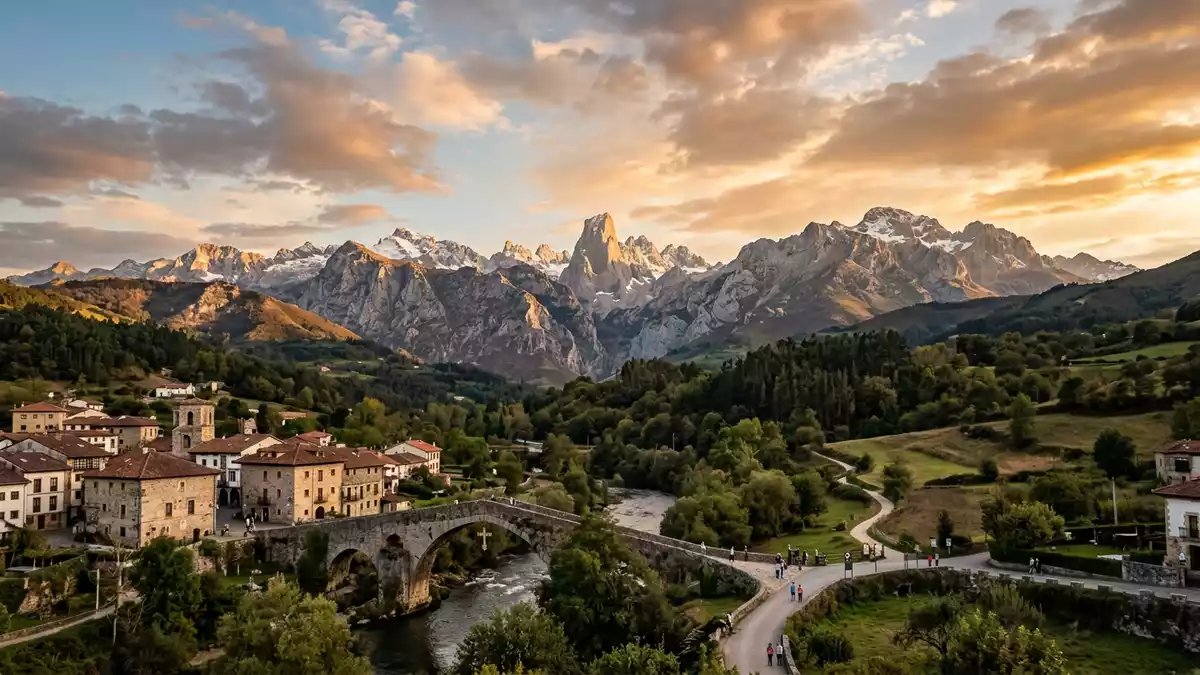
Picos de Europa is a compact limestone mountain range in northern Spain, rising above Cangas de Onis and forming part of the Cantabrian Mountains.
Limestone massifs facing the Atlantic
The Picos de Europa form a distinct section of the Cantabrian Mountains, set inland from the Bay of Biscay yet close enough that the highest peaks stand only a short distance from the coast.mountain range in the north of Spain The range lies within the autonomous communities of Asturias, Cantabria and Castile and León, creating a shared highland between these regions.situated in Asturias, Cantabria and Castile and León
Geologically, the Picos de Europa are built from folded Carboniferous limestone, forming a classic karst landscape of cliffs, sinkholes and high plateaus.rocha calcaria carbonífera pregada Within a relatively compact footprint the range carries many summits above 2,000 m (6,562 ft), so that steep rocky walls rise sharply from deep valleys and river gorges on every side.verkarstetes Faltengebirge mit vielen Gipfeln
Three massifs and their high peaks
The Picos de Europa are commonly described in terms of three main massifs: the western Cornión, the central Urrieles and the eastern Andara.three massifs Cornión Urrieles Andara Each massif has its own set of ridges and valleys, with passes linking them and deep gorges cutting between their flanks, such as the Cares gorge that separates the eastern and central massifs.Garganta do Cares entre os macizos
The highest summit of the range is Torre de Cerredo, reaching 2,648 m (8,688 ft) on the central Urrieles massif and forming the top of one of its most jagged skylines.Torre de Cerredo 2648 m Other named peaks have taken on a life of their own, including Naranjo de Bulnes, also known in Asturian as Picu Urriellu, and Peña Santa de Castilla in the Cornión massif, each standing above surrounding ridges of limestone towers and bowls.Naranjo de Bulnes e Peña Santa de Castilla
From Covadonga park to national designation
Protection of this landscape dates back to the early twentieth century, when a first national park was declared in the western sector around Covadonga in 1918, making it Spain’s earliest national park.established in 1918 as Spain’s first national park That initial area has grown over time into a much larger protected zone now recognised as Picos de Europa National Park, with boundaries extended to bring more of the three massifs under a single designation.park given its current name and expanded
Today the national park stretches over tens of thousands of hectares and forms part of a wider biosphere reserve recognised under UNESCO’s Man and the Biosphere Programme, which highlights the relative intactness of the mountain ecosystems.Picos de Europa Biosphere Reserve Within Asturias, the municipality of Cangas de Onis is one of the recognised gateways, with part of its territory included inside the park and its history tied closely to the creation of the original Covadonga National Park in the early 1900s.Cangas de Onis gateway to the park
Visiting Picos de Europa: what travellers from Western Europe should know
- Picos de Europa rises inland in northern Spain between Asturias, Cantabria and Castile and León, with Cangas de Onis on its southern Asturian side providing one of the main road approaches into the valleys.
- The terrain consists of steep limestone slopes, narrow paths and rocky ridges, and many routes involve sustained ascents and descents on uneven ground for extended distances on foot.
- Within the Asturian sector, Cangas de Onis shares access with nearby Covadonga and the glacial lakes area, combining valley pastures with sudden views of high cliffs and distant summits.
- The official language is Spanish and the currency is the euro.
Searching for Picos de Europa on social platforms
These links open searches for Picos de Europa on each platform.
Frequently asked questions about Picos de Europa
Where is Picos de Europa in relation to Cangas de Onis?
Picos de Europa rises in northern Spain within Asturias, Cantabria and Castile and León, with Cangas de Onis on its Asturian side at the foot of the range.
What should visitors expect on a visit to Picos de Europa?
Visitors encounter steep limestone peaks, deep gorges and long routes on uneven mountain terrain, with access into different valleys and massifs from towns such as Cangas de Onis.
What makes Picos de Europa distinctive among Spanish mountain ranges?
The range combines a compact area of high limestone summits, including Torre de Cerredo, with river gorges and proximity to the Atlantic coast, and holds a long-established national park designation dating back to 1918.


