
Piazza San Marco, Venice’s stone stage between basilica and lagoon
Published on 09/12/2026 at 17:58 | Editorial responsibility: Rafael Müller, Editor-in-Chief AD HOC NEWS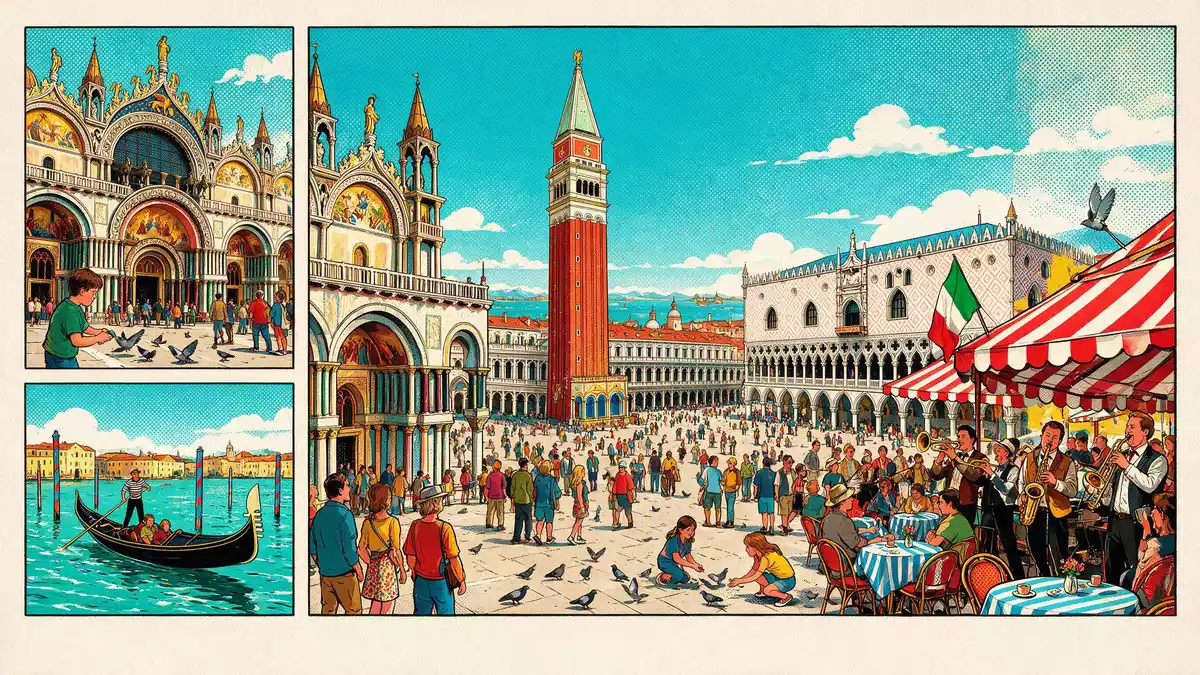
Piazza San Marco in Venedig is a grand paved square where stone, water and architecture meet, framed by St Mark’s Basilica, the Doge’s Palace and the Campanile on the edge of the Venetian lagoon. Set within the historic sestiere of San Marco, it forms part of the Venice and its Lagoon area inscribed on the UNESCO World Heritage List in 1987, embedding the piazza in a protected landscape of canals, islands and monumental buildingsVenice and its Lagoon. From its origins in the ninth century as a small open space in front of the earliest church of St Mark, the square has grown into the principal civic stage of the city.
A trapezoidal expanse shaped over centuries
The core layout of Piazza San Marco dates back to a major enlargement in the twelfth century, when the area in front of St Mark’s Basilica was expanded and given the trapezoidal outline that still defines the square todaycurrent size and trapezoidal layout. Earlier, the space had been partly divided by the Rio Batario, a canal that once ran across the western side before being filled to create a unified paved surfaceRio Batario filled in. The resulting square stretches as a long stone floor flanked by arcaded buildings, opening at its southern end towards the water of the lagoon via the Piazzetta.
The paving itself has changed with successive eras. In the late twelfth century the piazza was paved with bricks laid in a herringbone pattern, defining the surface with bands that ran along its main axisbricks laid in a herringbone pattern. In the eighteenth century this brick surface was replaced by natural stone, notably grey trachyte marked out with a geometric pattern of lighter marble, a design associated with the architect Andrea Tirali and largely preserved in later restorationsgrey trachyte with geometric marble. Walking across Piazza San Marco today means crossing this long, subtly patterned floor that visually ties the basilica, palaces and arcades into a single composition.
Framed by basilica, palaces and bell tower
The eastern side of Piazza San Marco is dominated by the façade of St Mark’s Basilica, whose origins lie in the ninth century when a church was built to house the relics of the evangelist Mark brought to Venice from Alexandria in 828relics of St Mark. Over the following centuries the basilica developed into a richly decorated structure with multiple domes and extensive mosaics, giving the square a distinctive religious backdrop. Beside it stands the Campanile di San Marco, the brick bell tower rising above the piazza as one of the most prominent landmarks of the city and reconstructed in the early twentieth century after its collapse in 1902Campanile collapse and rebuild.
On the southern side, the Doge’s Palace defines the edge towards the lagoon, presenting its long waterfront façade to both the square and the basin. The northern and southern flanks of Piazza San Marco are lined by the Procuratie buildings, extended in the sixteenth and seventeenth centuries when the Procuratie Vecchie and Procuratie Nuove took shape as long arcaded ranges for the officials responsible for the administration of St Mark’s church assetsProcuratie Vecchie and Nuove. At the western end, the Ala Napoleonica, built in the early nineteenth century after the fall of the Republic of Venice, closes the perspective with a neoclassical wing, completing the sense of Piazza San Marco as a stone room open on one side to the lagoonAla Napoleonica.
A civic stage in the history of Venice
Piazza San Marco has served as the political, religious and social centre of Venice since the ninth century, evolving from a modest forecourt in front of a chapel into the principal setting for ceremonies, announcements and gatheringscentre since the 9th century. Successive doges reshaped the square to match the ambitions of the maritime republic: Doge Sebastiano Ziani in the twelfth century is closely associated with the enlargement that aligned the piazza with the growing importance of Venice as a trading and naval powerSebastiano Ziani enlargement. From this period onwards, the space in front of St Mark’s Basilica became not only an access route but also a formal stage for processions between the church, the Doge’s Palace and the waterfront.
Over the thirteenth to eighteenth centuries the visual unity of the square consolidated as the Procuratie wings, the basilica, the bell tower and the palace acquired their present outlinescurrent outline of Piazza and Piazzetta. In 1807 the demolition of the church of San Geminiano and the construction of the Procuratie Nuovissime, including the Ala Napoleonica, marked the completion of the western closing wall under French ruleProcuratie Nuovissime completed. Across these phases, Piazza San Marco remained the place where the architecture of state and church is set against the open prospect of the lagoon, giving any visit a clear sense of Venice as a city built between land and water.
Visiting Piazza San Marco: what travellers from Western Europe should know
- Piazza San Marco lies in the San Marco district of Venedig, immediately inland from the Bacino di San Marco, and is reached on foot from the city’s network of alleys and bridges or by vaporetto services that stop along the nearby waterfront.
- The square itself is level but broad, surfaced with stone paving divided by lighter marble bands, and movement across it involves walking on hard, open ground with little shade from the surrounding buildings.
- The official language is Italian and the currency is the euro.
Searching for Piazza San Marco on social platforms
These links open searches for Piazza San Marco on each platform.
Frequently asked questions about Piazza San Marco
Where is Piazza San Marco located in Venice?
Piazza San Marco lies in the San Marco district of Venedig, directly behind St Mark’s Basilica and beside the Doge’s Palace, opening towards the Bacino di San Marco.
What should visitors expect when they arrive at Piazza San Marco?
Visitors encounter a large stone-paved square framed by arcaded façades, the domes of St Mark’s Basilica, the Campanile and the waterfront, with long sightlines across the space.
What makes Piazza San Marco distinctive among Venetian squares?
Piazza San Marco is the only square in the city formally designated as a “piazza”, combining religious, political and waterfront architecture in a single paved expanse linked to the lagoon.


