
Piazza San Marco, Venice’s stone square between basilica and lagoon
Published on 09/21/2026 at 07:56 | Editorial responsibility: Rafael Müller, Editor-in-Chief AD HOC NEWS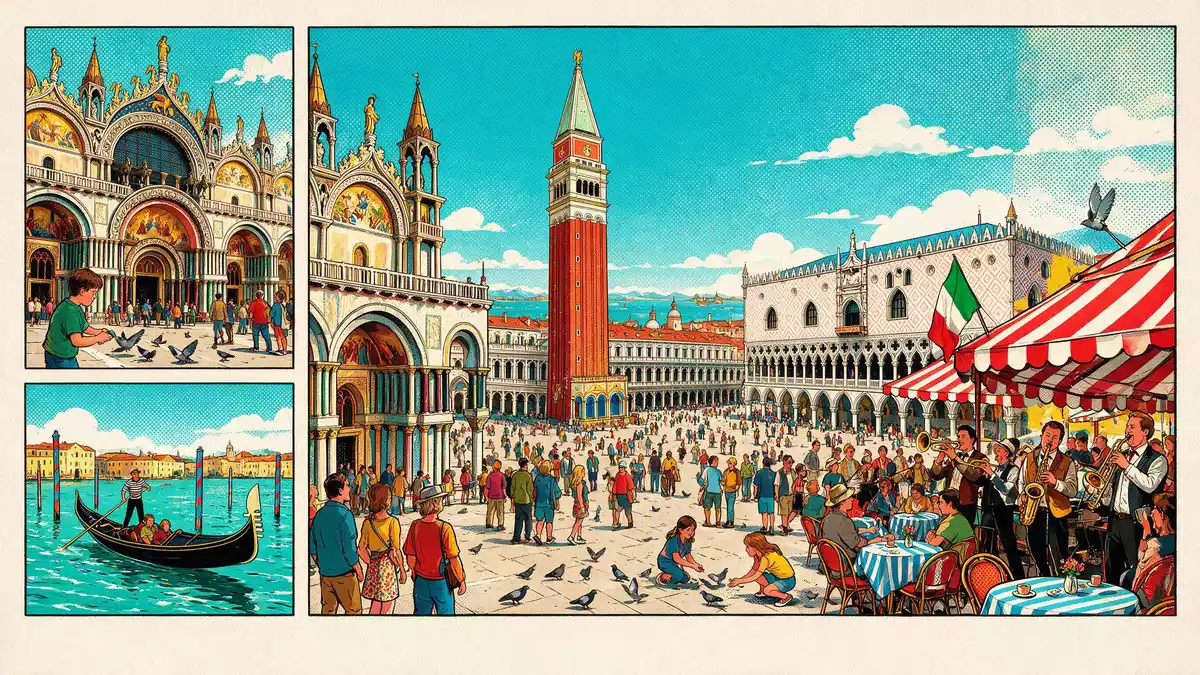
Piazza San Marco in Venedig is the great paved square at the eastern edge of Venice’s historic centre, facing the lagoon and framed by monumental stone architecture. The space took shape as a civic forecourt in the ninth century, in front of the early church dedicated to St Mark, and gained its broad trapezoidal outline during the twelfth century.
A stone stage shaped around St Mark’s Basilica
The defining presence on Piazza San Marco is St Mark’s Basilica, a church on the eastern end of the square whose origins go back to the early ninth century, when a first basilica was founded to house the relics of the Evangelist Mark.The most prominent building facing the square is the Byzantine Saint Mark’s Basilica Its architecture mixes Byzantine massing with later Gothic and Renaissance additions, creating a multi-domed skyline above a facade lined with arches and mosaics.
The square itself originated as a smaller open area in front of this church and the Doge’s Palace and was enlarged in the twelfth century when waterways such as the Rio Batario and adjoining dock were filled in, producing the extended paved space recognised today.It was enlarged to its present size and shape in 1177, when the Rio Batario and a dock were filled in In the thirteenth century the surface was laid with bricks in a herringbone pattern, and in the eighteenth century this paving was replaced by natural stone with a more complex geometric layout designed by architect Andrea Tirali.In 1735 the bricks were replaced with natural stone according to a design devised by architect Andrea Tirali
Arcades, procuratie wings and Napoleonic additions
The long arcaded wings that frame Piazza San Marco on its north and south sides are known collectively as the procuratie, named for the Procurators of St Mark who once lived and worked there.The buildings on the north side are known as the Procuratie Vecchie, formerly the homes and offices of the Procurators of St Mark On the north side stands the Procuratie Vecchie, whose arcade fronts the square; opposite lies the Procuratie Nuove, and between them a later Napoleonic wing closes the western end of the piazza with a straight facade.Napoleon built a new wing, called Ala Napoleonica, facing towards Basilica di San Marco
Together these wings form continuous covered walkways around much of the square, with regular arches and repeated window bays giving Piazza San Marco a strongly ordered architectural frame. Behind parts of the procuratie is the Correr Museum, housed within former administrative rooms of the Venetian Republic, while near the waterfront side of the ensemble rises the Sansovino-designed Biblioteca Nazionale Marciana, a Renaissance library building whose facade adds sculpted detail to the southern edge of the piazzetta.Piazza San Marco gathers structures such as the Doge’s Palace, St. Mark’s Basilica, the Clock Tower, the Sansovino National Library and the Procuratie wings
Campanile, Doge’s Palace and the open link to the lagoon
The western part of Piazza San Marco opens towards the Grand Canal and the wider lagoon through the smaller space of the Piazzetta, where two granite and marble columns frame the water’s edge. On one side stands the Doge’s Palace, or Palazzo Ducale, whose Venetian Gothic arcades and patterned stone walls rise directly from the canal, while the main body of the palace also addresses the square.Standing next to the basilica is the Palace of the Doge, an outstanding masterpiece of Venetian Gothic architecture Edges of the piazza nearest the water link to the Molo, the historic quay for ceremonial arrivals by boat.
Separate from the basilica but closely associated with it is St Mark’s Campanile, a tall brick bell tower whose origins lie in the twelfth century and which was rebuilt in the early twentieth century after collapsing.St Mark’s Campanile was originally built in the 12th century and rebuilt following its collapse in the early 20th century Near its base stands the Loggetta. At the opposite corner of the basilica, a late fifteenth-century clock tower marks the passage between the main piazza and the Mercerie shopping street, its blue and gold clock face and sculptural details providing a vertical accent on the north side.Near the basilica is the late-15th century elaborately decorated St Mark’s Clocktower
Visiting Piazza San Marco: what travellers from Western Europe should know
- Piazza San Marco lies at the eastern edge of Venice’s historic centre, beside the St Mark’s Basin and the entrance to the Grand Canal, and is reached on foot from nearby vaporetto stops.
- The square itself is flat and paved with stone, but approaches and viewpoints involve steps, including staircases inside the Campanile di San Marco and passages within the Doge’s Palace.
- The surroundings include the Molo waterfront, the Piazzetta leading towards the lagoon, and narrow streets such as the Mercerie connecting the square with other districts.
- The official language is Italian and the currency is the euro.
Searching for Piazza San Marco on social platforms
These links open searches for Piazza San Marco on each platform.Frequently asked questions about Piazza San Marco
Where is Piazza San Marco located in Venice?
Piazza San Marco stands at the eastern end of Venice’s historic centre, beside St Mark’s Basin and close to the entrance of the Grand Canal.
What can visitors expect when they arrive on Piazza San Marco?
Visitors find a broad paved square framed by arcades, with St Mark’s Basilica, the Doge’s Palace, St Mark’s Campanile and the clock tower all around its edges.
What makes Piazza San Marco distinctive among Venice’s squares?
Piazza San Marco combines its trapezoidal layout, monumental religious and civic buildings and a direct relationship with the lagoon waterfront into a single continuous urban space.


