
Piazza San Marco: Venice’s stone room beneath the sky
Published on 09/23/2026 at 17:56 | Editorial responsibility: Rafael Müller, Editor-in-Chief AD HOC NEWS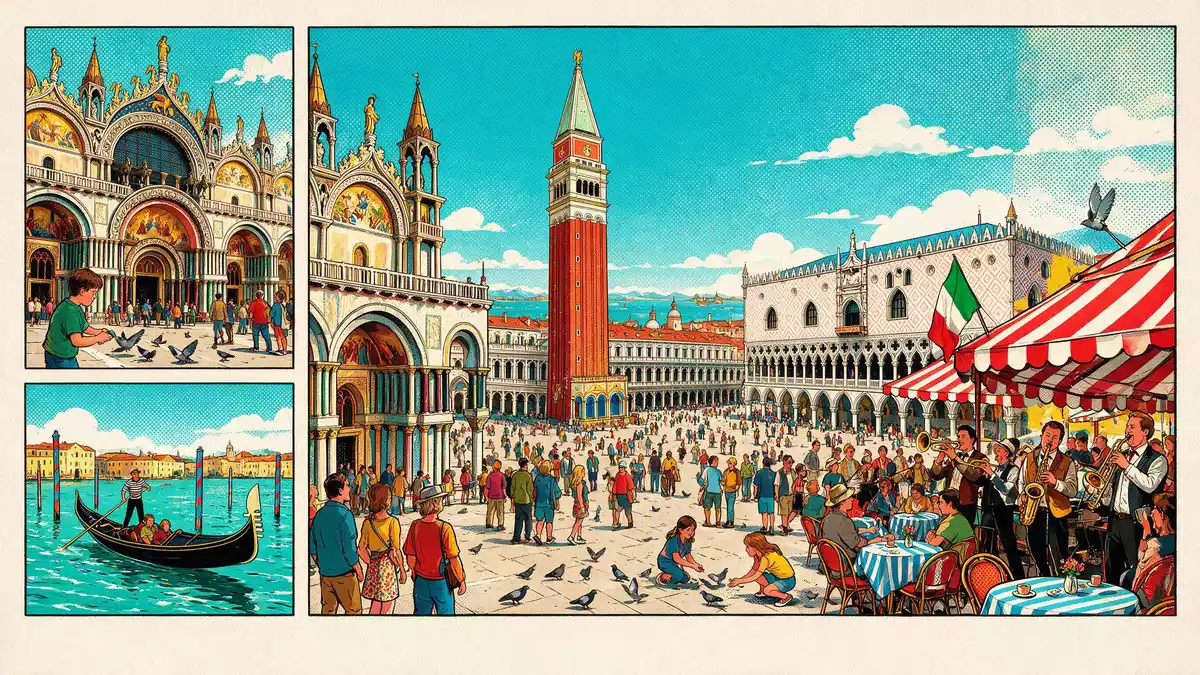
Piazza San Marco is Venedig’s great open room, a paved space framed by St Mark’s Basilica, the Doge’s Palace and long arcades. Its broad trapezoidal outline gathers Byzantine domes, Gothic stonework, Renaissance façades and the Venetian lagoon into one urban scene.
A trapezoid of stone beside the lagoon
The square measures roughly 175 m (574 ft) along its length. Its width changes from about 82 m (269 ft) at one end to roughly 56 m (184 ft) at the other, giving the paving a clearly narrowing form.
Dark stone and pale lines form the surface beneath the buildings. The eastern end is dominated by St Mark’s Basilica, while the Campanile rises beside it as a separate brick bell tower. Across the open space, the Procuratie buildings create a continuous architectural edge.
From a ninth-century forecourt to Venice’s civic centre
Piazza San Marco began in the ninth century as an open area beside the first church dedicated to St Mark. The square expanded during the twelfth century, when its layout moved towards the broad form associated with Venice.
The square became a setting for religious ceremonies, political announcements and public gatherings. Its name refers to St Mark, whose relics became central to Venetian religious identity.
Basilica, palace and tower in one ensemble
St Mark’s Basilica gives Piazza San Marco its strongest visual focus. The church combines Byzantine forms with later Gothic and Renaissance additions, and its façade carries arches, columns, marble surfaces and golden mosaics.
The Doge’s Palace borders the adjoining Piazzetta San Marco. Its Gothic arcades face the lagoon, while the Torre dell’Orologio marks the northern entrance towards the city’s commercial streets. Together with the Campanile and Procuratie, these buildings place religious, political and civic architecture around one paved space.
Venice and its lagoon, including Piazza San Marco, form a UNESCO World Heritage property inscribed in 1987. The designation covers the historic city and its surrounding lagoon landscape in Italy’s Veneto region.
Visiting Piazza San Marco: what travellers from Western Europe should know
- Piazza San Marco lies in the San Marco district of Venedig, beside the Venetian lagoon. It is reached through Venice’s pedestrian streets or by vaporetto using stops serving San Marco and the nearby lagoon shore.
- The square is level, but the approach crosses bridges and pedestrian routes with steps. The adjoining Campanile and surrounding monuments contain stairways and enclosed interior spaces.
- The square connects directly with Piazzetta San Marco, the Doge’s Palace and the waterfront. St Mark’s Basilica, the Campanile, the Procuratie and the clock tower all stand around the same civic ensemble.
- The official language is Italian and the currency is the euro.
Searching for Piazza San Marco on social platforms
These links open searches for Piazza San Marco on each platform.
Frequently asked questions about Piazza San Marco
Where is Piazza San Marco?
Piazza San Marco is in the San Marco district of Venedig, beside the lagoon and near the Doge’s Palace, St Mark’s Basilica and the city’s waterfront.
What can travellers expect on a visit?
Travellers encounter a large paved square surrounded by historic buildings, with bridges and pedestrian routes forming the approach through Venice.
What makes Piazza San Marco distinctive?
Its trapezoidal paving brings a basilica, palace, bell tower, clock tower and civic arcades into one architectural ensemble beside the lagoon.


