
Piazza San Marco, Venedig’s stone theatre of power and faith
Published on 09/07/2026 at 13:48 | Editorial responsibility: Rafael Müller, Editor-in-Chief AD HOC NEWS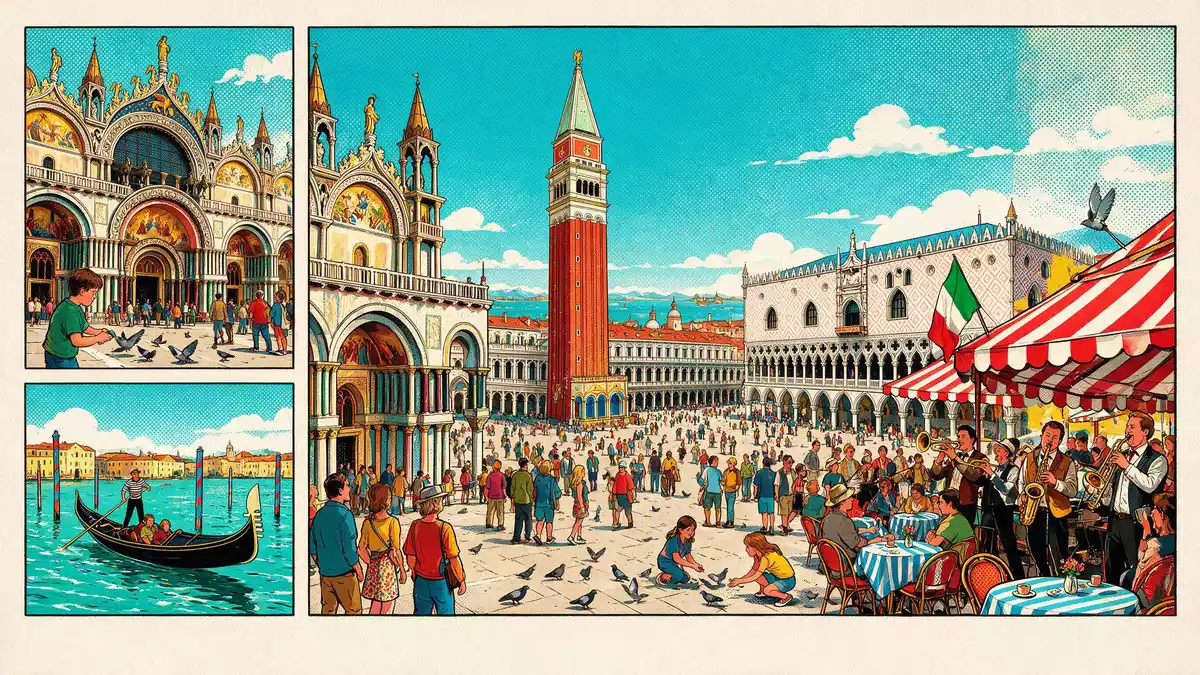
Piazza San Marco in Venedig is the city’s great stone theatre, where St Mark’s Basilica, the campanile and long palace wings frame an open stage that has shaped Venetian life for centuries. Laid out beside the lagoon in the historic centre of Venice, the square reached something close to its present outline in the twelfth century, when its modest beginnings in front of the earlier basilica grew into a broad paved space lined with arcades.
The square as Venice’s civic room
Piazza San Marco is the principal public square of Venice and the only one in the city formally designated as a “piazza”, with other open spaces termed “campi”.principal public square of Venice Its dimensions form a broad trapezoid around 175 m (574 ft) long, narrowing from a width of about 82 m (269 ft) at one end to roughly 56 m (184 ft) at the other, so that the flanking buildings seem to converge towards the basilica.trapezoid around 175 m long
The square’s origins lie in the ninth century, when a small free area in front of an earlier St Mark’s church began to serve as a focus of civic life.origins lie in the ninth century Its enlargement to near-present size followed major works in 1177, when canals crossing the site were filled and the space extended to host the meeting of Pope Alexander III and Emperor Frederick I Barbarossa.enlargement to near-present size From then on, Piazza San Marco became the scene of religious ceremonies, political proclamations and everyday gatherings of the Serenissima, turning the paved surface into a civic room under the open sky.
Architectural ensemble: basilica, campanile and Procuratie
At the eastern end of Piazza San Marco, St Mark’s Basilica anchors the space with its domes, mosaics and marble surfaces, a church whose present form dates from the eleventh century and was consecrated in 1094.present form dates from the eleventh century Rooted in Byzantine aesthetics, the basilica blends Byzantine, Gothic and later elements, reflecting Venice’s connections across the Eastern Mediterranean and its period as a maritime power.blends Byzantine and Gothic elements Its interior is known for extensive gold-ground mosaics and an array of coloured marble, while the façade presents arches and columns that face directly onto the square.
Beside the basilica stands the Campanile di San Marco, a free-standing bell tower rising about 98.6 m (323 ft) above the paving, making it the tallest structure in Venice.bell tower rising about 98.6 m The current tower dates from 1912, rebuilt after the collapse of its predecessor in 1902, and serves both as a landmark in views across the lagoon and as a vertical counterpoint to the horizontal expanse of the piazza.current tower dates from 1912 At its base sits the Loggetta, while the adjoining Piazzetta opens southwards towards the water, flanked by the Doge’s Palace and the Biblioteca Nazionale Marciana.
Stone wings and evolving surfaces
The long sides of Piazza San Marco are lined by the Procuratie Vecchie to the north and the Procuratie Nuove to the south, arcaded palace ranges that took much of their present form in the sixteenth century.present form in the sixteenth century Together with the Ala Napoleonica at the west end, completed in the early nineteenth century as an additional wing facing the basilica, these buildings create a continuous frame of arcades, windows and rooflines around the square.Ala Napoleonica at the west end Under their arches, historic cafés and institutions occupy rooms that once housed officials of the Venetian state.
The paving of Piazza San Marco has changed over time while retaining its role as a patterned floor to the open-air room. In the late twelfth century, the square was paved with bricks laid in a herringbone pattern, with bands of light-coloured stone running along its length.bricks laid in a herringbone pattern In 1723, architect Andrea Tirali designed a more complex geometrical pavement in stone, whose model continued to influence subsequent restorations.geometrical pavement in stone The surface today reflects these phases, with long straight bands and geometric fields marking out the large trapezoid.
Visiting Piazza San Marco: what travellers from Western Europe should know
- Piazza San Marco lies in the historic centre of Venice, on the western edge of the Bacino di San Marco, and is reached on foot from the city’s network of alleys and bridges as well as by vaporetto stops along the Grand Canal.
- The square itself is a broad paved area without kerbs, with the Campanile, basilica and palace wings rising directly from the stone surface, and approaches involve walking across level flagstones and low steps at surrounding thresholds.
- Nearby landmarks include the Doge’s Palace on the adjoining Piazzetta, the waterfront promenade along Riva degli Schiavoni and the entrance to the Mercerie, the shopping streets linking Piazza San Marco to the Rialto district.
- The official language is Italian and the currency is the euro.
- Entry requirements depend on your nationality; UK travellers can check the FCDO travel advice at gov.uk/foreign-travel-advice, Irish travellers the Department of Foreign Affairs at ireland.ie.
Searching for Piazza San Marco on social platforms
These links open searches for Piazza San Marco on each platform.
Frequently asked questions about Piazza San Marco
Where is Piazza San Marco in Venedig?
Piazza San Marco lies in the historic centre of Venice, on the edge of the Bacino di San Marco near the Doge’s Palace and the entrance to the Grand Canal.
What can visitors expect on a visit to Piazza San Marco?
Visitors encounter a large paved square enclosed by arcaded palaces, St Mark’s Basilica, the Campanile and the adjoining Piazzetta, with views towards the lagoon and surrounding streets.
What makes Piazza San Marco distinctive among European squares?
Its combination of Byzantine basilica, tall campanile and continuous palace wings around a trapezoidal paved space beside the water gives Piazza San Marco a character strongly associated with Venice’s historic identity.


