
Piazza San Marco, a grand stage of stone in Venedig
Published on 08/31/2026 at 10:02 | Editorial responsibility: Rafael Müller, Editor-in-Chief AD HOC NEWS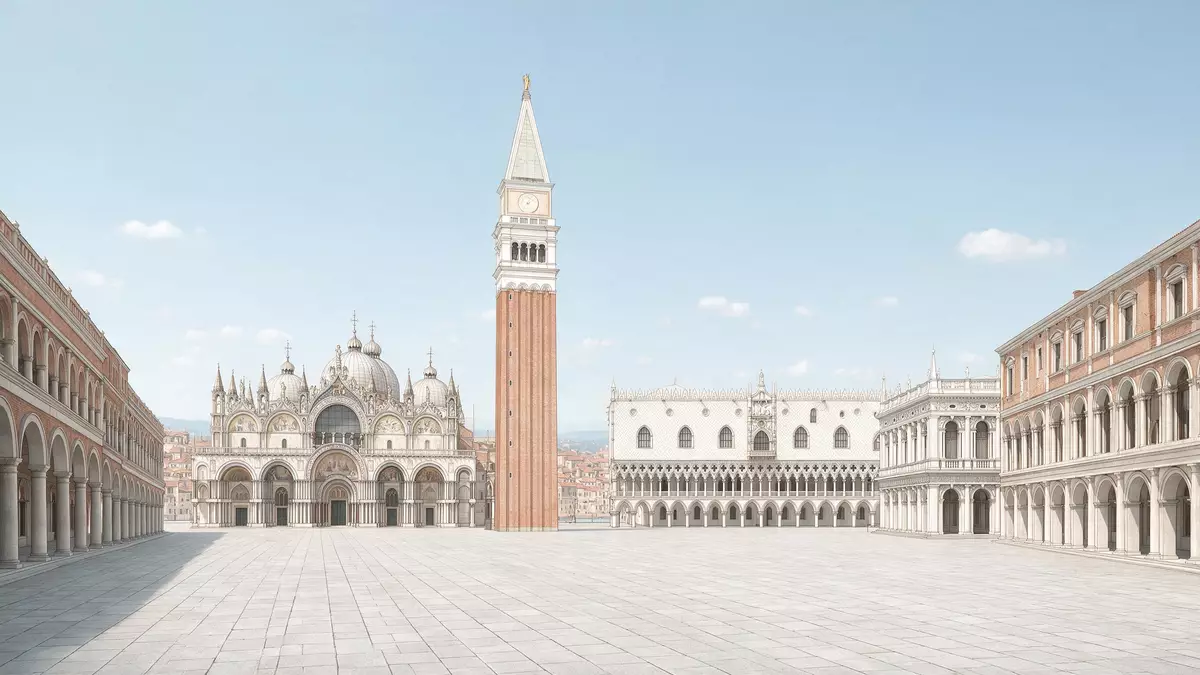
Piazza San Marco in Venedig is a long, gently widening rectangle of stone that reads like a catalogue of Venice’s history, framed by church, palace and arcades on three sides. It took shape as a civic space from the ninth century, when a small area in front of the original St Mark’s Basilica began to expand, and reached something close to its present outline in the twelfth century.The Square originated in the ninth century
A stone salon between basilica and lagoon
The first impression of Piazza San Marco is of an elongated space running from the façade of St Mark’s Basilica towards the water of the Venetian lagoon, with the Doge’s Palace and its pale stone arcades forming one side of the approach. The square lies at the eastern edge of the historic city, where the urban fabric opens towards St Mark’s Basin and the Grand Canal, and where ceremonial arrivals by boat once stepped directly onto its stones.Piazza San Marco gathers invaluable structures
In plan the piazza and its smaller extension, the Piazzetta, form a trapezoidal ensemble, with the main rectangle widening slightly towards the west and the short, narrower arm leading down to the water between the Doge’s Palace and the Biblioteca Nazionale Marciana. The open stone surface is laid in grey trachyte with lighter bands that trace geometric patterns, a pavement design introduced in 1723 by the Venetian architect Andrea Tirali, replacing earlier brickwork.The Square was paved with herringbone bricks from the late thirteenth century until 1723
Basilica, campanile and Doge’s Palace: a vertical skyline
At the eastern end, the façade of St Mark’s Basilica closes the piazza with domes, arches and mosaics, an 11th?century church that blends Byzantine, Gothic and later elements into a dense composition of marble and gold. The basilica’s origin lies in the eleventh century, when the present building was begun and consecrated in 1094, giving the square its religious anchor and lending its name to the whole ensemble.The centerpiece is St. Mark’s Basilica, an 11th-century masterpiece
Beside the basilica rises the Campanile di San Marco, a tall, simple bell tower whose vertical brick shaft and pyramidal top dominate the skyline and serve as a landmark from the lagoon. A campanile on this site was initially completed in the twelfth century as a watchtower and beacon, collapsed dramatically in 1902 and was rebuilt in the early twentieth century to the same outline.The famed Campanile was initially completed in the 12th century Between basilica and tower, a glimpse of the Doge’s Palace shows its Gothic tracery and pink stone panels, marking the former seat of the Venetian government.
Arcades of the Procuratie and the making of a civic room
The long north and south flanks of Piazza San Marco are defined by the Procuratie, ranges of arcaded buildings that turn the square into an architectural room. On the north side, the Procuratie Vecchie line the full length with repeated arches and small upper windows, structures dating from the early sixteenth century that housed the Procurators of St Mark, high officers of the Venetian state.The buildings on this side are known as the Procuratie Vecchie
The south side is formed by the later Procuratie Nuove, facing north towards the basilica and campanile, and the west end is closed by the Ala Napoleonica, a neoclassical wing added in the early nineteenth century for the French emperor Napoleon. Together these ranges, completed between the sixteenth century and the Napoleonic period, establish a continuous arcade around the square, with ground?floor arches opening onto cafés, shops and passageways, and upper storeys creating a rhythmic backdrop to civic ceremonies.It is enclosed on its other three sides by the Procuratie Vecchie, the Procuratie Nuove, and the Ala Napoleonica
Visiting Piazza San Marco: what travellers from Western Europe should know
- Piazza San Marco lies at the eastern edge of Venice’s historic centre, beside St Mark’s Basin; it is reached on foot from the city’s lanes or by vaporetto along the Grand Canal.
- The square itself is level and paved with stone, but approaches cross bridges over canals and the campanile climb uses enclosed stairways or lifts within a tall tower structure.
- Within or immediately beside Piazza San Marco stand St Mark’s Basilica, the Campanile di San Marco, the Doge’s Palace and the Procuratie arcades, so major sights cluster in a compact area.
- The official language is Italian and the currency is the euro.
Searching for Piazza San Marco on social platforms
These links open searches for Piazza San Marco on each platform.
Frequently asked questions about Piazza San Marco
Where is Piazza San Marco in Venedig?
Piazza San Marco lies at the eastern end of Venice’s historic centre, beside St Mark’s Basilica, the Campanile di San Marco and St Mark’s Basin on the lagoon.
What should a visitor expect on a first visit?
A visitor encounters a large stone piazza framed by church, bell tower, palace and arcaded façades, with major historic buildings clustered closely around the open space.
What makes Piazza San Marco distinctive among Italian squares?
Its combination of Byzantine?influenced basilica, Gothic palace and Renaissance?to?Napoleonic arcades around a single paved rectangle gives Piazza San Marco an unusually layered architectural character.


