
Piazza Navona in Rom: from ancient stadium to baroque stage
Published on 08/19/2026 at 15:01 | Editorial responsibility: Rafael Müller, Editor-in-Chief AD HOC NEWS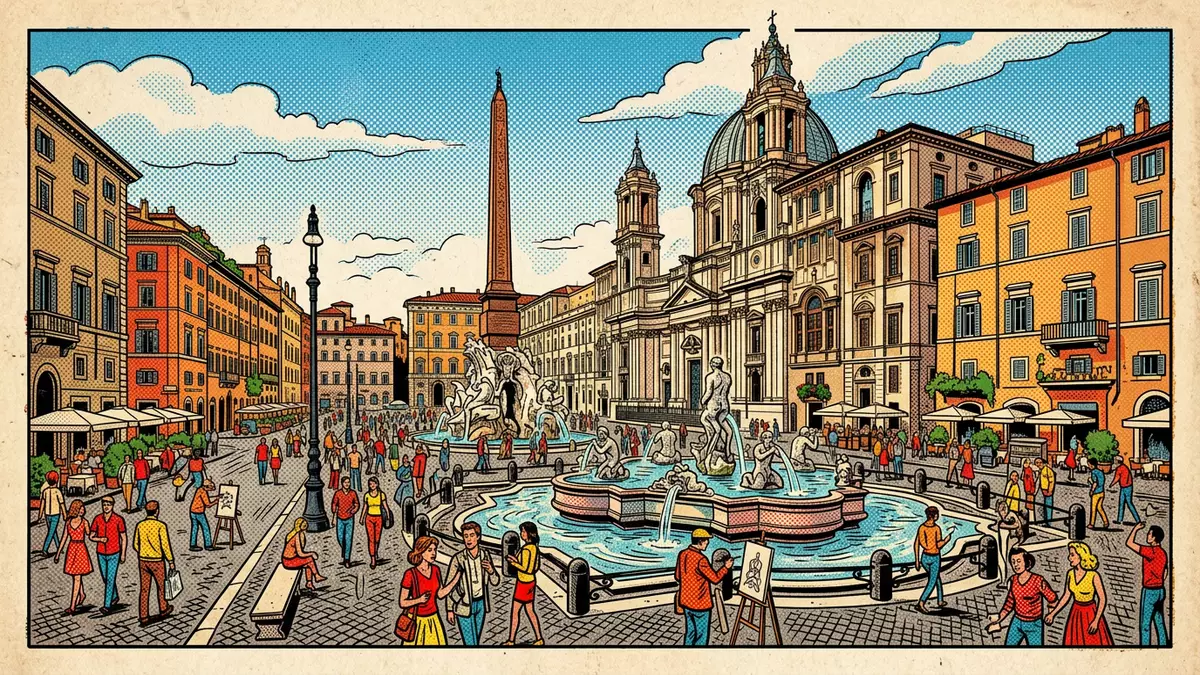
Piazza Navona in Rom is a long, theatrical square that still follows the footprint of the ancient Stadium of Domitian, turning a Roman arena into a baroque urban stage. Its present form brings together imperial foundations, seventeenth-century palaces and sculptural fountains in one elongated space that feels like an open-air gallery.
From Domitian’s stadium to a city square
The ground plan of Piazza Navona preserves the outline of the Stadium of Domitian, an athletic arena commissioned in the first century AD for competitive games.Stadium of Domitian The stadium stood on the Campus Martius, with a long central field surrounded by tiers of seating that gave the structure its characteristic stretched form.Greek-style running track When the arena fell out of use, houses were built along the former stands, but the central space remained open and would later become the piazza.
The name of Piazza Navona reflects these origins. Latin references to agones, the competitive games once held here, shifted through medieval usage from “in agone” to “Navone” and then “Navona”, keeping a memory of the stadium’s function in the modern name.from Circus Agonalis to Navona Defined as a public space in the late fifteenth century, when the city market moved here from the Capitoline Hill, the square began its second life as one of Rom’s main civic stages.late fifteenth-century market
Baroque Rome carved into stone and water
Piazza Navona acquired its baroque character in the seventeenth century, under the pontificate of Pope Innocent X Pamphilj, whose family palace faces the square.Pamphilj palace on the piazza The long sides are lined with palazzi and churches, while the centre is punctuated by fountains that turn the open space into a sequence of sculptural episodes. The most striking ensemble is the Fountain of the Four Rivers, Fontana dei Quattro Fiumi, designed by Gian Lorenzo Bernini in 1651 for Innocent X.Bernini’s Fountain of the Four Rivers
Bernini’s fountain gathers personifications of the Nile, Danube, Ganges and Río de la Plata around a travertine rock supporting an ancient Roman obelisk, so that river gods, stone and inscriptions rise together from the basin.rivers and obelisk composition At the southern end of the square the Fountain of the Moor adds another layer of baroque drama, with a central figure wrestling a dolphin surrounded by sea creatures, while a further fountain closes the northern perspective. Around them, Palazzo Pamphilj and the church of Sant’Agnese in Agone form a stone backdrop that matches the theatrical quality of the water and sculpture.
Shape, everyday life and layers of history
What makes Piazza Navona distinctive in Rom is the way its unusual length and curved ends shape everyday life in a former stadium. The piazza stretches along the line where athletes once ran, so that modern activity now crosses a space first laid out for foot races under Emperor Domitian.arena commissioned in 86 AD The long axis naturally breaks into informal sections: quieter corners by the churches, busier stretches around the central fountain and looser pockets of space near the northern entrance.
Beneath the paving, substantial remains of the Stadium of Domitian survive and can be visited through an underground museum, linking the present square back to its first-century masonry.remains beneath the square Over centuries the piazza has hosted markets, theatrical performances and celebrations, leaving it with a layered character in which imperial stonework, baroque façades and contemporary life all share the same elongated urban room.
Visiting Piazza Navona: what travellers from Western Europe should know
- Piazza Navona lies in central Rom on the historic Campus Martius, a short walk west of the Pantheon and near the course of the Tiber.
- The square itself is level and paved, but its length means that exploring the full space involves a walk along the former stadium field.
- Several streets lead into Piazza Navona from different directions, and the approaches from the Pantheon and Largo di Torre Argentina pass through narrow, historic lanes.
- Italian is the official language and the currency is the euro.
Searching for Piazza Navona on social platforms
These links open searches for Piazza Navona on each platform.
Frequently asked questions about Piazza Navona
Where is Piazza Navona in Rom?
Piazza Navona is in the historic centre of Rom on the former Campus Martius, a short walk west of the Pantheon and close to the Tiber river.
What can visitors expect when they come to Piazza Navona?
Visitors find a long, paved square framed by baroque palaces and churches, with three fountains along its axis and plenty of space to walk, sit and take in the architecture.
What makes Piazza Navona distinctive among Rom’s squares?
Piazza Navona stands out for its elongated plan that preserves the outline of Domitian’s stadium, combining ancient foundations with seventeenth-century architecture and Bernini’s central fountain.


