Piazza Navona hosts Isole e Santi until 29 October
Published on 10/21/2026 at 11:15 | Editorial responsibility: Rafael Müller, Editor-in-Chief AD HOC NEWSExhibition and square context
- At the École française de Rome, Isole e Santi runs until 29 October 2026.
- The public exhibition presents more than 100 ecclesiastical complexes from the eastern Adriatic.
- Domitian's Stadium shaped the square from 86 AD, while Bernini's fountain dates to 1651.
- The venue at Piazza Navona 62 places the exhibition beside Rome's Baroque square.
Piazza Navona hosts Isole e Santi, an archaeological exhibition at the École française de Rome, until 29 October 2026. The venue at number 62 gives visitors a current cultural reason to combine the square with a presentation on monasteries and sanctuaries along the eastern Adriatic.
Isole e Santi remains open at Piazza Navona
The exhibition is presented in the École française de Rome gallery. Turismo Roma lists the run from 28 May to 29 October 2026, while the École française de Rome gives the opening period as 27 May to 29 October 2026.
The exhibition explores the history and archaeology of ecclesiastical sites in Istria and Dalmatia between Late Antiquity and the Middle Ages. Its illustrated panels present and contextualise more than 100 church complexes on islands and along the eastern Adriatic coast, according to the Turismo Roma exhibition listing.
The project was created with the Archaeological Museum of Split and forms part of MONACORALE, an international research programme involving French, Croatian and Italian institutions. The organisers describe the display as a reduced and rethought version of an exhibition presented in Croatia in 2025.
How the exhibition reflects Piazza Navona history
The subject of the exhibition reaches beyond its address. It examines monasteries as places of prayer, literacy, art and exchange, while the surrounding square preserves a long record of public, religious and architectural activity.
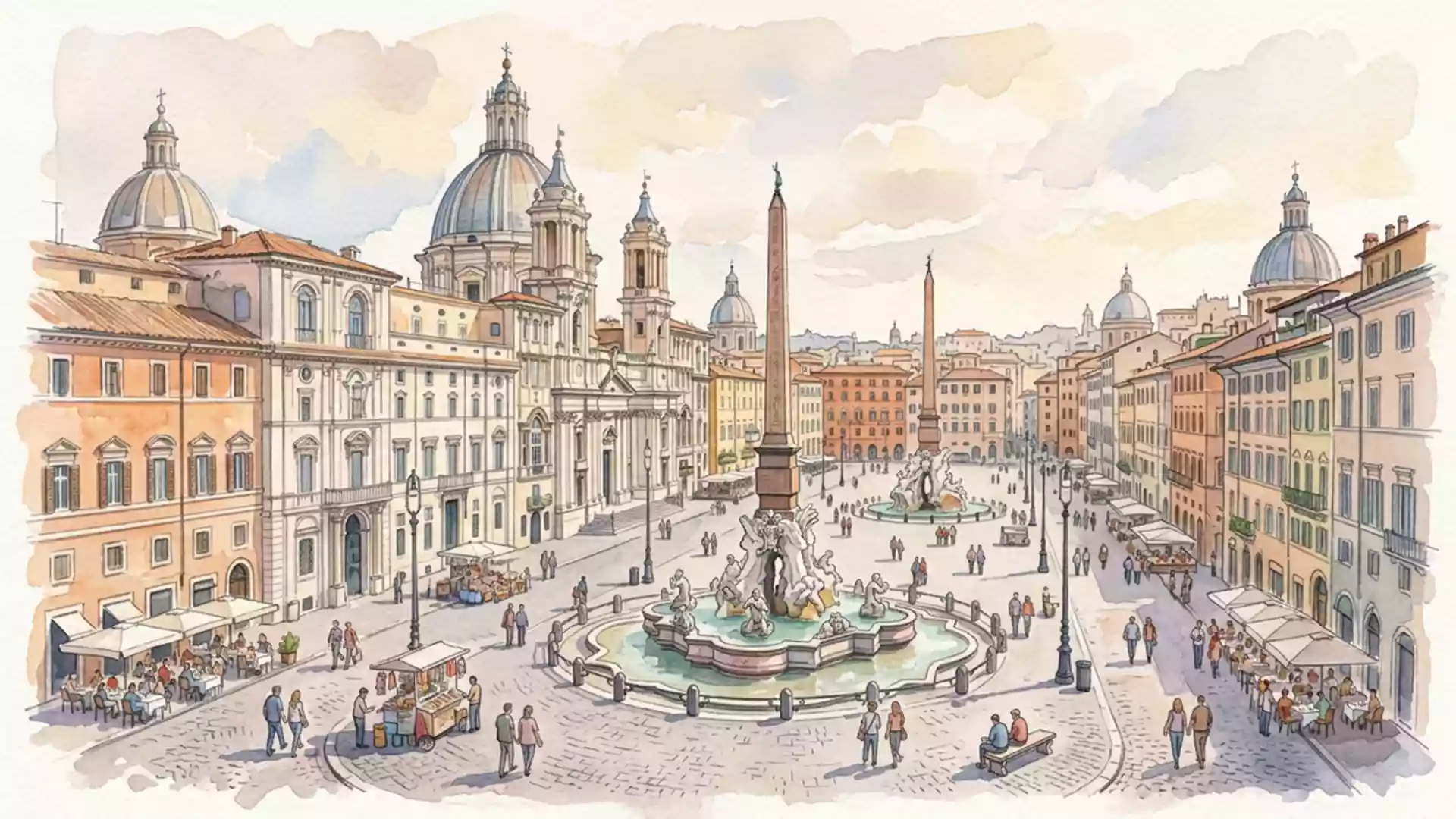
Modern Piazza Navona follows the footprint of Domitian's Stadium, built in 86 AD for athletics and horse racing. The ancient remains lie roughly 5 to 6 metres below the present street level, and sections can still be seen beneath buildings near the square and beneath Sant'Agnese in Agone, according to Rome's official square guide.
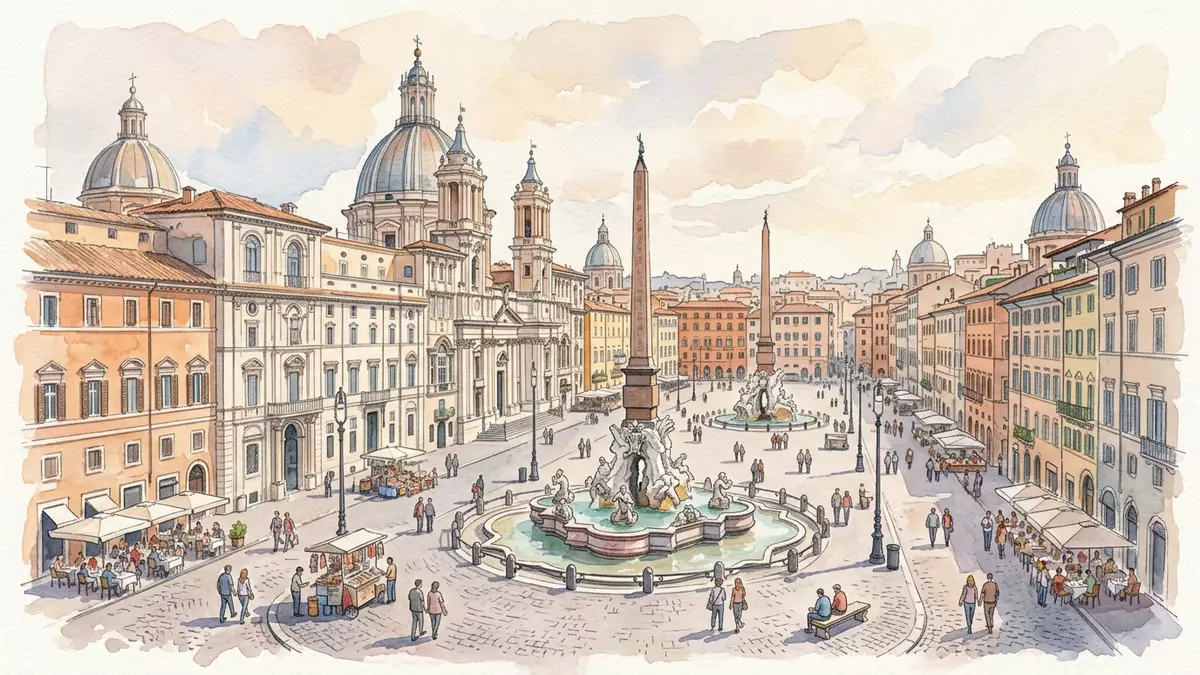
The Baroque appearance developed in the seventeenth century. The central Fountain of the Four Rivers was made by Gian Lorenzo Bernini in 1651, while the surrounding church, palaces and two other fountains frame the elongated stadium plan.
That setting gives the exhibition a specific connection with its location: visitors move from a square shaped by an ancient sports venue and later Baroque rebuilding into a gallery concerned with the religious and cultural networks of the Adriatic. The exhibition therefore adds a temporary archaeological theme to a place whose own form is an archaeological survival.
Visiting Piazza Navona: what travellers from Western Europe should know
- Isole e Santi is scheduled at the École française de Rome, Piazza Navona 62, through 29 October 2026.
- Admission to the exhibition is free, as stated by Turismo Roma and the École française de Rome.
- The venue is in Rome, Italy, beside the square's Baroque fountains, Sant'Agnese in Agone and the buildings that follow Domitian's Stadium footprint.
- The exhibition concerns monasteries and ecclesiastical sites in Istria and Dalmatia, while Italian is the official language and the euro is the national currency.
Searching for Piazza Navona on social platforms
These links open searches for Piazza Navona on each platform.
Frequently asked questions about Piazza Navona
When does Isole e Santi take place at Piazza Navona?
The exhibition runs at the École française de Rome, Piazza Navona 62, until 29 October 2026.
What is Piazza Navona?
It is a Baroque square in Rome built over the footprint of Domitian's Stadium, constructed in 86 AD.
Where is Piazza Navona and how do you get there?
Piazza Navona is in central Rome, Italy, and the exhibition venue is at number 62 on the square.