
Piazza Navona and Rome’s Baroque stage
Published on 09/15/2026 at 17:15 | Editorial responsibility: Rafael Müller, Editor-in-Chief AD HOC NEWS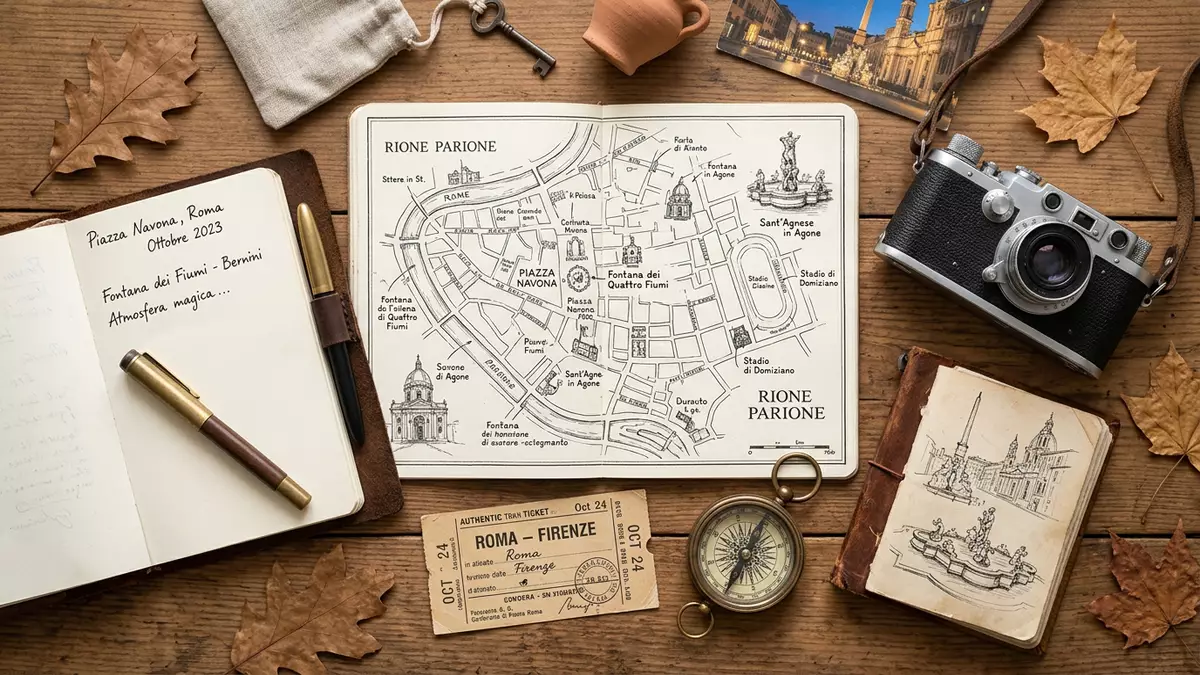
Piazza Navona in Rom is an open square with a long oval plan, set above the footprint of the Stadium of Domitian. That Roman base remains legible in the way the space stretches between palaces, churches and fountains.
An oval square over the Stadium of Domitian
The square follows the line of the ancient stadium, and that form gives it a character unlike a regular civic piazza. The broad middle opens onto the Fountain of the Four Rivers, while the edges hold façades from later centuries. The Stadium of Domitian and the square’s Baroque development anchor its historical identity.
The name recalls the older use of the site, and the open space belongs to the deep Roman layering that shapes much of the city centre. The square’s present appearance brings together antique substructure, seventeenth-century sculpture and later architectural additions. the Fontana dei Quattro Fiumi and Giacomo della Porta are part of that visual mix.
Bernini, Borromini and the square’s centre
At the centre stands Gian Lorenzo Bernini’s Fountain of the Four Rivers, completed in 1651. The fountain’s sculpted mass rises around an obelisk, and the ensemble gives the middle of the square a strong vertical accent. Francesco Borromini is present at the edge of the square in Sant'Agnese in Agone, one of the names tied most closely to Piazza Navona. Gian Lorenzo Bernini and Francesco Borromini remain the key Baroque names here.
The square also contains two additional fountains, one at each end, which balance the central composition. Giacomo della Porta’s work appears again in the Fontana del Moro and the Fountain of Neptune, extending the square’s sculptural rhythm across its length. The result is a civic space read as much through stone and water as through its façades.
A Roman public space with layered façades
Piazza Navona is surrounded by buildings that belong to different phases of Roman history. Palazzo Pamphilj faces the square, and Sant'Agnese in Agone marks one side with a church front tied to the Baroque reshaping of the area. The square reads as a sequence of façades rather than as a single enclosed room.
The Baroque character is strongest in the centre, but the wider setting remains urban and open. The square keeps the scale of a place for gathering, movement and pause, while its monuments hold the eye across a long enclosed oval. the 17th century and Baroque design describe the main period and style of this transformation.
Visiting Piazza Navona: what travellers from Western Europe should know
- The square lies in central Rom, within walking reach of the Pantheon and Campo de' Fiori. Buses serve the surrounding streets, and the nearest lanes lead directly into the piazza.
- The ground is level, but the square is broad and works as an open urban space rather than a compact courtyard. The longest sightlines run along the oval axis.
- The principal monuments sit in the open air, with the central fountain and the two end fountains forming the clearest visual markers. Sant'Agnese in Agone and Palazzo Pamphilj frame the edges.
- The area uses Italian as the official language and the euro as the currency.
Searching for Piazza Navona on social platforms
These links open searches for Piazza Navona on each platform.
Frequently asked questions about Piazza Navona
Where is Piazza Navona?
It is in central Rom, on the site of the Stadium of Domitian. The square sits close to other historic places in the city centre.
What should be expected on a visit?
An open Baroque square, three fountains and several façades define the experience. The space is broad, paved and framed by churches and palaces.
What makes Piazza Navona distinctive?
Its long oval plan follows the ancient stadium below it, and the Baroque fountains give the space its strongest visual identity. Bernini and Borromini remain the names most closely tied to it.


