
Piazza Navona and Rome’s baroque open stage
Published on 09/16/2026 at 22:39 | Editorial responsibility: Rafael Müller, Editor-in-Chief AD HOC NEWS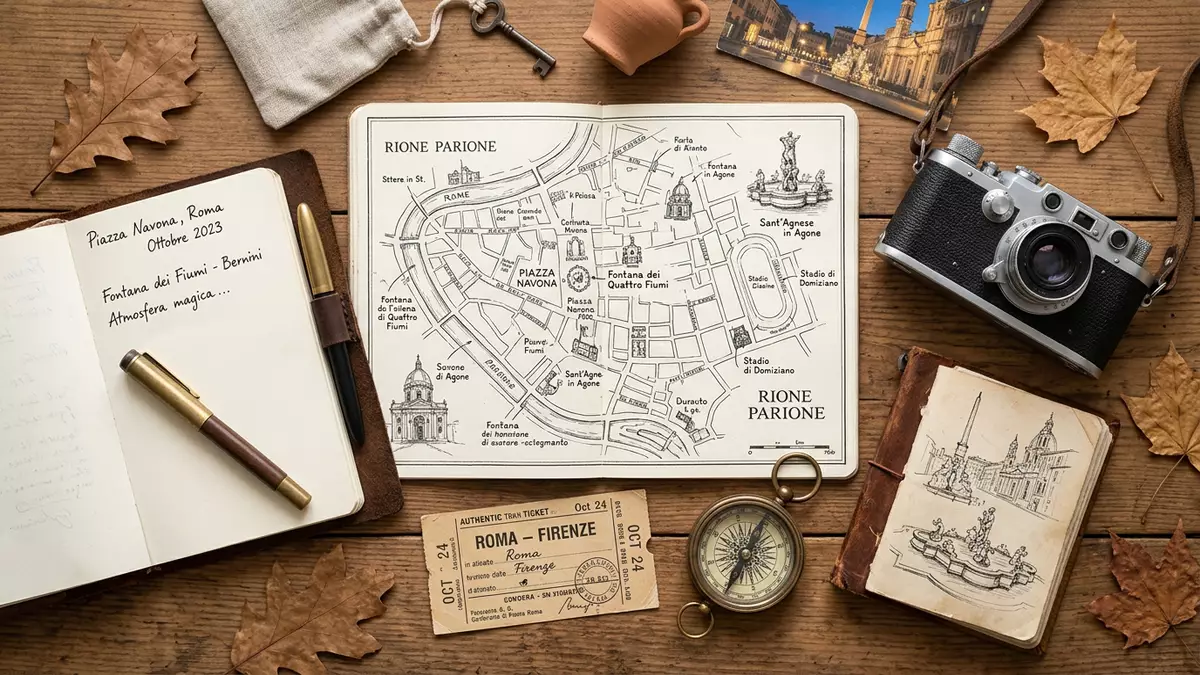
Piazza Navona in Rom keeps the long outline of the Stadium of Domitian, and that shape still defines the square’s open space. Gian Lorenzo Bernini and Francesco Borromini gave it a baroque face in the seventeenth century.
The oval that remembers Domitian
The square sits on the footprint of the Stadium of Domitian, built under Emperor Titus Flavius Domitianus in AD 80. Its elongated form is the most immediate clue to that earlier use, even before the fountains or churches come into view.Stadium of Domitian
In the last years of the fifteenth century, the area became a public market space, and the square later took on the layered appearance that survives in Rome’s centre. The baroque setting that followed sits on an older Roman plan rather than hiding it.ancient perimeter
Bernini, Borromini and the baroque frame
At the centre stands the Fountain of the Four Rivers, completed in 1651 and linked with Bernini’s name. Around it, the square gathers churches and palaces that define one of Rome’s clearest baroque ensembles.Fountain of the Four Rivers
Opposite the fountain stands Sant'Agnese in Agone, associated with Francesco Borromini, while Palazzo Pamphilj faces the piazza from the same historic setting. The result is a space where sculpture, church frontage and palace façade share the same broad urban stage.Sant'Agnese in Agone
Layers of use in the centre of Rom
The square belongs to the Parione district and lies west of the Pantheon, in a part of Rom dense with historic streets. Its role as a gathering place has been tied to market life, church architecture and civic display across different periods.Parione district
What makes the place distinctive is not a single monument but the way Roman remains, baroque façades and the broad paved square fit together in one field of view. That combination makes it an unusually readable fragment of central Rom.
Visiting Piazza Navona: what travellers from Western Europe should know
- The square lies in the Parione district, west of the Pantheon. It is reached on foot through the historic centre and by buses serving the surrounding streets.
- The ground is level and fully paved. The space is open, with no steep approach inside the square itself.
- Sant'Agnese in Agone, Palazzo Pamphilj and the central fountains are the main fixed elements to look for. Their arrangement gives the place its broad, enclosed feel.
- The setting is most legible in daylight, when the façades and the stadium outline are easier to read. The same form remains visible after dark, but the details are harder to distinguish.
Searching for Piazza Navona on social platforms
These links open searches for Piazza Navona on each platform.
Frequently asked questions about Piazza Navona
Where is Piazza Navona?
It is in central Rom, in the Parione district, west of the Pantheon. The square follows the footprint of the Stadium of Domitian.
What does a visit involve?
The place is an open urban square with fountains, churches and palaces around it. The broad paving and long outline make the older Roman plan easy to read.
What makes it distinctive?
The square combines an ancient stadium plan with baroque monuments by Bernini and Borromini. The result is a layered civic space rather than a single isolated building.


