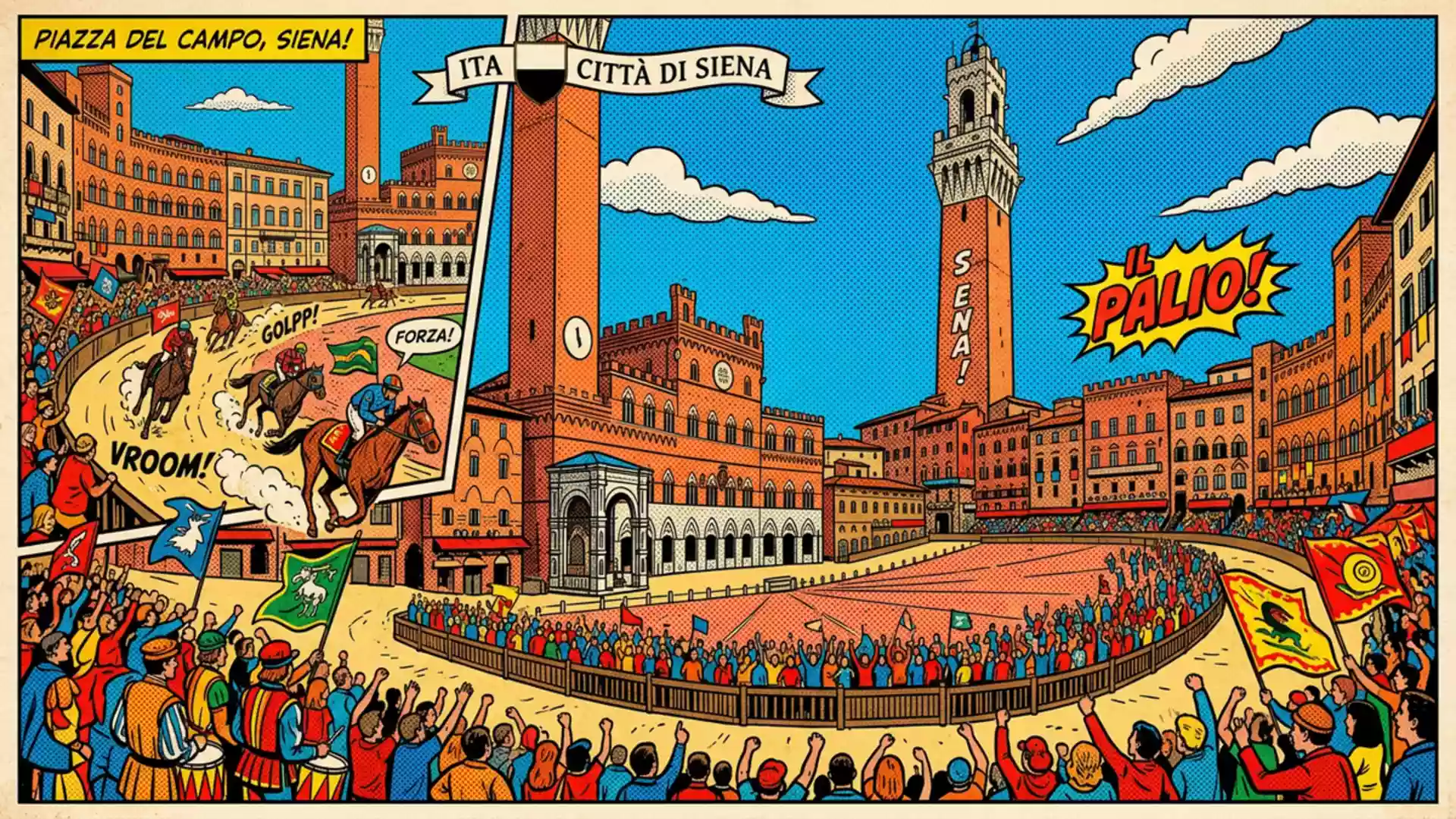
Piazza del Campo, Siena’s shell-shaped civic stage
Published on 09/07/2026 at 13:06 | Editorial responsibility: Rafael Müller, Editor-in-Chief AD HOC NEWS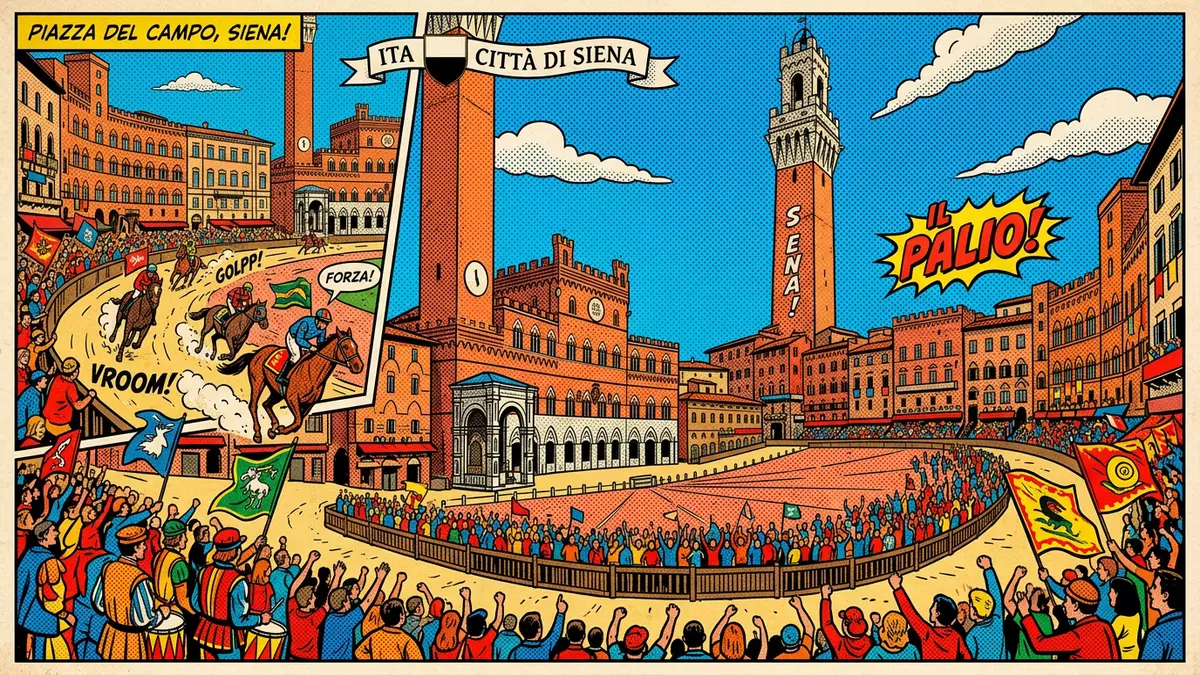
Piazza del Campo is the main square of Siena in Italy, a shell-shaped civic space laid out on a sloping hollow between three historic hills that merged into the medieval city.
The shell-shaped heart of Siena
Piazza del Campo occupies a shallow basin where the hillside districts of Castellare, San Martino and Camollia once converged, giving Siena a natural focal point for its public life.Castellare, San Martino and Camollia The name “Campo” recalls an earlier open field that drained rainwater and offered space for markets before it was formalised as a square.
The square’s surface descends gently towards the centre and spreads in a broad fan, creating a shell-like form that has become one of the clearest visual signatures of Siena.shell-like form Brick paving laid on edge emphasises the slope and curvature, turning the entire piazza into a continuous surface rather than a collection of separate plots.
Medieval government written into the bricks
Piazza del Campo took shape in the thirteenth and fourteenth centuries, when Siena’s republican institutions consolidated their authority and reshaped the valley into a single civic room for the town.thirteenth and fourteenth centuries The Government of Nine, a council that ruled Siena at the end of the thirteenth century, oversaw statutes regulating facades and windows facing the square, which gave the surrounding buildings a strikingly consistent appearance.statutes regulating facades
The brick paving completed in the fourteenth century is divided into nine long curving sections that converge near the lowest point of the piazza, a pattern commonly associated with the Government of Nine.nine sections of brick paving From ground level this geometry is visible as a series of slightly arched lines running across the surface, subtly organising the space without interrupting movement.
Palazzo Pubblico and Torre del Mangia
On the shallowest side of Piazza del Campo stands the Palazzo Pubblico, the medieval town hall built in the late thirteenth and early fourteenth centuries as the seat of Siena’s civic government.Palazzo Pubblico Its brick facade, crenellations and gothic windows form a continuous backdrop to the square, anchoring one end of the shell and framing views from almost every point on the paving.
Beside the Palazzo Pubblico rises the Torre del Mangia, Siena’s slender campanile, constructed between 1325 and 1348 and reaching around 102 m (335 ft) to the top of its lightning rod.Torre del Mangia height The tower’s brick shaft and lighter stone crown echo the colours of the surrounding buildings and give the square a strong vertical marker against the predominantly horizontal sweep of the paving.
Visiting Piazza del Campo: what travellers from Western Europe should know
- Piazza del Campo lies in the historic centre of Siena in Tuscany, reached on foot along narrow streets leading out from the main thoroughfares and bus stops.
- The square itself is a broad paved slope; moving around it involves walking on inclined brick surfaces, and some surrounding lanes rise sharply towards the hilltop districts.
- Several streets open directly onto the piazza from different levels, so approaches can involve short staircases or ramps between the surrounding buildings and the brick paving.
- The official language is Italian and the currency is the euro.
Searching for Piazza del Campo on social platforms
These links open searches for Piazza del Campo on each platform.
Frequently asked questions about Piazza del Campo
Where is Piazza del Campo located?
Piazza del Campo is in the historic centre of Siena, a Tuscan city in central Italy built across three hills.
What should visitors expect when they arrive?
Visitors encounter a broad, brick-paved slope enclosed by medieval palaces, with the Palazzo Pubblico and Torre del Mangia forming a dominant backdrop on one side.
What makes Piazza del Campo distinctive among Italian squares?
Its shell-like paved basin, nine-part brick pattern and integration of civic buildings such as the Palazzo Pubblico and Torre del Mangia give it a recognisable medieval character.