
Piazza del Campo, Siena’s shell-shaped civic heart
Published on 08/22/2026 at 15:52 | Editorial responsibility: Rafael Müller, Editor-in-Chief AD HOC NEWS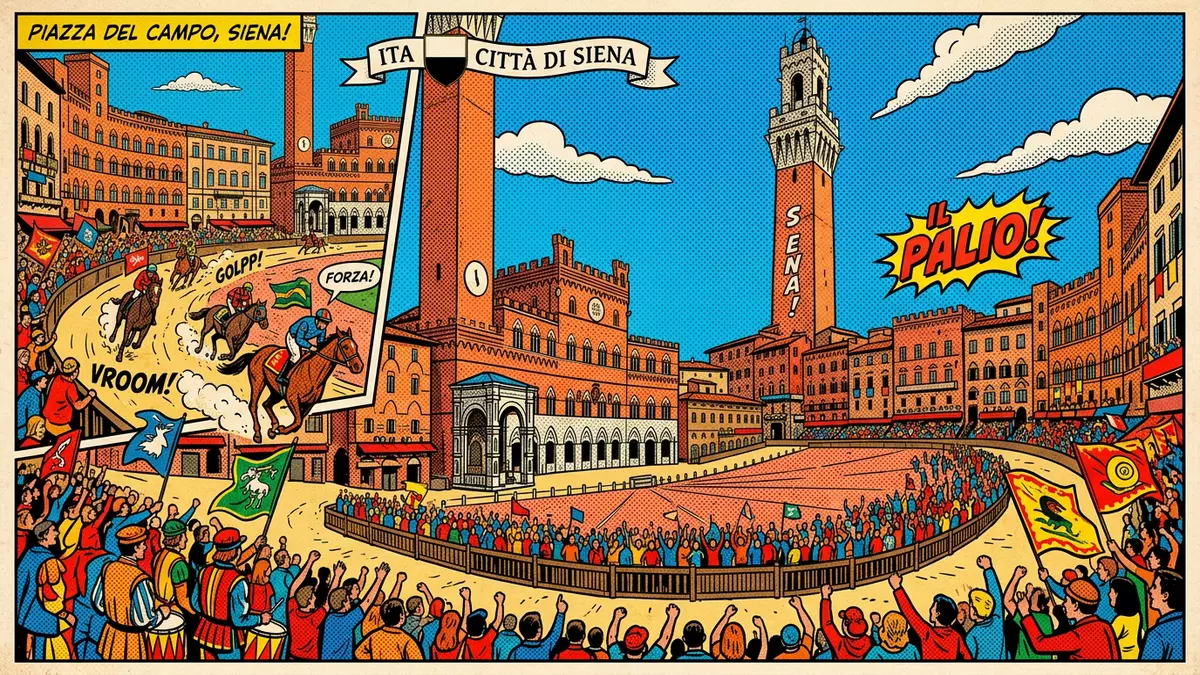
Piazza del Campo is the brick-paved civic square at the centre of Siena, shaped as a broad shell that slopes towards the Palazzo Pubblico and its slender Torre del Mangia. Its present form belongs to the late thirteenth and fourteenth centuries, when the republican Government of the Nine fixed Siena’s civic focus around this amphitheatre-like space.
A shell-shaped stage in a natural hollow
The defining impression of Piazza del Campo is its shell-like plan, a gently sloping hollow framed by closely packed brick and stone palaces. The square occupies a natural depression where three historic hilltop communities of Siena converged, a meeting point that helped turn this valley into the city’s civic centre.The open site was established before the thirteenth century and gradually formalised into a paved piazza.
The brick paving is laid in broad bands that fan out from the lowest edge, divided by stone ribs into nine distinct sections. These nine wedges echo the Government of the Nine that ruled Siena between 1287 and 1355, embedding political memory directly into the surface of the square.The surfacing of the Campo was completed in 1349 with this nine-part pattern, turning an open market field into a carefully ordered urban floor.
From medieval market field to civic drawing room
Long before it became a formal piazza, this valley floor functioned as a market ground serving the communities clustered on Siena’s surrounding ridges. Documentary references from 1169 already mention the area under the Latin name Campus Sancti Pauli, covering both the present Campo and the adjacent market square behind the later Palazzo Pubblico.The first recorded mention of the Campo dates to 1169, when it was described as a valley used for markets.
Through the thirteenth century, Siena’s republican government acquired and regulated this land, dividing it from the separate Piazza del Mercato and issuing statutes that controlled the facades facing the Campo.By the end of the thirteenth century, rules specified window types and alignment for palaces opening onto the square, creating the cohesive brick and stone frontage that still frames the space. The result is a continuous ring of buildings that read as a single architectural ensemble, despite being the work of different families and institutions.
Palazzo Pubblico, Torre del Mangia and the civic skyline
At the lowest edge of the slope stands the Palazzo Pubblico, Siena’s medieval town hall built in brick with stone trim, forming a long, slightly concave front that mirrors the curvature of the piazza. Construction of this civic palace began in the 1290s, providing a permanent seat for Siena’s republican magistrates and visually anchoring the southern side of the Campo.The Palazzo Pubblico rose from 1297 under the Government of the Nine, tying the building chronologically and politically to the layout of the square.
Beside the palace rises the Torre del Mangia, a slim brick and stone campanile completed in the mid-fourteenth century and reaching over 100 m (328 ft) above the piazza.The tower is recorded as 102 m high, its height carefully balanced against the nearby cathedral’s dome in Siena’s skyline. The tower’s belfry, with its pale stone crown above a brick shaft, adds a vertical counterpoint to the broad brick fan of the Campo below, reinforcing the sense of the piazza as a civic theatre focused on its public institutions.
Visiting Piazza del Campo: what travellers from Western Europe should know
- Piazza del Campo lies in the historic centre of Siena in Tuscany, Italy, a short walk downhill from the city’s cathedral along streets that follow the ridges into the natural hollow.
- The surface of the piazza slopes noticeably towards the Palazzo Pubblico, and the brick paving follows this gradient, so walking across the square involves gentle inclines rather than a level floor.
- Vehicles are excluded from the interior of the Campo, and access from the surrounding streets involves short descents along stone or brick-paved lanes that open suddenly into the wide shell-shaped space.
- The official language is Italian and the currency is the euro.
Searching for Piazza del Campo on social platforms
These links open searches for Piazza del Campo on each platform.
Frequently asked questions about Piazza del Campo
Where is Piazza del Campo?
Piazza del Campo is in the historic centre of Siena in Tuscany, Italy, occupying a natural hollow where several of the city’s main streets converge.
What should visitors expect on a first visit?
Visitors encounter a broad brick-paved square that slopes towards the Palazzo Pubblico and Torre del Mangia, framed by medieval palaces forming a continuous architectural ring.
What makes Piazza del Campo distinctive among Italian piazzas?
The shell-like plan divided into nine brick sections, the pronounced slope and the alignment on Siena’s civic buildings together give Piazza del Campo a theatrical character unusual among Italian squares.


