
Piazza del Campo, Siena’s brick-lined civic amphitheatre
Published on 09/15/2026 at 17:56 | Editorial responsibility: Rafael Müller, Editor-in-Chief AD HOC NEWS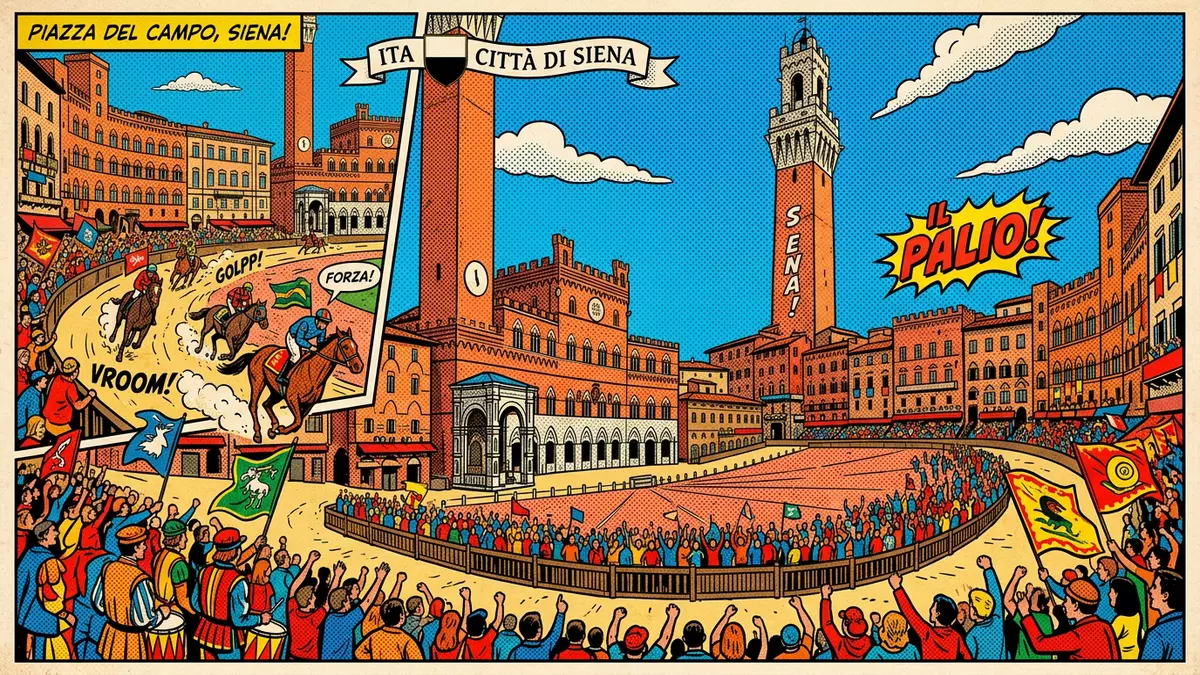
Piazza del Campo is the brick-paved main square of Siena in Tuscany, set within a natural hollow where three historic hilltop communities meet. Its shell-like layout, brick surfacing and surrounding medieval palazzi turn an uneven valley into a broad civic amphitheatre focused on the Palazzo Pubblico and the Torre del Mangia.
A medieval square shaped around a natural hollow
Piazza del Campo occupies a shallow valley at the junction of three hills that once held separate settlements, later fused into the city of Siena. Long before stone facades and brick paving framed the space, this hollow functioned as a field and marketplace, a central ground for trade and civic life beneath the surrounding streets and houses.main public space of Siena The name “Campo” reflects this origin as an open field area, only gradually formalised into the distinct piazza known today.origins of the Campo as a concave field
Documents from 1169 already refer to the valley that became Piazza del Campo, at that point encompassing the area later divided between the present square and the adjacent Piazza del Mercato. By the end of the twelfth century the commune of Siena began asserting control over this terrain, separating the trading functions of the Campo from the smaller market piazza and embedding the hollow within the growing network of streets and civic spaces.early references from 1169 and 1193 Over the thirteenth century this ground evolved from a loosely defined fairground into a deliberate urban stage at the heart of the republic.
Governo dei Nove and the brick shell of the Campo
The present form of Piazza del Campo is closely tied to the Government of Nine, the oligarchic council that guided Siena through its thirteenth and fourteenth-century heyday. Under this regime the commune issued regulations in 1297 governing facades and building lines around the valley, ensuring a continuous ring of palazzi and civic structures that shared a coherent architectural rhythm.municipal regulations of 1297 The same period saw the rise of the Palazzo Pubblico, a brick Gothic town hall anchoring the lower edge of the square, with the tall Torre del Mangia as its civic tower.Palazzo Pubblico and Torre del Mangia above the Campo
The paving of the Campo in brick and stone belongs to the early fourteenth century, when the surface was laid out in a distinctive fishbone pattern of red brick divided by pale travertine lines. These lines create a shell-like fan divided into nine wedge-shaped sectors that converge towards the Palazzo Pubblico, echoing the number of the council members of the Governo dei Nove and reinforcing the sense of a staged civic room.brick paving divided into nine sections The square’s circumference is recorded as around 333 m (1,093 ft), giving enough breadth for markets, assemblies and mass gatherings framed by the enclosing arc of buildings.333 metre shell-shaped piazza
Brick, stone and civic landmarks around the Campo
Walking across Piazza del Campo reveals the careful interplay between materials and civic symbols. Underfoot, red brick laid in a herringbone pattern rises and falls gently with the hollow, cut by pale stone bands that mark the nine sectors associated with Siena’s republican government. At the lower edge, the brick mass of the Palazzo Pubblico presents crenellations, pointed openings and a long loggia, gathering municipal functions that have occupied the building since the late thirteenth century.seat of city governments Above the palace rises the Torre del Mangia, a civic tower built in the early fourteenth century and recorded at about 102 m (335 ft) high, with a stone crown above its brick shaft.102 metre Torre del Mangia
Around the remaining sides of the square, noble townhouses and later palazzi form an unbroken backdrop of brick and stone, many with gently curved fronts that follow the arc of the paving. At one side stands the Fonte Gaia, a historic fountain whose present marble basins and reliefs recall a fifteenth-century project by Jacopo della Quercia, relocated and reconstructed in later centuries while retaining its role as a focal point on the upper edge of the Campo.Fonte Gaia and early square development The ensemble of brick paving, civic tower, town hall and arc of palazzi gives Piazza del Campo a coherent medieval character that reflects Siena’s thirteenth and fourteenth-century prosperity and self-government.thirteenth and fourteenth-century urban centre
Visiting Piazza del Campo: what travellers from Western Europe should know
- Piazza del Campo lies in the historic centre of Siena in Tuscany, with streets radiating from the square towards district gateways and nearby landmarks.
- The square occupies a sloping hollow, so access from surrounding streets involves short descents on brick or stone surfaces that can feel uneven underfoot.
- The Torre del Mangia rises beside the Palazzo Pubblico on the lower side of the Campo, and the Fonte Gaia sits on the opposite, higher edge of the square.
- Siena is in Italy; the official language is Italian and the currency is the euro.
Searching for Piazza del Campo on social platforms
These links open searches for Piazza del Campo on each platform.
Frequently asked questions about Piazza del Campo
Where is Piazza del Campo?
Piazza del Campo is the main square of Siena, a historic city in Tuscany in central Italy, set within the medieval core on a natural hollow.
What should visitors expect when they arrive at the Campo?
Visitors encounter a wide, shell-shaped brick surface sloping down towards the Palazzo Pubblico and Torre del Mangia, ringed by medieval palazzi and overlooked by civic buildings.
What makes Piazza del Campo distinctive among Italian squares?
Piazza del Campo is distinguished by its shell-like brick paving divided into nine sectors, its position in a hollow between three hills, and the ensemble of Palazzo Pubblico and Torre del Mangia.


