
Piazza del Campo and Siena’s brick-paved civic bowl
Published on 09/23/2026 at 01:28 | Editorial responsibility: Rafael Müller, Editor-in-Chief AD HOC NEWS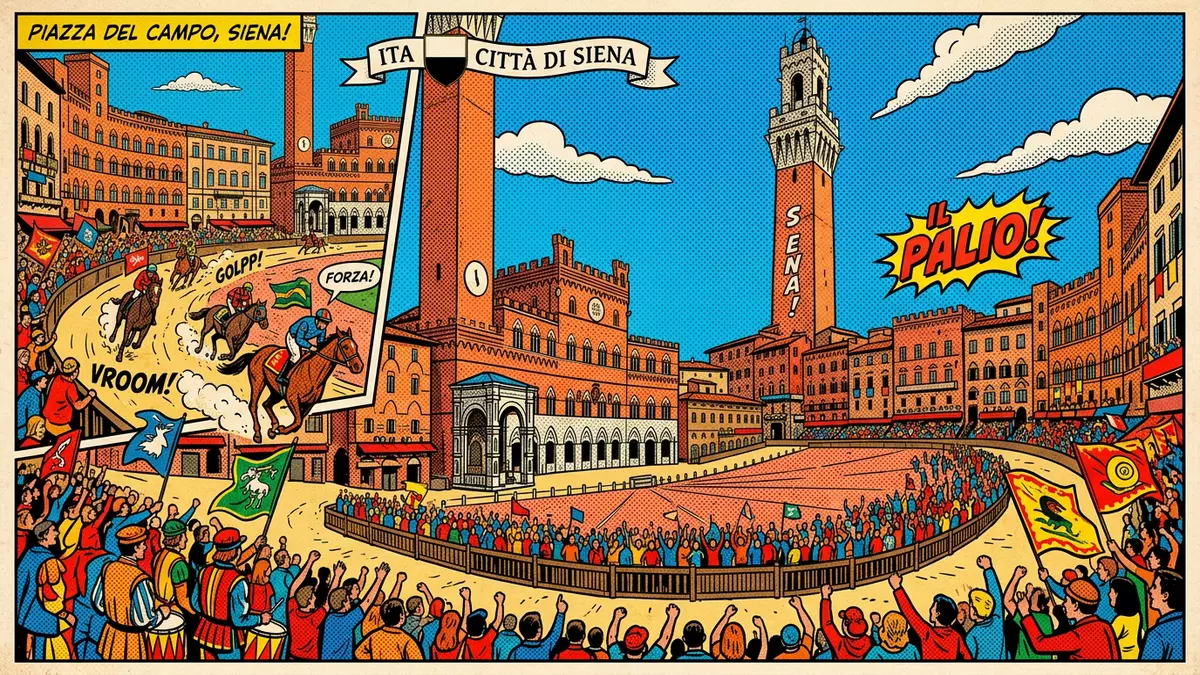
Piazza del Campo spreads across Siena as a shallow civic bowl paved in red brick and white travertine. Its shell-like surface gathers the eye towards the Palazzo Pubblico and Torre del Mangia, while the surrounding Gothic façades form a continuous urban room.
A shell of brick and travertine
The piazza’s surface is divided into nine sectors by bands of pale travertine. Red bricks laid in a herringbone pattern fill each section, creating a clear contrast between the warm paving and the lighter lines.
The square has a circumference of about 333 metres. Its sloping profile descends towards the Palazzo Pubblico, the historic seat of Siena’s civic government. The surrounding façades follow a restrained visual language, with masonry, brick and regular windows facing the open space.
The nine-part division recalls the Government of the Nine, which governed Siena from 1287 to 1355. Municipal regulations issued in 1297 shaped the appearance of buildings around the square, linking the paving and architecture within one civic setting. the nine-part paving remains the most visible expression of that arrangement.
From medieval market to civic stage
The first recorded reference to the Campo dates from 1169, when the name covered a broader valley that included the nearby market area. By 1193, the two spaces had been divided, and the Campo developed as a setting for commerce, public gatherings and civic occasions.
The Government of the Nine shaped the square during the late thirteenth and fourteenth centuries. The Palazzo Pubblico began in 1297, and its Gothic frontage forms the architectural focus of the lower side. The building contains the Museo Civico, whose rooms preserve major works connected with Siena’s artistic history.
Beside the palace rises the Torre del Mangia, a brick campanile with a pale stone crown. Construction of the tower belongs to the fourteenth century, and its vertical form balances the broad sweep of the piazza. the Palazzo Pubblico remains the square’s principal architectural landmark.
Fonte Gaia occupies the opposite side of the Campo. Jacopo della Quercia created the original fountain in the fifteenth century, while the sculpture visible in the piazza is a nineteenth-century reproduction by Tito Sarrocchi. The fountain’s marble reliefs add a sculptural counterpoint to the brick and stone setting.
The Palazzo Pubblico, Torre del Mangia and Fonte Gaia
The Palazzo Pubblico combines a long brick façade with pale stone details and a tall central tower. Its lower arcades open onto the piazza, while the upper storeys contain civic and museum spaces.
The Torre del Mangia stands immediately beside the palace. Built between 1325 and 1348, it rises in brick above the square and ends in a light-coloured stone belfry. Its name comes from Giovanni di Duccio, a bell ringer whose nickname referred to spending money on food.
At the tower’s base, the Cappella di Piazza forms a small open chapel facing the square. It was built between 1352 and 1376, and its marble elements continue the palette of the surrounding buildings.
Fonte Gaia marks the upper side of the Campo. The present basin carries copies of Jacopo della Quercia’s reliefs, while the originals are preserved elsewhere in Siena. The fountain’s position completes the visual relationship between water, paving and the civic buildings.
The historic centre of Siena, including Piazza del Campo, entered the UNESCO World Heritage list in 1995. the 1995 World Heritage inscription places the piazza within the protected urban fabric of the Tuscan city.
Visiting Piazza del Campo: what travellers from Western Europe should know
- Piazza del Campo lies in the historic centre of Siena, with pedestrian approaches from the surrounding medieval streets. The Palazzo Pubblico and Torre del Mangia stand on its lower side.
- The paving slopes across the square and consists of brick divided by travertine bands. Seating directly on the sloping surface is part of the ordinary layout.
- The Museo Civico occupies the Palazzo Pubblico, while the Torre del Mangia rises beside it and Fonte Gaia faces the palace across the piazza.
- The official language is Italian and the currency is the euro.
Searching for Piazza del Campo on social platforms
These links open searches for Piazza del Campo on each platform.
Frequently asked questions about Piazza del Campo
Where is Piazza del Campo?
Piazza del Campo is the principal public square in Siena, Tuscany, within the city’s historic centre. The Palazzo Pubblico and Torre del Mangia face the piazza.
What can visitors expect there?
The square presents a sloping brick surface, travertine divisions, Gothic façades, Fonte Gaia and the civic buildings around its edge. The Museo Civico occupies the Palazzo Pubblico.
What makes Piazza del Campo distinctive?
Its shell-like paving divides the square into nine sectors that point towards the Palazzo Pubblico. Brick, travertine, civic architecture and medieval planning share one continuous urban space.


