
Piazza dei Miracoli, Pisa’s marble meadow of monuments
Published on 08/22/2026 at 08:38 | Editorial responsibility: Rafael Müller, Editor-in-Chief AD HOC NEWS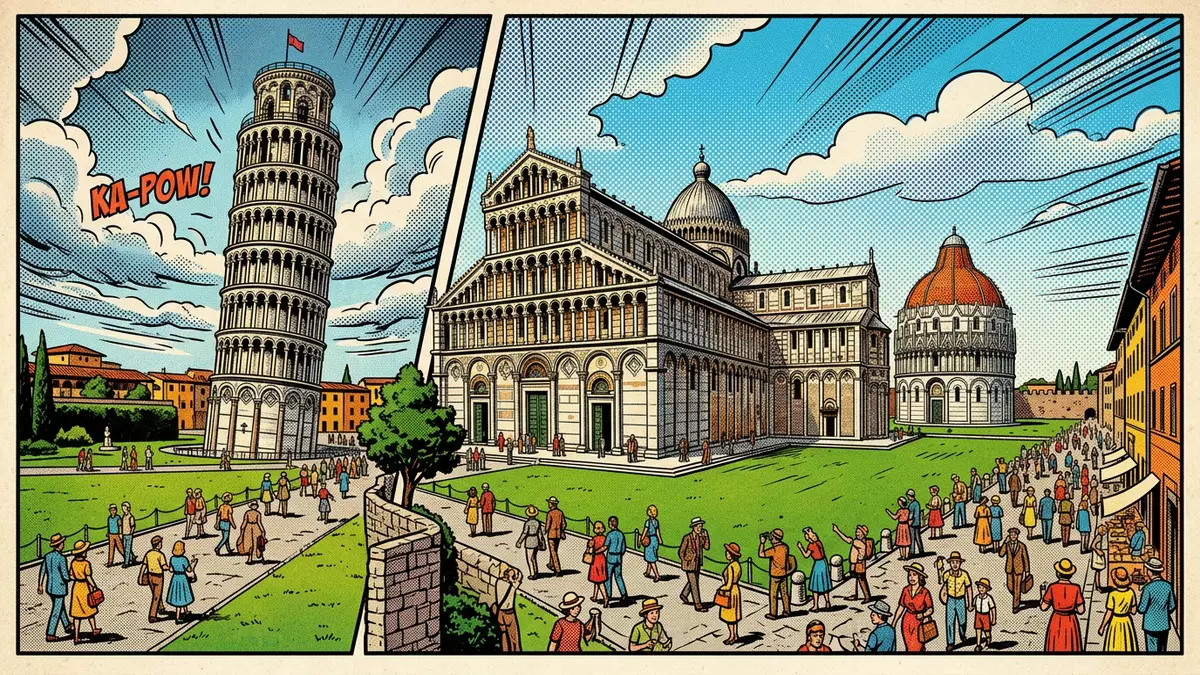
Piazza dei Miracoli in Pisa brings together a cathedral, baptistery, bell tower and monumental cemetery on a single expanse of grass, framed by medieval walls. This ensemble, formally known as Piazza del Duomo, became a UNESCO World Heritage Site in 1987 and remains one of the clearest statements of Tuscan Romanesque architecture. The square’s four main religious buildings rose between the eleventh and thirteenth centuries, turning a formerly peripheral area of Pisa into a composed landscape of white marble volumes.
A walled sacred field of marble and grass
Piazza dei Miracoli occupies a broad rectangular plot on the north-western edge of historic Pisa, set apart from the dense streets of the city centre by its own boundary walls and by the sweeping lawn that fills much of the interior. The formal name Piazza del Duomo underlines its role as the religious heart of Pisa, yet the nickname “Square of Miracles” has become the common term, referring to the visual impact of the four monumental structures rising from the grass.walled compound in Pisa The layout places the cathedral roughly at the centre, with the baptistery aligned to its western façade, the Leaning Tower standing to the south, and the Camposanto Monumentale closing the northern side.
The entire square is anchored in Pisan Romanesque architecture, which gives the buildings a shared vocabulary of pale stone, blind arcades and rhythmic colonnades. The grass underlines this coherence, acting as a continuous plane from which the marble structures rise without any major paved piazza dominating the view.architectural whole with stylistic accordance The surrounding walls, punctuated by gates, reinforce the sense of a distinct precinct dedicated to worship and ceremony rather than everyday commercial life.
The cathedral of Santa Maria Assunta
The cathedral of Santa Maria Assunta is the largest building on Piazza dei Miracoli and the one that defines the axis of the square. Construction of the present church began in 1064, in the midst of Pisa’s era as a maritime power, and the structure reflects that ambition in its scale and decorative richness.project to build the church dates from 1064 The cathedral’s plan follows a Latin cross, with a long nave, side aisles and a projecting transept, while the exterior combines Romanesque massing with decorative elements taken from classical monuments.
The main façade presents tiers of arcades carried on slender columns, set against a background of pale stone accented with coloured inlays and spolia from earlier Roman buildings. The side walls continue the arcaded rhythm at ground level, punctuated by portals that open towards the grass and towards the Camposanto. Inside, rows of columns separate the nave from the aisles, their capitals drawing on Byzantine and Islamic motifs that reached Pisa through trade and conflict in the Mediterranean.cathedral, baptistery, bell tower and cemetery The cathedral anchors the whole ensemble, with the other buildings oriented to it rather than to the city street grid.
Baptistery and Leaning Tower: vertical accents on the meadow
West of the cathedral stands the Baptistery of San Giovanni, a free-standing cylindrical structure that provides the space for the sacrament of baptism. Building work on this baptistery began in the 1150s under the architect Diotisalvi, and later campaigns in the following century by Nicola and Giovanni Pisano gave it a taller outer shell with Gothic detailing.construction started in 1153 under Diotisalvi The lower storey displays rounded Romanesque arches, while the upper zones add pointed gables, sculpted figures and intricate tracery, creating a layered effect when viewed against the grass.
The famous Leaning Tower of Pisa rises to the south of the cathedral as its campanile, providing both a vertical marker and the square’s most recognisable silhouette. Construction started in 1173, and the tower’s leaning profile appeared early in the building process due to the soft ground beneath its foundations.campanile started in 1173 and began to lean The tower climbs in stacked arcaded galleries, each level ringed by slender columns, so that the whole structure reads as a sculpted cylinder set slightly off the vertical.
At around 56 m (184 ft) in height, the Leaning Tower is not among the tallest bell towers in Europe, yet the combination of tilt and repetition of arches gives it a strong presence in the open field.tower 56 metres high with 8 storeys From the grass of Piazza dei Miracoli the viewer sees the tower always in relation to the cathedral, with the campanile’s curve echoing the apses and arcades of the main church rather than standing as an isolated monument.
Camposanto Monumentale and the extended ensemble
Along the northern edge of Piazza dei Miracoli runs the Camposanto Monumentale, a monumental cemetery that aligns burial chapels and tombs around an internal cloister. Work on this enclosure began in the late thirteenth century, giving Pisa a structured, architecturally coherent space for its funerary art.Camposanto Monumentale among the square’s monuments The exterior presents long walls marked by blind arches, mirroring the arcaded language of the cathedral but in a more restrained form.
Inside the Camposanto, sarcophagi from Late Antiquity stand alongside medieval and later tomb slabs, forming a sequence of marble reliefs and inscriptions that track centuries of local history.old burial ground with Late Antiquity sarcophagi Beyond the four most prominent buildings, the wider complex also includes the Opera del Duomo Museum and the Sinopie Museum, housed in structures near the square, which hold sculptures, paintings and preparatory drawings removed from the monuments to conserve them.six monuments and museums listed Taken together, the square and its associated museums form a concentrated record of Pisa’s religious and artistic life from the Middle Ages onwards.
Visiting Piazza dei Miracoli: what travellers from Western Europe should know
- Piazza dei Miracoli lies on the north-western side of Pisa’s historic centre and is reached on foot from central streets, or via local buses that stop near the walled square.
- The interior of the square consists largely of level grass and paved paths, while access to the towers and upper levels of monuments involves narrow staircases with several hundred steps.
- The site is within Italy, where the official language is Italian and the currency is the euro.
Searching for Piazza dei Miracoli on social platforms
These links open searches for Piazza dei Miracoli on each platform.
Frequently asked questions about Piazza dei Miracoli
Where is Piazza dei Miracoli located?
Piazza dei Miracoli is in Pisa, a Tuscan city in central Italy, on the north-western side of the historic centre within its own walled precinct.
What can visitors expect on a visit?
Visitors encounter a large grassed square containing the cathedral of Santa Maria Assunta, the Baptistery of San Giovanni, the Leaning Tower of Pisa and the Camposanto Monumentale.
What makes Piazza dei Miracoli distinctive among Italian squares?
The square’s distinction lies in its concentration of major medieval religious monuments, arranged on a single lawned field and recognised together as a UNESCO World Heritage Site since 1987.


