
Piazza dei Miracoli and Pisa’s marble meadow
Published on 09/24/2026 at 11:28 | Editorial responsibility: Rafael Müller, Editor-in-Chief AD HOC NEWS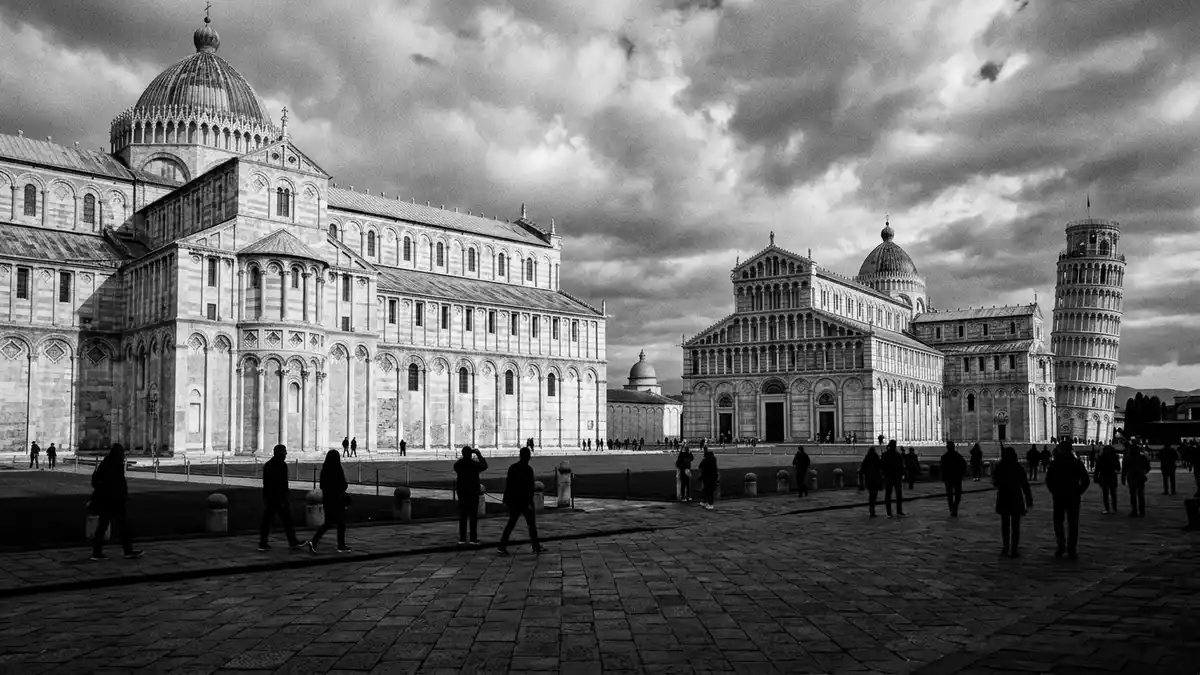
Piazza dei Miracoli spreads a cathedral, baptistery, leaning campanile and monumental cemetery across a broad green setting in Pisa. The white marble buildings form a medieval architectural group whose parts remain visible together from the square.
Piazza dei Miracoli: four monuments on one field
The formal name is Piazza del Duomo, while Piazza dei Miracoli is the name used for the wider monumental setting. Its four principal buildings are the Cathedral of Santa Maria Assunta, the Baptistery of San Giovanni, the Campanile known as the Leaning Tower, and the Camposanto Monumentale.
The arrangement brings several forms of medieval religious architecture into one open composition. The cathedral occupies the centre of the ensemble, with the baptistery facing it and the campanile standing separately beside it. The cemetery completes the group with an enclosed marble building and inner cloister. The four principal monuments belong to the same World Heritage property.
Medieval Pisa in marble, arcades and mosaics
The complex took shape between the eleventh and fourteenth centuries, during Pisa’s period as a powerful maritime republic. The Cathedral of Santa Maria Assunta began in the eleventh century, and its architecture established the scale and character of the group.
Pisan Romanesque details appear across the buildings: bands of coloured marble, repeated arcades, carved capitals, sculptural decoration and carefully ordered façades. The cathedral contains bronze and mosaic work, while the Baptistery combines a circular body with an elaborate exterior and sculpted portals. Inside the Camposanto, arcades surround a cloistered space associated with funerary art. The medieval building period gives the square its shared historical frame.
The Leaning Tower within a larger ensemble
The Leaning Tower is the campanile of Pisa Cathedral, yet its separation from the church makes it a distinct object in the square. Its cylindrical marble form rises through stacked arcades, with the visible inclination setting it apart from the upright buildings around it.
Seen across the grass, the tower’s curve contrasts with the cathedral’s long body, the baptistery’s rounded volume and the cemetery’s enclosed galleries. This contrast is central to the character of Piazza dei Miracoli: the celebrated campanile belongs to a larger group whose identity depends on all four buildings.
The name Piazza dei Miracoli means Square of Miracles. The official name, Piazza del Duomo, connects the site to the cathedral, while the familiar name evokes the extraordinary concentration of medieval monuments within one walled area. The ensemble entered the UNESCO World Heritage List in 1987, a designation covering its architectural and artistic unity. The World Heritage inscription records the group as four medieval masterpieces placed close together.
Visiting Piazza dei Miracoli: what travellers from Western Europe should know
- Piazza dei Miracoli lies in Pisa, Tuscany, just outside the historic centre. Pisa Centrale railway station connects the city with Italy’s main rail network, and local buses serve the area around the square.
- The site is an open grassy precinct crossed by paved approaches. The Leaning Tower contains a staircase, while the cathedral, baptistery and Camposanto have separate interior routes.
- The official language is Italian and the currency is the euro.
Searching for Piazza dei Miracoli on social platforms
These links open searches for Piazza dei Miracoli on each platform.
Frequently asked questions about Piazza dei Miracoli
Where is Piazza dei Miracoli?
Piazza dei Miracoli is in Pisa, Tuscany, beside the historic centre. The formal name of the square is Piazza del Duomo.
What can visitors see there?
The complex contains Pisa Cathedral, the Baptistery of San Giovanni, the Leaning Tower and the Camposanto Monumentale. Their façades, arcades, sculpture and marble surfaces create a connected medieval group.
What makes Piazza dei Miracoli distinctive?
Four major religious buildings occupy one open setting, with the leaning campanile contrasting with the cathedral, baptistery and cemetery. The ensemble has held UNESCO World Heritage status since 1987.


