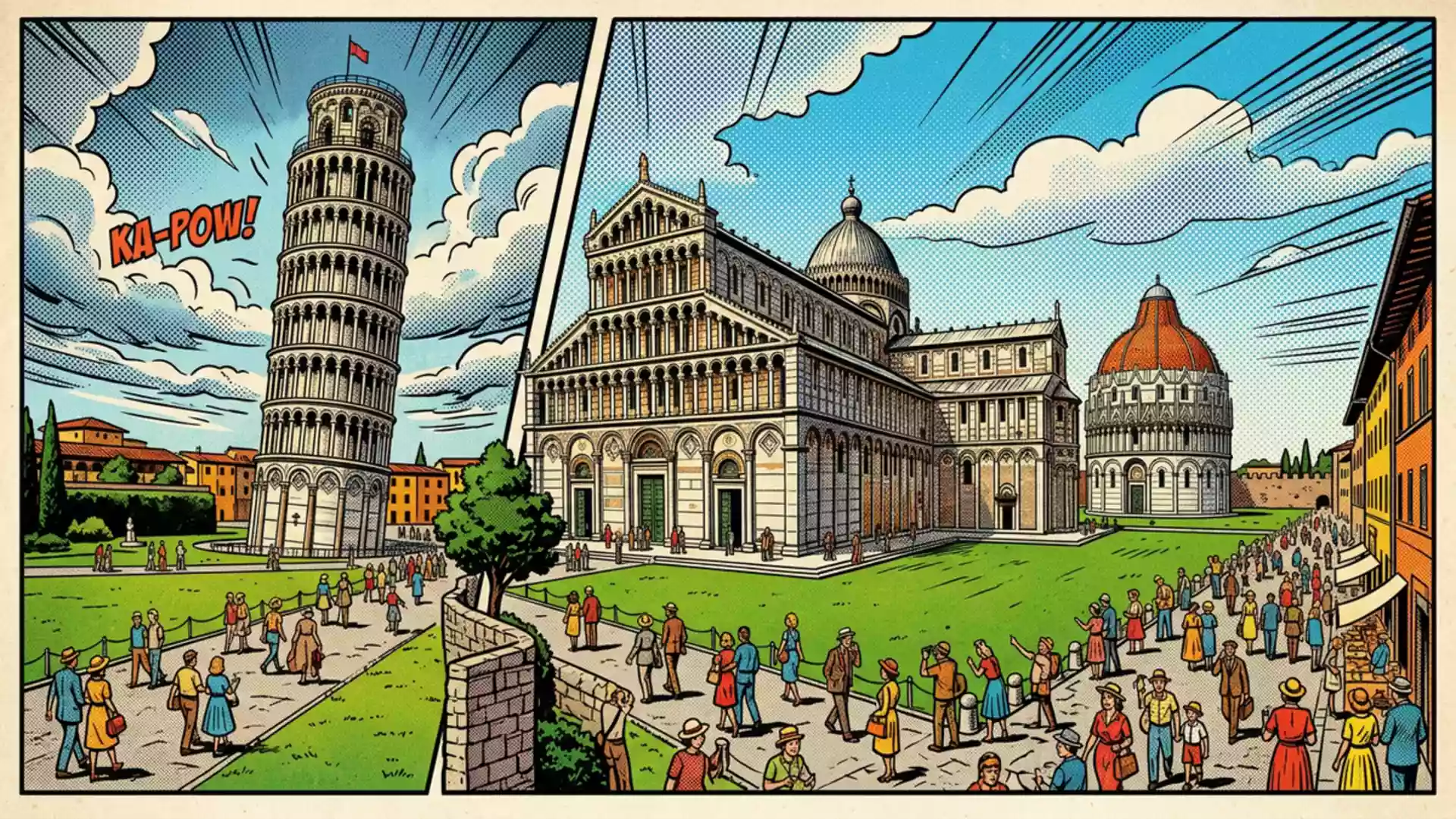
Piazza dei Miracoli, a walled meadow of marble in Pisa
Published on 09/02/2026 at 10:20 | Editorial responsibility: Rafael Müller, Editor-in-Chief AD HOC NEWS
Piazza dei Miracoli in Pisa is a walled expanse of grass and stone where an entire medieval religious world stands side by side: cathedral, baptistery, Leaning Tower and monumental cemetery, enclosed within one compound. Recognised as a UNESCO World Heritage Site in the twentieth century, the square concentrates centuries of Tuscan craftsmanship in a single, coherent ensemble that still reads as a sacred precinct.
A medieval sacred field enclosed by walls
Piazza dei Miracoli, formally Piazza del Duomo, occupies a large rectangle in the north-west of Pisa’s historic centre, pressed against the line of the medieval city walls that once defended the maritime republic.The Domplatz of Pisa Within this enclosure, visitors step onto a broad lawn punctuated by white marble structures whose sculpted facades stand out clearly against the grass. The compound has an area of about 8.87 hectares (21.9 acres), enough to hold major freestanding buildings while retaining the feeling of a single unified space rather than a dispersed city quarter.a walled 8.87-hectare compound
The name Piazza dei Miracoli goes back to the writer Gabriele d’Annunzio, who described the lawn beside the cathedral as a “meadow of miracles” in 1910, capturing the concentration of monuments in his phrase.the expression “Prato dei Miracoli” For centuries, however, the space has functioned as Piazza del Duomo, the cathedral square, where the city’s main church, its baptistery, its cemetery and its bell tower stand together as a self-contained religious district. The lawn, the stone paving and the encircling walls give the impression of entering a separate world devoted to ritual and memory rather than everyday urban life.
Cathedral, baptistery and the Leaning Tower
At the heart of Piazza dei Miracoli rises the Cathedral of Santa Maria Assunta, the seat of the archbishop of Pisa and a major example of Pisan Romanesque architecture.the Cathedral of Santa Maria Assunta Its long nave and tiered arcades are clad in pale marble, with bands and inlays that pick out arches and columns across the facade. The building was begun in the eleventh century, at a time when Pisa was asserting itself as a Mediterranean power, and its form reflects both the local Romanesque language and distant influences absorbed through trade.
Beside the cathedral stands the circular baptistery of San Giovanni, begun in the mid-twelfth century and completed in stages over the thirteenth century.the Pisa Baptistery Its lower body continues the Romanesque arcades of the cathedral, while the upper storeys introduce Gothic pinnacles and more elaborate sculptural detail. The baptistery’s position close to the cathedral door underlines its role in the ritual sequence of Christian life, linking initiation with worship within the same piazza. Completing the trio is the world-famous Leaning Tower of Pisa, the free-standing bell tower for the cathedral whose tilt began during construction in the twelfth century because of the soft ground beneath its foundations.the freestanding Campanile
Camposanto Monumentale and museums of memory
Closing the northern edge of Piazza dei Miracoli is the Camposanto Monumentale, a monumental cemetery whose cloister surrounds a central grassed court.the northern edge of the Cathedral Square The Camposanto was begun in 1277, forming a long, arcaded rectangle with round-arched openings that look inward to a quiet interior space of lawn and cypress trees.period of construction 1277 Inside the cloister walls, tombs and memorials line the passage, and fragments of frescoes recall the rich painted decoration that once covered large areas of the interior.
On the eastern side of the square, former hospital buildings house the Museo delle Sinopie and the Museo dell’Opera del Duomo, which together preserve preparatory drawings, sculpture and furnishings from the monuments around the lawn.the Sinopias Museum and the Cathedral Museum These museums add an additional layer of interpretation, taking visitors behind the finished marble surfaces to the processes and designs that produced them. As a group, cathedral, baptistery, Leaning Tower, Camposanto and museum buildings present a continuous sequence from birth through life to death, all held within the same walled precinct.
Visiting Piazza dei Miracoli: what travellers from Western Europe should know
- Piazza dei Miracoli lies in the north-west of Pisa’s historic centre, close to the medieval city walls; it is reached on foot or by local bus from the Pisa Centrale railway station.
- The monuments stand on a broad lawn and stone paving, with approaches that include cobbled paths and interior staircases; moving between them involves walking across open ground and negotiating steps inside the buildings.
- The square is in Italy, where the official language is Italian and the currency is the euro.
Searching for Piazza dei Miracoli on social platforms
These links open searches for Piazza dei Miracoli on each platform.
Frequently asked questions about Piazza dei Miracoli
Where is Piazza dei Miracoli located?
Piazza dei Miracoli is in Pisa, in the Tuscany region of Italy, on the north-western side of the historic centre close to the medieval walls.
What should a visitor expect on a first visit?
A visitor encounters a large walled lawn with the marble cathedral, baptistery, Leaning Tower and monumental cemetery standing as distinct buildings within the same enclosed space.
What makes Piazza dei Miracoli distinctive among Italian squares?
The square brings together the city’s principal religious buildings and cemetery in one walled compound, combining Romanesque and later elements in a consistent architectural ensemble focused on ritual and memory.