
Phra Borom Maha Ratcha Wang, Bangkok’s layered royal palace complex
Published on 09/14/2026 at 09:27 | Editorial responsibility: Rafael Müller, Editor-in-Chief AD HOC NEWS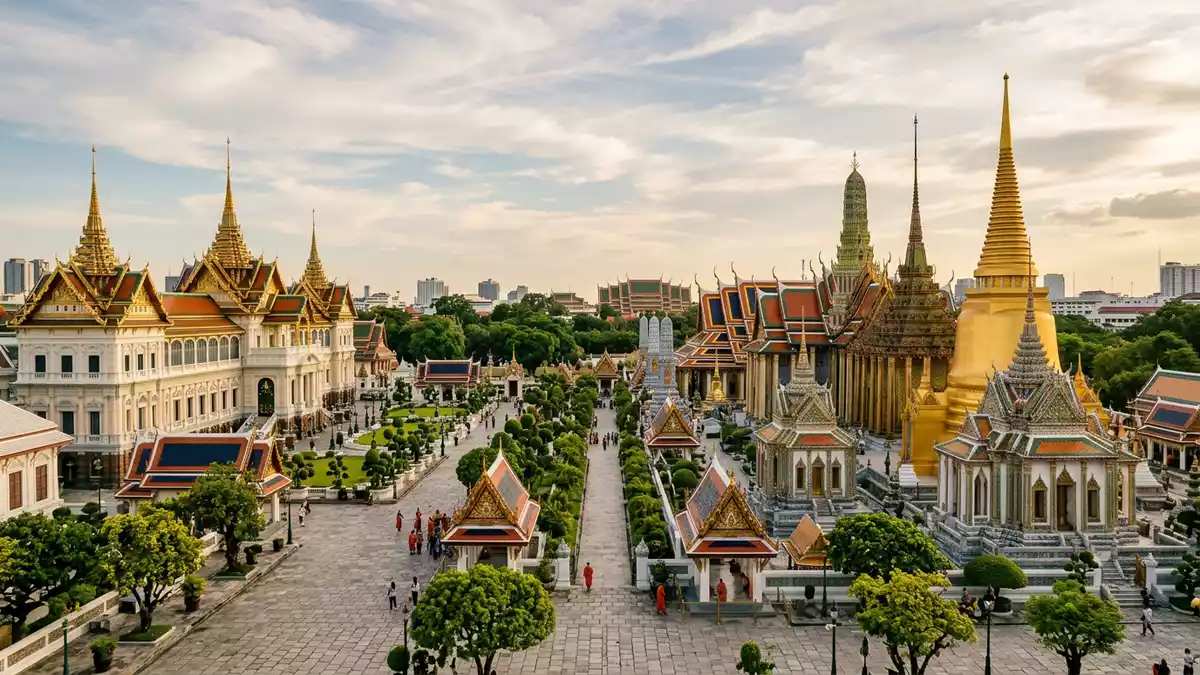
Phra Borom Maha Ratcha Wang, known in English as Bangkok’s Grand Palace, is a walled royal palace complex on Rattanakosin Island that has shaped the city’s historic core since the late eighteenth century. Construction began in 1782 under King Phutthayotfa Chulalok, Rama I of the Chakri dynasty, when the royal court shifted from Thonburi to the east bank of the Chao Phraya River.
A riverside royal seat at the heart of Rattanakosin
The palace complex occupies a prominent site in Phra Nakhon District on the western bank of the Chao Phraya, enclosed by defensive walls and formal gates that mark a clear boundary between the royal enclosure and the rest of Bangkok.The Grand Palace The chosen position on the river formed part of the historic Rattanakosin Island, an urban core shaped by the main channel and surrounding canals, and turned this section of Bangkok into the centre of the Siamese kingdom.
When Rama I ordered the construction of Phra Borom Maha Ratcha Wang in 1782, he also established Bangkok as the capital of Siam, anchoring the new city around the palace and the nearby administrative quarters.Rattanakosin Island in Phra Nakhon District Over time, successive kings expanded and altered parts of the palace, but the basic relationship between the complex, the river and the surrounding district has remained recognisable: a dense set of royal and religious buildings pressed against the riverfront, with ceremonial grounds and courtyards within the enclosure.
From royal residence to ceremonial and religious centre
For much of its history Phra Borom Maha Ratcha Wang served as the official residence of the kings of Siam and later Thailand, as well as the seat of the court and important state offices.official residence of the kings Within the palace grounds, different zones accommodated royal apartments, audience halls and administrative buildings, arranged to support a monarchy that combined political and ritual authority.
The complex also houses Wat Phra Kaew, the Temple of the Emerald Buddha, in its outer palace area, integrating a major religious site into the royal precinct.Temple of the Emerald Buddha in the Outer Palace Even after the royal residence moved elsewhere in the twentieth century, Phra Borom Maha Ratcha Wang retained its role as a setting for state ceremonies, royal rites and receptions, so the blend of palace and temple architecture still reflects an active ceremonial function rather than a purely historical display.
Architectural layers: Thai court style and imported forms
Architecturally, Phra Borom Maha Ratcha Wang brings together traditional Thai court buildings with structures that show later European influence. Early palace halls follow forms familiar from Ayutthaya, with multi-tiered roofs, rich gilded ornament and coloured glass set into pediments and wall panels, creating a profile of clustered roofs rising above the enclosure.Ayutthaya-derived royal architecture
During the reign of King Chulalongkorn, Rama V, new palace buildings were added that adopted elements of European architectural languages, including facades with classical detailing and more rectilinear masses alongside the older Thai halls.European-influenced palace buildings under Rama V This combination of ornate Thai rooflines, enclosed courtyards, temple structures and European-influenced palaces makes Phra Borom Maha Ratcha Wang a readable record of the Chakri dynasty’s engagement with different architectural traditions, all contained within one royal compound.
Visiting Phra Borom Maha Ratcha Wang: what travellers from Western Europe should know
- Phra Borom Maha Ratcha Wang stands in Phra Nakhon District on the western bank of the Chao Phraya River in Bangkok, reached by urban roads and river transport that converge around Rattanakosin Island.
- Within the palace grounds, movement between the halls, temples and courtyards involves walking on paved surfaces and climbing stairways between levels, so a visit includes time on foot in outdoor and indoor spaces.
- The official language of Thailand is Thai and the national currency is the baht.
- Entry requirements depend on your nationality; UK travellers can check the FCDO travel advice at gov.uk/foreign-travel-advice, Irish travellers the Department of Foreign Affairs at ireland.ie.
Searching for Phra Borom Maha Ratcha Wang on social platforms
These links open searches for Phra Borom Maha Ratcha Wang on each platform.
Frequently asked questions about Phra Borom Maha Ratcha Wang
Where is Phra Borom Maha Ratcha Wang located within Bangkok?
Phra Borom Maha Ratcha Wang stands in Phra Nakhon District on Rattanakosin Island by the Chao Phraya River, forming part of Bangkok’s historic centre.
What should visitors expect inside the palace complex?
Visitors encounter a dense ensemble of royal halls, temple buildings, courtyards and ceremonial grounds within a walled enclosure, with both Thai and European-influenced architecture.
What makes Phra Borom Maha Ratcha Wang distinctive among Thai royal sites?
The palace’s riverside setting, its role as the historic residence of the Chakri kings and its combination of Thai court architecture with later European forms give it a distinctive layered character.


