
Philae Temple and the island sanctuary of Isis near Assuan
Published on 08/21/2026 at 18:16 | Editorial responsibility: Rafael Müller, Editor-in-Chief AD HOC NEWS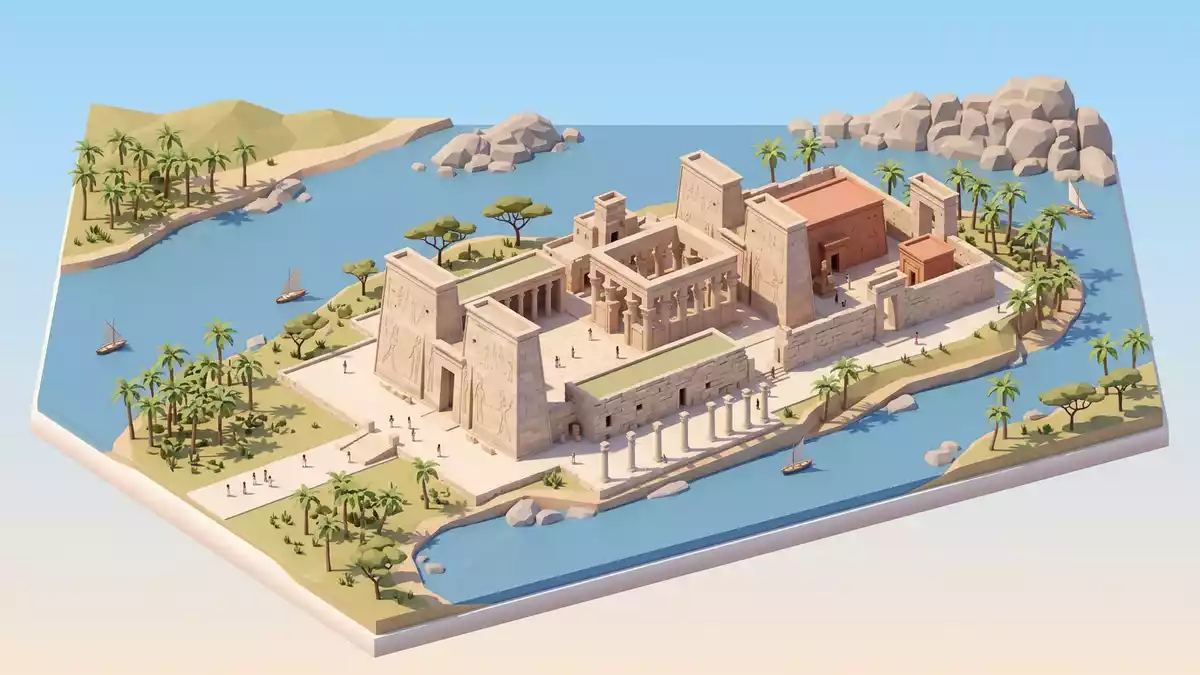
Philae Temple near Assuan in southern Egypt is an island sanctuary of the goddess Isis, rebuilt stone by stone on Agilkia Island after rising Nile waters threatened its original home on Philae Island. The complex spans late Pharaonic, Ptolemaic, Roman and Christian periods, making it one of the clearest architectural records of how Egyptian temple culture adapted through changing empires.
An island temple rescued from the Nile
Philae Temple stands on Agilkia Island in the Nile River between the old Aswan Dam and the Aswan High Dam, a short distance downstream from the submerged island of Philae itself. The complex originally rose on Philae Island above the First Cataract, a stretch of rocky rapids that marked the traditional frontier between Egypt and Nubia, where the river narrows and granite outcrops form natural platforms for temples.island in the Nile River After the construction of the Aswan dams and the impoundment of Lake Nasser, Philae Island lay partially and then largely under water, leaving its ancient buildings exposed to repeated flooding and structural damage.
To safeguard the sanctuary, an international campaign organised under UNESCO dismantled the Philae monuments into many thousands of blocks and reassembled them on Agilkia Island, at a level protected from the reservoir.UNESCO rescued the complex The relocation formed part of the wider rescue of the Nubian monuments between Abu Simbel and Philae, a group inscribed on the World Heritage List in 1979 as “Nubian Monuments from Abu Simbel to Philae”.Nubian Monuments from Abu Simbel to Philae Visitors approaching by boat see the colonnades and pylons rising directly from the reservoir, with the main temple aligned along the island’s spine.
Temple of Isis and the layered architecture of empire
The core of Philae Temple is the Temple of Isis, begun during the reign of Ptolemy II Philadelphus in the third century BC and expanded by his successors and Roman emperors.temple begun by Ptolemy II Philadelphus Earlier rulers had already marked Philae as a sacred place: Taharqa of the Twenty-fifth Dynasty and Nectanebo I of the Thirtieth Dynasty added shrines and colonnades in the late Pharaonic period, elements of which were later absorbed into the larger complex.structures known are those of Taharqa The result is a stratified ensemble where Kushite, Saite, Ptolemaic and Roman construction phases sit on the same rocky foundation.
Walking the main processional route brings these layers into sequence. A monumental first pylon with towers and reliefs opens onto an open court, flanked by subsidiary chapels and the so?called mammisi or birth house dedicated to the divine childhood of Horus. Beyond the second pylon lies a hypostyle hall with rows of stone columns supporting the roof, leading step by step towards the inner sanctuary of Isis. Around this axis, the island carries further structures: a small temple of Hathor, a kiosk attributed to Emperor Trajan rising beside the water, and shrines linked to Augustus and later rulers.includes the Temple of Hathor and Trajan's Kiosk Together they form a compact but dense architectural field, where pylons, courts and colonnades repeat in miniature.
From hieroglyphs to churches on a sacred Nubian border
Philae was a major centre for the cult of Isis, whose myths tied the island to the story of Osiris and the divine kingship of Egypt.Ptolemaic sanctuary of the goddess Isis The sanctuary’s inscriptions have exceptional chronological importance: the walls preserve the final known hieroglyphic text from AD 394 and the last recorded Demotic inscription from AD 452, marking the closing chapter of native temple writing in Egypt.last known hieroglyphic inscription from AD 394 The island’s position between Egypt and Nubia meant its rituals drew worshippers from both sides of the frontier, and the deities honoured here include Horus, Hathor and Osiris alongside Isis.
In late antiquity, imperial policy brought religious change. Isis worship continued at Philae into the reign of the Byzantine emperor Justinian I in the sixth century AD, when he ordered the closure of pagan temples and the conversion of sites such as Philae to Christian use.continued to function until the reign of Justinian I Within the complex, reused spaces and carved crosses record this phase, where classical colonnades and Egyptian reliefs share walls with early church fittings. For visitors, Philae Temple therefore presents not only an island shrine of Isis but also a compact dossier of how religious and political transformations were inscribed directly into architecture.
Visiting Philae Temple: what travellers from Western Europe should know
- Philae Temple stands on Agilkia Island in the Nile River south of Assuan, reached by road to the boat landing near the dams and then by motor launch across the reservoir.
- The approach from the landing involves boarding a small river boat and disembarking at a stone quay; inside the complex, movement follows paved paths and broad flights of stone steps between pylons and courts.
- Assuan lies in southern Egypt on the Nile; the official language is Arabic and the currency is the Egyptian pound.
- Entry requirements depend on your nationality; UK travellers can check the FCDO travel advice at gov.uk/foreign-travel-advice, Irish travellers the Department of Foreign Affairs at ireland.ie.
Searching for Philae Temple on social platforms
These links open searches for Philae Temple on each platform.
Frequently asked questions about Philae Temple
Where is Philae Temple located?
Philae Temple stands on Agilkia Island in the Nile near Assuan in southern Egypt, between the old Aswan Dam and the Aswan High Dam.
What should visitors expect on a visit?
Visitors cross the reservoir by boat to reach a compact island lined with pylons, colonnades and stone courts, with movement largely along paved routes and steps.
What makes Philae Temple distinctive among Egyptian sites?
Philae Temple combines a long cult of Isis, inscriptions marking the last use of hieroglyphs and Demotic, and an entire island complex relocated block by block to escape inundation.


