
Philae Temple and the island sanctuary in the Nile at Assuan
Published on 09/07/2026 at 09:04 | Editorial responsibility: Rafael Müller, Editor-in-Chief AD HOC NEWS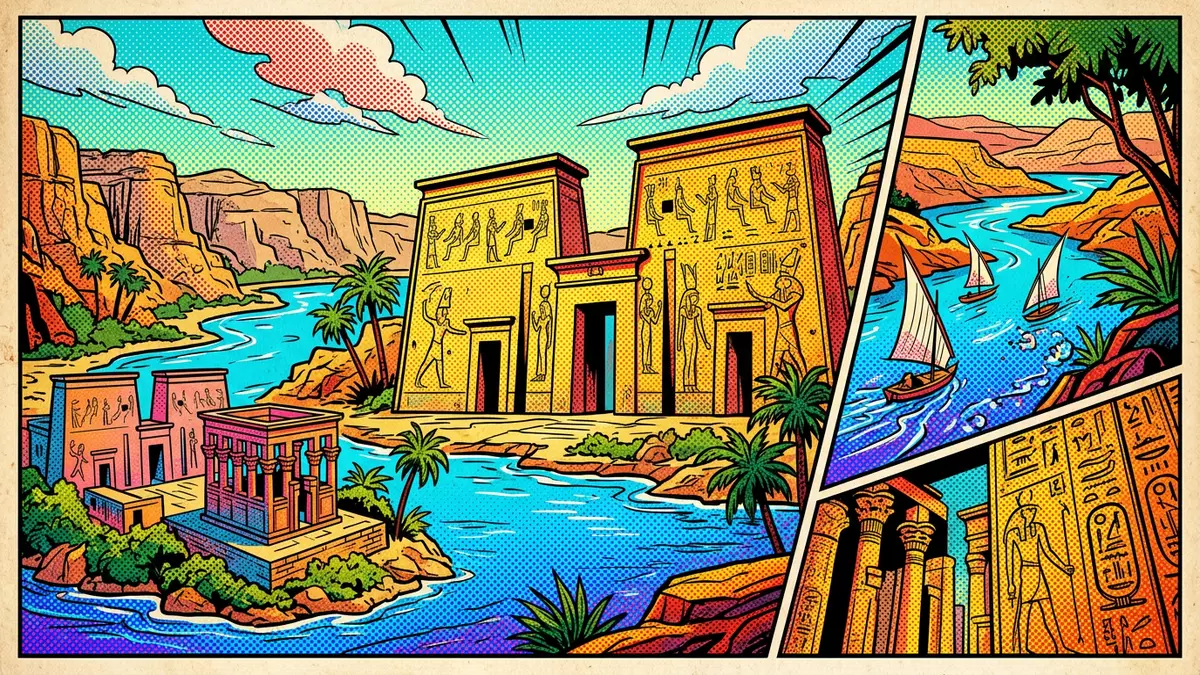
Philae Temple is an island sanctuary in the Nile near Assuan, relocated to Agilkia Island in the twentieth century and dominated by the great Temple of Isis from the Ptolemaic period. Its colonnades, pylons and lakeside setting make one continuous ensemble where ancient Egyptian carvings meet the waters impounded by the Aswan dams.
An island temple complex in the Nile
The Philae temple complex occupies Agilkia Island in the reservoir formed by the Aswan Low Dam, a stretch of the Nile between the old dam and the Aswan High Dam in southern Egypt. The site lies in the historic region of Nubia, a landscape of rocky river banks and broad water, with the temple buildings set a short distance above the current water level.reservoir of the Aswan Low Dam The complex is reached by boat from the shore, and the landing point opens directly onto the ceremonial approach to the main temple.
Philae was originally on a different island, now submerged, and was relocated to Agilkia during an international campaign in the late twentieth century led by UNESCO and Egyptian authorities. The move allowed the preservation of the façades and reliefs that had been threatened by rising water after the construction of the Aswan High Dam.UNESCO dismantled and reassembled the temple The current island layout was planned to echo the original setting, with the main Temple of Isis still forming the visual centre.
Temple of Isis and the Ptolemaic builders
At the heart of Philae Temple stands the great Temple of Isis, begun under Ptolemy II Philadelphus in the third century BC and continued by later Ptolemaic rulers.temple begun by Ptolemy II Philadelphus Isis, venerated here as mother of Horus and associated with kingship and protection, appears repeatedly in the reliefs, often accompanied by Horus and other deities of the Nile valley. The architecture belongs to the late pharaonic and Ptolemaic tradition, with massive pylons, processional ways and hypostyle halls, and the stone surfaces carry hieroglyphic inscriptions carved across centuries.
Construction work on the sanctuary spans the late Pharaonic and Hellenistic periods, involving rulers such as Nectanebo I of the thirtieth dynasty and later Ptolemaic kings. Nearby stands a smaller temple dedicated to Hathor, attributed to Ptolemy VI Philometor and the Roman emperor Augustus, which continues the decorative programme with scenes of music and festivity.Temple of Hathor and other monuments Together, these structures form a compact complex where different eras of Egyptian religion are present in stone.
Reliefs, colonnades and the long history of worship
Visitors walking through Philae Temple pass tall stone colonnades leading towards the inner courts, with capitals carved in lotus and papyrus forms and roof slabs carrying further inscriptions. The main pylon of the Temple of Isis rises above an open forecourt, and its gateway leads to successive halls, a sanctuary and side chambers that once housed cult images and ritual equipment.Temple of Isis of the Ptolemaic Period Along the way, reliefs show processions, offerings and royal figures making contact with the gods beside hieroglyphic texts.
The religious use of the site continued well into the first millennium AD, and Philae became one of the last centres of formal worship of Isis in Egypt. Later, Christian communities adapted parts of the complex, reusing some spaces as churches and leaving crosses carved over earlier scenes, so walls preserve traces of this transformation alongside the older imagery.cult of Isis continued here until at least AD 550 The result is a layered set of inscriptions and symbols that record changing religious practice on the island across many centuries.
Visiting Philae Temple: what travellers from Western Europe should know
- Philae Temple lies south of central Assuan in southern Egypt, between the old Aswan Dam and the Aswan High Dam, and access to Agilkia Island is by boat from the lakeside.
- Movement around the complex involves walking across uneven stone surfaces, steps between courtyards and passages within the main temple buildings, and exposed areas without shade along the waterfront.
- The monuments stand within a reservoir landscape, with views towards dam structures and rocky islands along the Nile, so a visit combines archaeological remains with broad stretches of water and distant hills.
- The official language is Arabic and the currency is the Egyptian pound.
- Entry requirements depend on your nationality; UK travellers can check the FCDO travel advice at gov.uk/foreign-travel-advice, Irish travellers the Department of Foreign Affairs at ireland.ie.
Searching for Philae Temple on social platforms
These links open searches for Philae Temple on each platform.
Frequently asked questions about Philae Temple
Where is Philae Temple and what kind of site is it?
Philae Temple is an ancient temple complex on Agilkia Island in the Nile south of Assuan, situated in a reservoir formed by the Aswan dams.
What can visitors expect during a visit to Philae Temple?
Visitors can expect stone colonnades, pylons, relief-covered halls and lakeside views, reached by boat and explored on foot through open courtyards and interior chambers.
What makes Philae Temple distinctive among Egyptian temple sites?
Philae Temple is distinctive as a relocated island sanctuary centred on the Temple of Isis, where late Pharaonic, Ptolemaic and Christian phases of worship are all preserved in the same complex.


