
Petra’s sandstone city of the Nabataeans in Wadi Musa
Published on 08/31/2026 at 10:58 | Editorial responsibility: Rafael Müller, Editor-in-Chief AD HOC NEWS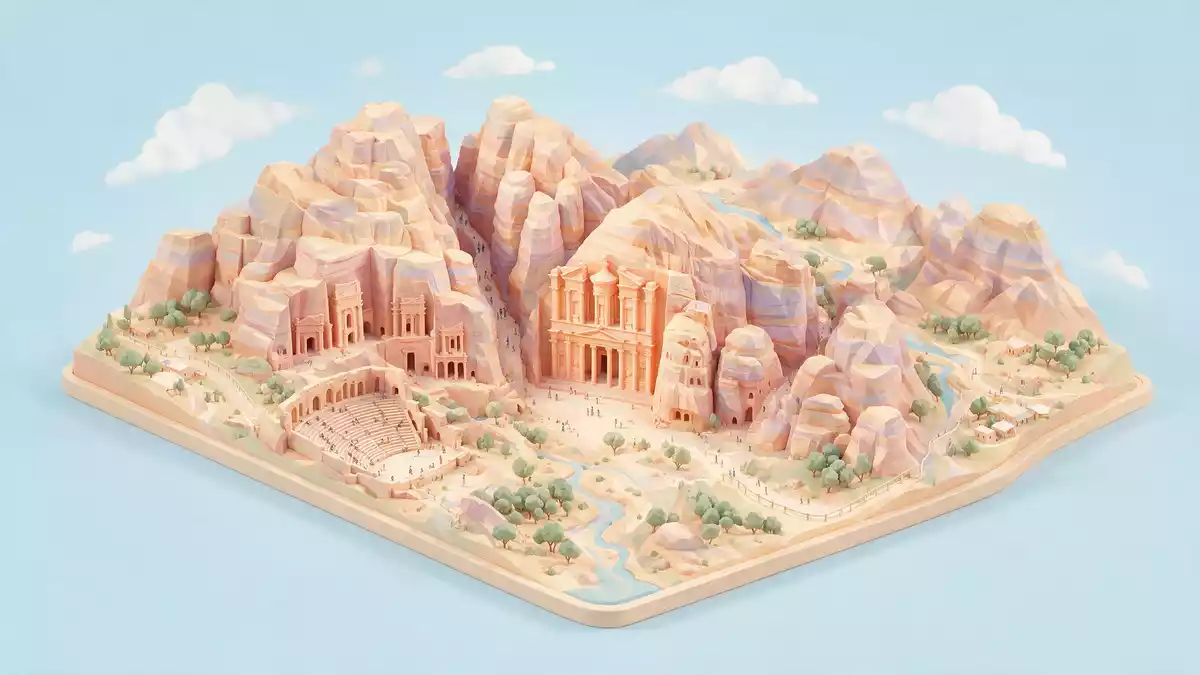
In the mountains near Wadi Musa in southern Jordan, Petra unfolds as a city carved directly into rose?coloured sandstone cliffs, where entire façades emerge from the rock rather than being built in front of it. In a basin at the edge of the desert, this former Nabataean capital brings architecture, geology and history together in one continuous landscape of canyons, tombs and temples dating from the classical world.
Sandstone, canyons and a hidden basin
Petra lies in Jordan’s Ma’an Governorate, in a basin enclosed by rugged hills near the northern end of the Wadi Araba rift valley. The ancient city sits among cliffs of layered sandstone, whose natural reds, pinks and ochres give Petra its widely used “rose city” epithet. The rock itself is the city’s fundamental material: walls, columns and steps have been cut out of the cliffs, so the terrain and the architecture form one continuous mass.Ma'an Governorate in southern Jordan The surrounding mountains create a sense of enclosure, with approaches running through narrow gorges where sheer rock faces rise on either side.
This enclosed setting helped Petra grow as a place connected to wider caravan routes while remaining visually hidden among the hills. The city stands between the Red Sea and the Dead Sea, in a region that historically linked Arabia with the Mediterranean world. Over time, footpaths, steps and channels were cut into the rock to provide access and manage water, adding further layers of human geometry to the natural forms of the sandstone basin.between the Red Sea and the Dead Sea
A Nabataean capital shaped by trade
Petra has been inhabited since prehistoric times, but it came into particular prominence when the Nabataeans, an Arab people, established it as the capital of their kingdom.capital of the Nabataean kingdom This role developed in the centuries around the turn of the first millennium BC, when the Nabataeans controlled caravan routes carrying incense, spices and other luxury goods across the deserts of Arabia towards ports and markets in the Mediterranean. As trade flowed through their territory, Petra became a centre where wealth was expressed in monumental rock?cut architecture.
Later, in the second century BC, Petra served as the formal capital city of the Nabataean Kingdom, integrating Greek and Roman influences into local building traditions.Nabataean caravan?city When Rome annexed the kingdom around AD 106, Petra became part of the Roman province of Arabia, and classical architectural language remained visible in its temples and façades. The site’s long continuity means that visitors encounter layers of history: traces of prehistoric occupation, Nabataean tombs and public spaces, and later Roman interventions, all sharing the same sandstone setting.
Al?Khazneh and Petra’s rock?cut monuments
The route into Petra’s central area leads through the Siq, a narrow gorge whose twisting course frames visitors’ first encounter with Al?Khazneh, the Treasury. At the end of the gorge, a monumental carved façade appears directly in the cliff, its details emerging from the same pink sandstone that shapes the surrounding rock. Al?Khazneh is among Petra’s best?known monuments, a rock?cut mausoleum whose front measures about 25 m wide and 39 m high, with a deep entrance cut behind the sculpted surface.rock?cut mausoleum about 25 m wide and 39 m high The façade blends Nabataean and Hellenistic motifs, including columns, pediments and sculptural figures that recall classical temples.
Al?Khazneh was probably built during the second half of the reign of King Aretas IV, who ruled from 9 BC to AD 40, and is often understood as a royal tomb, though its precise original function remains debated.possibly a royal tomb from the reign of Aretas IV Elsewhere in Petra, similar rock?cut facades front tombs, temples and other ceremonial spaces, many arranged in lines along valley walls. Some are comparatively simple, with rectangular openings and modest decoration; others have multiple storeys of columns and sculpted reliefs. Together, these monuments show how the Nabataeans treated the cliffs themselves as a canvas for architecture, carving down from the top to create layered fronts and interior chambers within the sandstone.
Petra’s status and its rediscovery
After the Roman period, Petra’s role as a caravan centre diminished, and over centuries its monumental remains became known mainly to local communities and to occasional travellers crossing the region. In 1812, the Swiss explorer Johann Ludwig Burckhardt reached Petra while travelling in the Levant, publishing accounts that introduced the site to a wider European audience.rediscovered in 1812 by Johann Ludwig Burckhardt Later archaeological work documented Petra’s extensive remains, from monumental tombs and temples to a theatre, streets and domestic structures.
In 1985 Petra was inscribed as a UNESCO World Heritage Site, recognised for its cultural significance and the way architecture and landscape interlock across the basin.UNESCO World Heritage Site since 1985 The site was also named one of the New7Wonders of the World in 2007, reinforcing its position as a major destination for travellers interested in archaeology and ancient history.one of the Seven New Wonders of the World in 2007 At Petra, large?scale stone carving, a long trading history and a dramatic desert setting combine into a landscape that remains distinct within the broader heritage of the Near East.
Visiting Petra: what travellers from Western Europe should know
- Petra lies near the town of Wadi Musa in southern Jordan, reached by road connections from other Jordanian cities and by regional flights to Jordanian airports.
- The approach into Petra involves walking along the Siq, a narrow gorge with uneven ground and stretches of rock?cut path, followed by further distances on foot between major monuments.
- The terrain within Petra includes stone steps, sandy valley floors and exposed rock surfaces, so sturdy footwear helps when moving between tombs, temples and viewpoints.
- The official language is Arabic and the currency is the Jordanian dinar.
- Entry requirements depend on your nationality; UK travellers can check the FCDO travel advice at gov.uk/foreign-travel-advice, Irish travellers the Department of Foreign Affairs at ireland.ie.
Searching for Petra on social platforms
These links open searches for Petra on each platform.
Frequently asked questions about Petra
Where is Petra and how is it related to Wadi Musa?
Petra is an ancient city and archaeological site in southern Jordan’s Ma’an Governorate, with the modern town of Wadi Musa serving as the main gateway nearby.
What should visitors expect when exploring Petra?
Visitors can expect substantial walking along rock?cut paths and through gorges such as the Siq, with sandstone tombs, temples and other monuments carved directly into surrounding cliffs.
What makes Petra distinctive among ancient sites?
Petra is distinctive for its role as the Nabataean capital, its extensive rock?cut architecture in rose sandstone and its recognition as a UNESCO World Heritage Site and one of the New7Wonders of the World.


