
Petra’s sandstone city carved into the mountains
Published on 09/23/2026 at 20:52 | Editorial responsibility: Rafael Müller, Editor-in-Chief AD HOC NEWS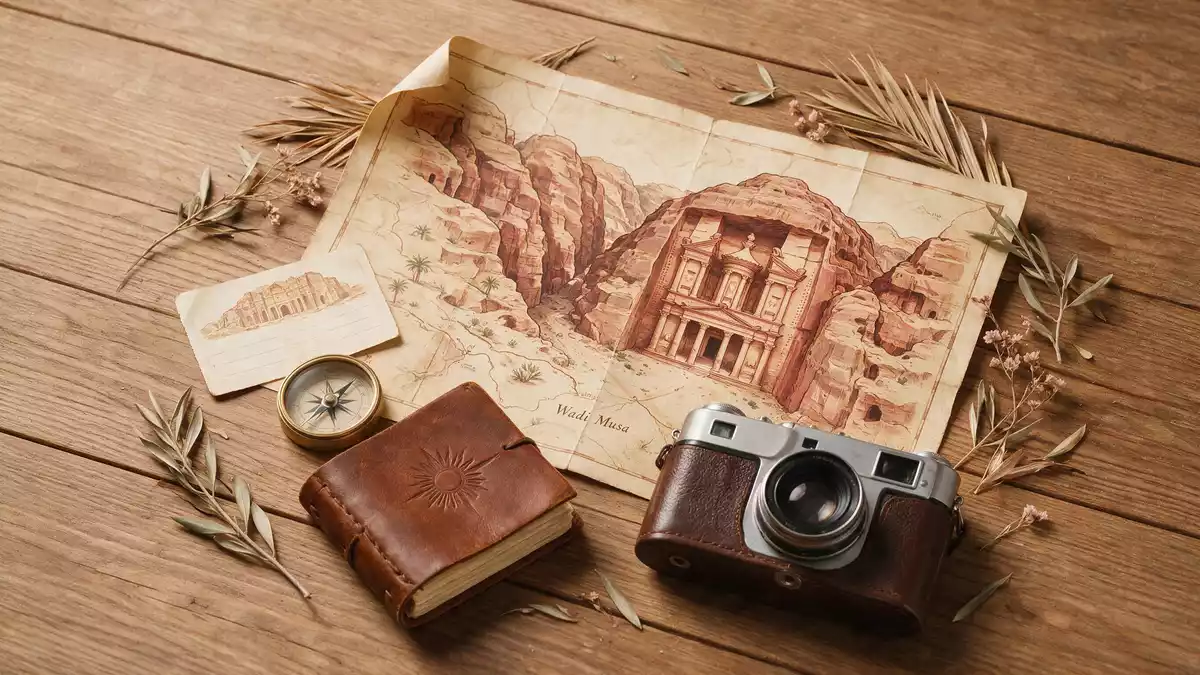
Petra is a rock-cut city in southern Jordan, near Wadi Musa, where sandstone cliffs carry tombs, temples and public buildings. The Nabataeans made Petra their capital by the fourth century BC, creating a settlement whose architecture remains inseparable from the surrounding mountains.
Petra and the colour of carved sandstone
The approach passes through the Siq, a narrow gorge with steep rock walls. Its winding passage ends at Al-Khazneh, the Treasury, whose classical facade is carved directly into the cliff. The building combines columns, pediments and sculpted details with the layered colours of the sandstone.
Petra extends far beyond the Treasury. Rock-cut tombs line the valley, while paths lead towards the Royal Tombs, the Theatre and Ad Deir, the Monastery. The monuments vary in scale and decoration, yet they share the same material: the rose, red, ochre and pale bands of the surrounding rock.
The Nabataean capital between desert routes
Petra grew as the capital of the Nabataean kingdom, an Arab polity associated with caravan routes across Arabia and the Levant. Incense, spices and other valuable goods moved through this region, linking Petra with Arabia, Egypt and Syria-Phoenicia.
The city also contains evidence of Hellenistic and Roman influence. Temples, columns, theatres, roads and civic remains stand alongside distinctly Nabataean forms. Water channels, cisterns and reservoirs form part of the ancient settlement, whose inhabited landscape reaches across valleys and mountain passages.
Roman control began in 106 AD, when Petra became part of the Roman province of Arabia. Churches and other later buildings add further layers to the archaeological site. Petra was inscribed as a UNESCO World Heritage Site in 1985, recognising the relationship between its architecture, landscape and history.
From the Siq to the Monastery
Petra is encountered as a sequence of spaces rather than as a single monument. The Siq frames the first view of the Treasury, then the valley opens towards facades, freestanding ruins and routes cut into the hillsides.
The Royal Tombs occupy a broad sandstone face, with large chambers and elaborate exteriors. The Theatre is cut into the mountain, while the Colonnaded Street marks a more urban part of Petra. Ad Deir stands in a mountain setting reached by a long ascent of steps.
Stone surfaces carry traces of changing colour, erosion and carving. Some facades remain sharply defined, while others merge into the cliffs. Petra’s visible character comes from this connection between constructed forms and natural rock.
Visiting Petra: what travellers from Western Europe should know
- Petra lies near Wadi Musa in southern Jordan. The site is reached from the town, with roads connecting Wadi Musa to Jordan’s main settlements.
- The approach includes the narrow Siq, uneven ground and an extended walk through a mountainous archaeological landscape. Routes towards Ad Deir include a substantial staircase.
- The official language is Arabic and the currency is the Jordanian dinar.
- Petra lies between the Dead Sea and the Red Sea, within a landscape of sandstone valleys, cliffs and mountain passages.
- Entry requirements depend on your nationality; UK travellers can check the FCDO travel advice at gov.uk/foreign-travel-advice, Irish travellers the Department of Foreign Affairs at ireland.ie.
Searching for Petra on social platforms
These links open searches for Petra on each platform.
Frequently asked questions about Petra
Where is Petra?
Petra is in southern Jordan, beside Wadi Musa. The archaeological site lies between the Dead Sea and the Red Sea.
What can visitors see at Petra?
The site contains the Siq, Al-Khazneh, rock-cut tombs, the Theatre, the Royal Tombs, temples, churches and Ad Deir.
What makes Petra distinctive?
Petra combines a Nabataean capital with architecture carved into rose-coloured sandstone cliffs. The city’s monuments and mountain landscape form one continuous archaeological setting.


