
Petra’s rose-red facades in the desert mountains of Jordan
Published on 08/21/2026 at 13:08 | Editorial responsibility: Rafael Müller, Editor-in-Chief AD HOC NEWS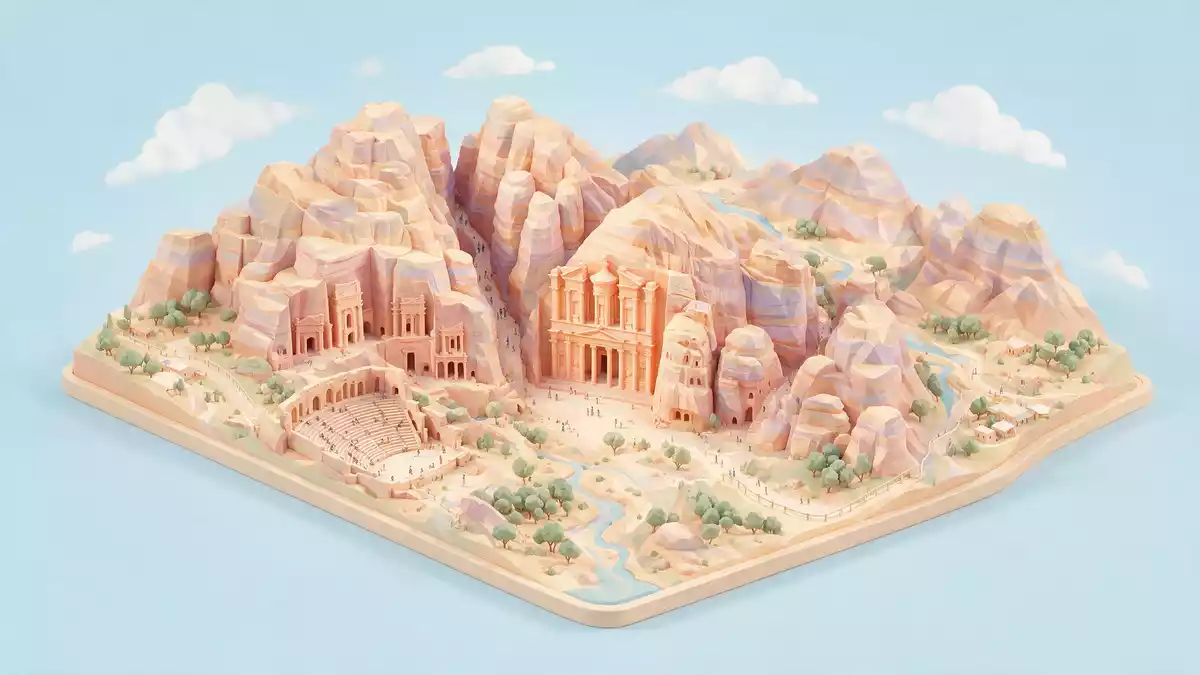
South of Wadi Musa in southern Jordan, Petra unfolds as an immense rock-cut city where façades, shrines and stairways are hewn directly into red sandstone cliffs. The former Nabataean capital lies in the Ma’an Governorate and forms one of Jordan’s most extensive archaeological landscapes, recognised as a UNESCO World Heritage Site since 1985.
Carved city of the Nabataeans
Petra occupies a basin in the desert mountains between the Red Sea and the Dead Sea, reached from Wadi Musa through narrow gorges that open into broad valleys framed by high sandstone walls.between the Red Sea and the Dead Sea The city is half-cut into the rock and half built in freestanding masonry, with streets, terraces and stairways climbing across slopes shaped by wind and water.
Petra served as the capital of the Nabataean Kingdom in the centuries around the turn of the era, becoming a caravan centre on routes linking Arabia, Egypt and Syria-Phoenicia.caravan centre on regional trade routes Nabataean builders cut tombs, temples and meeting halls directly into the cliffs, working the sandstone into deep porticoes and columned fronts. Later, under Hellenistic and Roman influence, monumental façades combined local rock-cut practice with classical architectural elements.
Approaching Petra through sandstone and shadow
The approach from Wadi Musa leads across open terrain and then into a long, twisting gorge where sandstone walls rise high on either side. In places the passage narrows to a corridor with towering rock faces close together, the ground underfoot worn by centuries of caravan traffic. Light falls in shafts between the cliffs, revealing bands of colour in the rock from pale cream to deep red.
Emerging from this canyon, visitors suddenly meet the façade of Al-Khazneh, the Treasury, carved into a sandstone cliff at the end of the gorge.Al-Khazneh Columns, pediments and sculpted details are cut from the cliff face rather than assembled from separate blocks, creating an entire classical front in the surface of the rock. Further inside Petra, other tombs and temple façades line valley slopes, and stairways rise towards high places used for ritual.
World Heritage, sandstone and water
UNESCO inscribed Petra as a World Heritage Site in 1985 for its architectural and hydraulic achievements, recognising the fusion of Nabataean and Hellenistic forms and the remains of extensive water management systems.World Heritage Site in 1985 Channels, tunnels and diversion dams run along cliff bases and across slopes, feeding cisterns and reservoirs cut into the rock. These structures collected seasonal rain and directed it across the settlement, supporting occupation in arid surroundings.
The sandstone itself shapes Petra’s character. Many façades and walls show hues described collectively as rose-red, with vertical faces bearing natural erosion patterns alongside carved architectural detail.rose-coloured temples and tombs In wider views, cliffs, gorges and freestanding rock forms frame the archaeological remains, giving the ancient city a setting that combines man-made surfaces with rugged desert relief.
Visiting Petra: what travellers from Western Europe should know
- Petra lies in southern Jordan in the Ma’an Governorate, with the town of Wadi Musa immediately to the north acting as the main modern gateway.
- The approach from Wadi Musa into Petra includes stretches on foot along uneven ground and through a canyon where the path follows a gradual descent and ascent between high rock walls.
- The terrain within Petra combines stone-built paths, rock-cut stairways and open sandy areas, and longer routes across the site involve sustained walking over changing surfaces.
- The official language is Arabic and the currency is the Jordanian dinar.
- Entry requirements depend on your nationality; UK travellers can check the FCDO travel advice at gov.uk/foreign-travel-advice, Irish travellers the Department of Foreign Affairs at ireland.ie.
Searching for Petra on social platforms
These links open searches for Petra on each platform.
Frequently asked questions about Petra
Where is Petra and how is it connected to Wadi Musa?
Petra lies in the Ma’an Governorate of southern Jordan, immediately south of the town of Wadi Musa, which serves as the main access point.
What should visitors expect on a walk through Petra?
Visitors can expect extended walks on uneven paths, canyon approaches, stone stairways and open valleys, with extensive rock-cut façades and archaeological remains along the routes.
What makes Petra distinctive among ancient cities?
Petra is distinctive for its combination of Nabataean and classical architecture carved directly into rose-red sandstone cliffs, together with large-scale water management structures in a desert mountain setting.


