
Petra’s carved sandstone city in Wadi Musa
Published on 09/18/2026 at 18:21 | Editorial responsibility: Rafael Müller, Editor-in-Chief AD HOC NEWS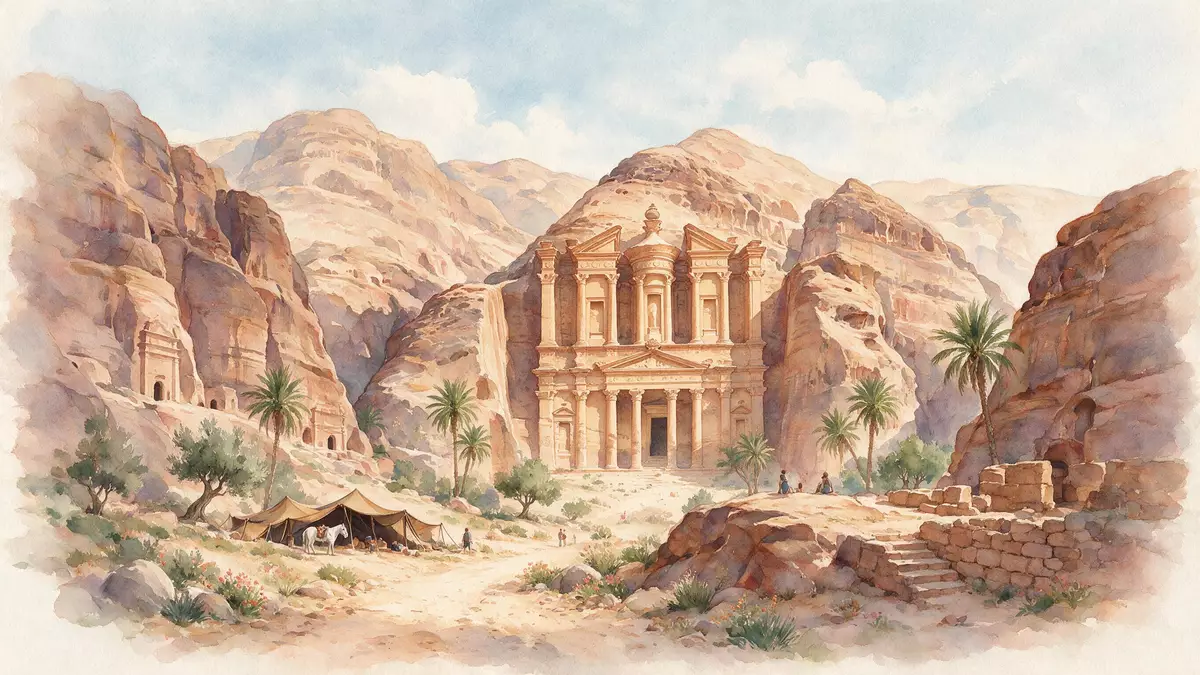
South of the Dead Sea in southern Jordan, near the town of Wadi Musa, Petra stretches across a basin of pink and red sandstone cliffs that have been carved into an entire cityscape.the rock-cut capital city of the Nabataeans grew into a major caravan centre linking Arabia, Egypt and Syria-Phoenicia, and its ruins now form one of the most extensive archaeological sites in the region.
Carved facades in rose-red sandstone
Petra’s defining impression is that of architecture cut directly into the cliffs rather than built as free-standing structures. The Nabataeans worked into the soft sandstone, chiselling tombs, temples and streets of facades along the slopes and canyon walls, so that whole cliff faces became ornamental fronts for chambers hidden inside.the fusion of Hellenistic architectural facades with traditional Nabataean rock-cut temple-tombs is visible in the way classical column orders, pediments and entablatures are translated into relief on the rock.
The sandstone itself carries much of Petra’s character. Layers of varying colour create bands and swirls across the cut surfaces, so that walls and columns stand striped in reds, pinks and browns. Weathering has softened edges and ornament, but the depth of carving on major monuments remains clear, with capitals, niches and sculpted figures still discernible on many facades. Walking among them, the sense is of a city half-carved, half-built, with freestanding structures and rock-cut architecture sharing the same stone landscape.Petra is half-built, half-carved into the rock and surrounded by mountains riddled with passages and gorges.
The Siq and the Treasury
Most visitors approach Petra through the Siq, a narrow, winding gorge that serves as the main entrance to the ancient city.the Siq is a dim, narrow gorge, in places only a few metres wide, that runs for roughly 1.2 km and ends at Al-Khazneh. Its high sandstone walls rise on either side, sometimes revealing carved niches and remnants of channels that once carried water along the route from Wadi Musa. The path bends several times, so that the first glimpse of Petra’s most celebrated facade comes almost as a reveal.
That facade is Al-Khazneh, “The Treasury”, cut into a lofty sandstone cliff at the end of the Siq.Al-Khazneh is Petra’s rock-cut monument carved by the Nabataeans in the first century CE, about 39 m (128 ft) tall. Its design blends local carving traditions with classical motifs: a two-storey arrangement of columns and pediments, with a central circular element framed by broken pediments above, and sculpted figures placed between and beside the architectural members.the structure is one of the most elaborate rock-cut tombs in Petra and is thought to have been built as a mausoleum and crypt at the beginning of the first century AD, during the reign of Aretas IV Philopatris. Behind the ornate front lies a main chamber and side rooms cut into the rock, relatively plain compared with the facade outside.
Nabataean capital and UNESCO World Heritage site
The area around Petra shows traces of human presence from deep prehistory, but it is most closely associated with the Nabataeans, an Arab people who established it as the capital of their kingdom.in 300 BC Nabataean groups captured Petra, which had been the capital of the Edomite Kingdom, and from there controlled east–west trade routes between the Mediterranean and Arabia, Syria and Egypt. Caravans carrying incense, spices, textiles and other goods crossed these routes, paying taxes that funded the monuments carved into the city’s rocks. The result is an urban landscape where economic and political power is recorded in stone.
Petra’s significance has been formally recognised through its inscription as a UNESCO World Heritage Site.Petra was inscribed on the World Heritage List in 1985 as property no. 326, meeting cultural criteria i, iii and iv. The protected area covers a large tract of mountains and valleys around the main city, with rock-cut tombs, high places of worship, temples, a theatre and remains of later churches and public buildings.the site is described as a Nabataean caravan city renowned for its elaborate tomb and temple architecture, developed between the Dead Sea and the Red Sea in the first centuries BCE and CE. Together, these remains show how Petra operated as a regional centre and how its builders adapted architectural currents from Hellenistic and Roman worlds to the sandstone terrain of Wadi Musa.
Visiting Petra: what travellers from Western Europe should know
- Petra lies near the town of Wadi Musa in southwest Jordan, inland from the Dead Sea, and is reached by road; the ancient city is entered on foot through the Siq gorge.
- The approach from Wadi Musa and movement within Petra involve walking on uneven stone and sand, and the site includes substantial gradients and stairways cut into the rock.
- The surrounding region is arid, with exposed sandstone and limited shade in open areas, so sun and heat on the routes between major monuments are a constant factor.
- The official language is Arabic and the currency is the Jordanian dinar.
- Entry requirements depend on your nationality; UK travellers can check the FCDO travel advice at gov.uk/foreign-travel-advice, Irish travellers the Department of Foreign Affairs at ireland.ie.
Searching for Petra on social platforms
These links open searches for Petra on each platform.
Frequently asked questions about Petra
Where is Petra and how is it situated in the landscape?
Petra stands in southwest Jordan near Wadi Musa, in a basin ringed by sandstone mountains cut by gorges and passages.
What should a visit to Petra involve in physical terms?
A visit generally involves extended walking on uneven surfaces, with ascents and descents on paths and stairways between rock-cut monuments and viewpoints.
What makes Petra distinctive among archaeological sites?
Petra is distinctive for its scale of rock-cut architecture carved into coloured sandstone cliffs and for its role as the Nabataean caravan capital.


