
Petergof and its fountains near Sankt Petersburg
Published on 09/09/2026 at 20:05 | Editorial responsibility: Rafael Müller, Editor-in-Chief AD HOC NEWS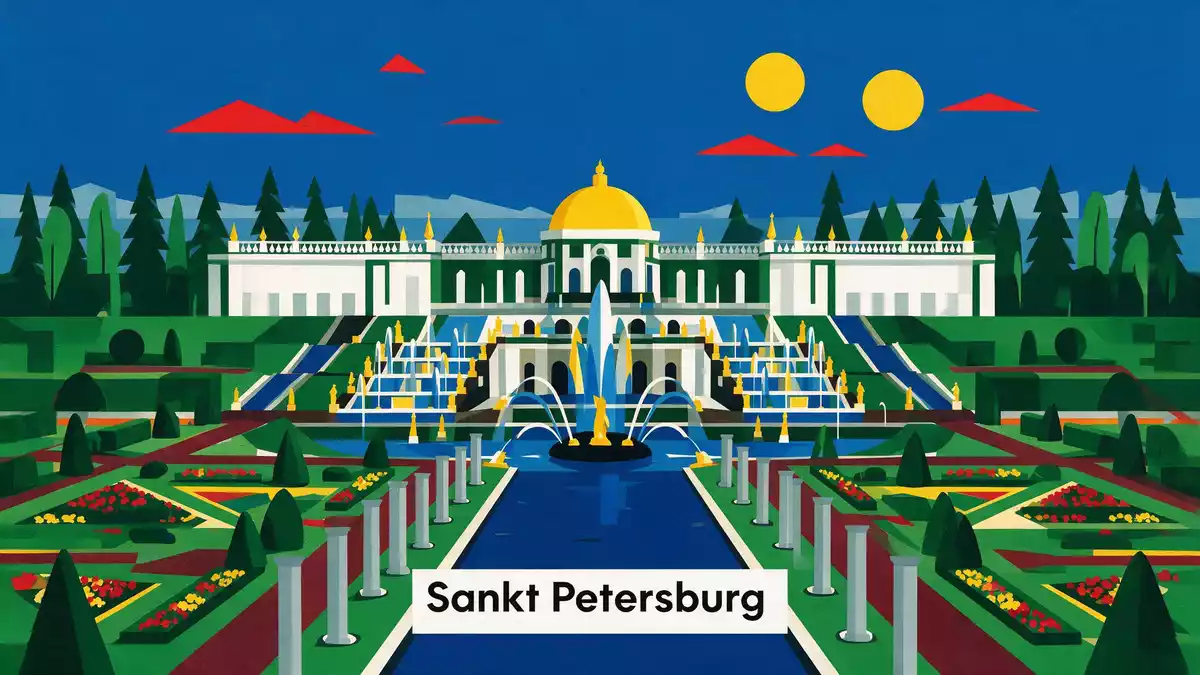
Petergof on the southern shore of the Gulf of Finland is a palace and park ensemble where water, architecture and landscape are woven into a single composition. Laid out in the early eighteenth century for Peter the Great, the estate developed into an ornate residence centred on the Grand Peterhof Palace and an intricate system of fountains and cascades.
A royal residence above the Gulf of Finland
Petergof lies south-west of Sankt Petersburg on the coast of the Gulf of Finland, facing open water across a low shoreline. It forms a suburb of the wider city and stands within reach of the historic centre along the coastal strip of north-western Russiasuburb of St. Petersburg. The ensemble occupies ground slightly raised above the sea, from which terraces descend towards the shore.
The core of the estate is the Grand Peterhof Palace, a Baroque residence built between 1714 and 1728 for Tsar Peter I, known as Peter the GreatBaroque Grand Palace (1714–28). The initial plan and design are associated with the architect Domenico Trezzini, while Alexandre Le Blond shaped the gardens and Bartolomeo Rastrelli later enlarged the palace in the mid-eighteenth centurydesigned by Domenico Trezzini. Together they created a residence whose long facade links formal planting above to waterworks below.
Grand Peterhof Palace and the two main parks
The Grand Peterhof Palace stretches for almost 300 m (around 980 ft) along the central axis of the estate, forming a horizontal line above the sea-facing slopefacade stretching for almost 300 meters. Its frontage links the Upper Garden on the landward side with the Lower Park on the side towards the Gulf, tying the two parts into a single ceremonial entityform a single ceremonial ensemble. Inside, the palace contains state rooms with gilded decoration, mirrors and painted ceilings arranged in sequence along the main enfilade.
Above the palace, the Upper Garden is laid out as a formal parterre with straight paths, clipped greenery and a set of fountains. Below, the Lower Park occupies more than 100 hectares of sloping ground leading towards the coastarea of 102,5 hectares. Within this park, smaller palaces, pavilions, ponds and flowerbeds are set along avenues and alleys, interspersed with sculptures and viewpointssmall palaces and pavilions. The spatial organisation uses terraces and slopes to stage the movement from the palace down to the sea.
Fountains, cascades and gravity-fed water
The fountains of Petergof form one of its defining features, with waterworks distributed between the Upper Garden and Lower Park. There are four main cascades and more than 150 fountains in total, most of them created in the eighteenth century during and after the reign of Peter the Greatover 150 fountains. The fountains operate through a gravity-fed water supply system that directs water from upland reservoirs through canals, without the use of mechanical pumpsgravity-fed water supply system. This hydraulic arrangement has been in service for around three centuries.
In the Lower Park, three named cascades articulate the hillside: the Great Cascade drops directly below the central axis of the Grand Peterhof Palace, while Chessboard Hill lies to one side and Golden Hill to the other“The Great” “Chessboard Hill” “Golden Hill”. In front of these cascades stand pairs of fountains with titles such as Bowl, Roman and Menager, adding separate jets and basins to the stepped flowspaired fountains. Other fountains are concealed among trees or composed as formal groups along straight walks, so that water appears both as spectacle and as an element of garden geometry.
Visiting Petergof: what travellers from Western Europe should know
- Petergof stands south-west of central Sankt Petersburg on the Gulf of Finland, reached along the coastal corridor that links the city with its western suburbssouthern shore of the Gulf of Finland.
- The palace and parks are laid out on terraced ground with long walks and numerous steps; moving between the Upper Garden and Lower Park involves descending and climbing sloping paths beside cascadescascades are set on the hillsides.
- The site lies close to the Gulf, so exposed sections of the Lower Park are open to maritime weather, while woodland areas and built structures offer more sheltered routes.
- Petergof is in Russia, where the official language is Russian and the currency is the rouble.
- Entry requirements depend on your nationality; UK travellers can check the FCDO travel advice at gov.uk/foreign-travel-advice, Irish travellers the Department of Foreign Affairs at ireland.ie.
Searching for Petergof on social platforms
These links open searches for Petergof on each platform.
Frequently asked questions about Petergof
Where is Petergof and what kind of place is it?
Petergof is a palace and park ensemble on the Gulf of Finland south-west of Sankt Petersburg in north-western Russia, combining a royal residence with extensive gardens and fountains.
What can visitors expect when walking through Petergof?
Visitors encounter a Baroque palace linking a formal Upper Garden and a large Lower Park, with terraces, cascades, tree-lined avenues, smaller pavilions and numerous fountains arranged between the palace and the shoreline.
What makes Petergof distinctive among historic estates?
Petergof is distinctive for its combination of an eighteenth-century imperial palace, a coastal setting and a gravity-fed system of around 150 fountains and cascades that integrate water into the design of both gardens and architecture.


